Contents
What a hedge actually does to your moneyAn example with 0.1 BTCThree ways people hedgeWhat the hedge costs, worked outWhich exchange makes this easierWhen you do not need a hedge at all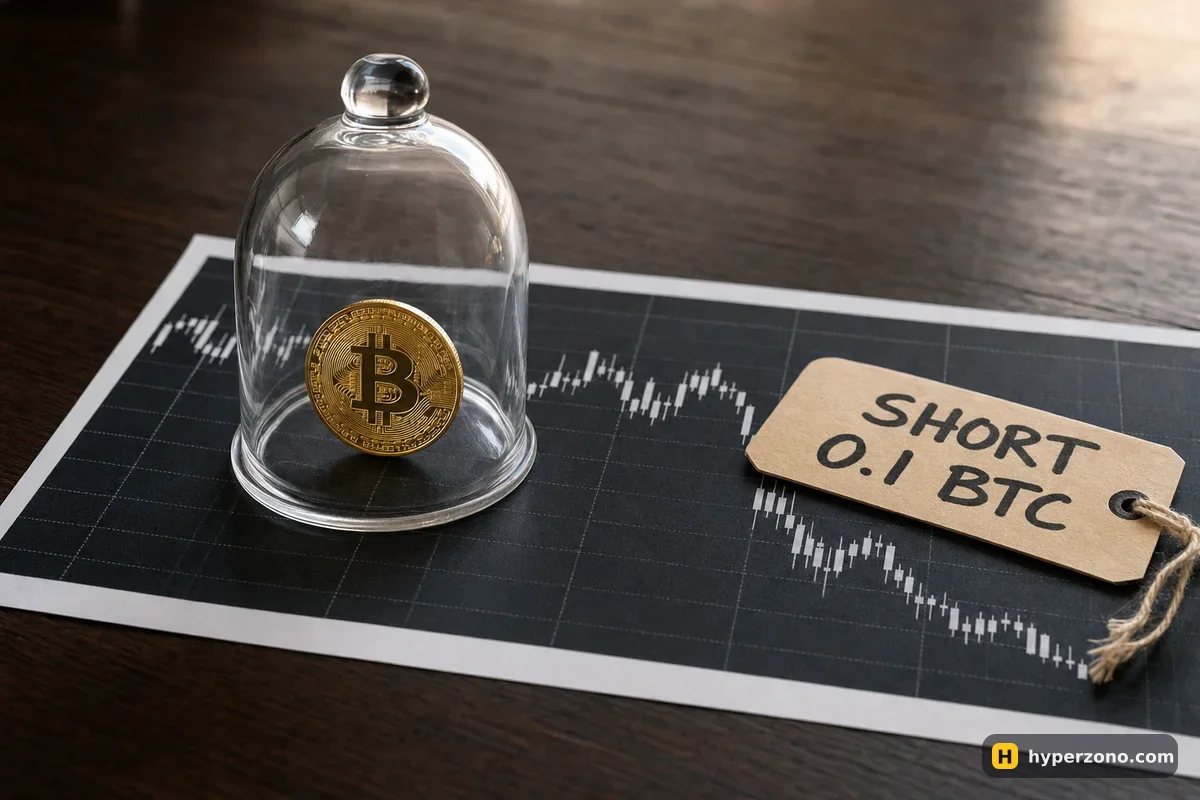
What a hedge actually does to your money
You own something whose price can fall — coins on spot, or an open futures trade. A hedge is a second position pointed the other way, sized so that what you lose on one side you roughly gain on the other. Nothing is cancelled magically: the money simply moves from one line of your account to the other.
While the hedge is on, your result stops moving in both directions. That is the honest answer to "does it eat all my profit": it does not eat the profit you already have, it pauses any new profit until you take the hedge off. People hedge when they want to keep the coins but not the price risk for a few days or weeks — before big news, over a holiday, while a transfer is pending.
An example with 0.1 BTC
Say you hold 0.1 BTC on spot and bitcoin is at 80,000 USDT — illustrative round numbers. Your coins are worth 8,000 USDT and you do not want to sell them, but the next couple of weeks look nervous to you. You open a short futures position on 0.1 BTC, which is 8,000 USDT of position size.
If the price drops to 72,000, your coins are now worth 7,200 — down 800. Your short gains 0.1 × (80,000 − 72,000) = 800. You end up roughly where you started. If instead the price climbs to 88,000, your coins gain 800 and the short loses 800, and again you end up where you started. That is the whole point: the two sides cancel out.
The short still needs margin — money set aside while it is open. Choosing 2x or 10x changes only how much is set aside, not the money result at the same position size; that part is covered in what leverage really is. Keep the short in isolated margin with spare funds, because a sharp rally can push a thinly funded short into liquidation even though your coins are doing fine — and then you are left with the fall risk and no cover.
Three ways people hedge
The first way is the one above: coins on spot, short futures on the same amount. The second is holding a long and a short on the same pair at the same time — useful if you want to park an open trade without closing it. Whether both can sit side by side depends on the exchange's position mode setting; in the simpler mode an opposite order just reduces or closes what you have. Check what the modes are called in your app before you try it.
The third way is buying a put option. You pay a premium now and get the right to sell at a set price, so you are covered below that price and you keep your gains above it. Options are not offered everywhere and the contract details differ, so look in your exchange's app to see whether they are available to you; the mechanics step by step get their own page in protecting a futures trade with an option.
| Way to hedge | How it works | Main cost | If the price rises |
|---|---|---|---|
| Short futures against coins you own | You keep the coins and open a short of the same size | Fees on entry and exit, plus funding while it is open | Your coin gain is cancelled by the short's loss |
| Long and short on the same pair | Both legs sit side by side, if the position mode allows it | Fees on both legs, funding on both | Your result is frozen until you close one leg |
| Bought put option | You pay a premium now for the right to sell at a set price | The premium, paid up front and not returned | You keep the gain, minus the premium you paid |
Say the put costs 200 USDT for your 0.1 BTC, which is 2,000 USDT per whole bitcoin — an illustrative price, not a quote. Below 80,000 your loss stops there; above it you keep the gain, minus that 200.
| BTC price | Futures | Option | Together |
|---|---|---|---|
| 64,000 | −1,600 | +1,400 | −200 |
| 72,000 | −800 | +600 | −200 |
| 80,000 | 0 | −200 | −200 |
| 88,000 | +800 | −200 | +600 |
| 96,000 | +1,600 | −200 | +1,400 |
Long 0.1 BTC from 80,000, put with strike 80,000 for a premium of 2,000 USDT per BTC (200.00 USDT in total). Table amounts are in USDT, before fees and funding; practice figures, check the live premium on the exchange.
What the hedge costs, worked out
Fees first, because they are the predictable part. On Binance USDⓈ-M futures the standard fee is 0.05% of the position size if you take the price shown on the screen, charged when you open and again when you close. On an 8,000 USDT short that is about 4 USDT each way — around 8 USDT to cover 8,000 USDT of coins.
Then comes funding, a payment between longs and shorts on perpetual contracts, by default every 8 hours on Binance (some contracts run more often). When the rate is positive, longs pay shorts, so your hedging short receives it; when the rate turns negative, your short pays. At an illustrative 0.01% per payment, 8,000 USDT works out to 0.80 USDT each time, about 2.40 a day, roughly 17 USDT over a week — a cost or a small income depending on the sign. The details of that are in how funding works, and you can try your own numbers here.
Add it up: in a normal week, covering 8,000 USDT of coins costs you something in the range of a few dollars to roughly 25 USDT — a fraction of a percent of what you are protecting. An option instead costs you the premium up front, which is larger, but it is fixed and known on the day you buy it. Neither one is expensive compared with watching 800 USDT evaporate; both are expensive if you leave them running for months out of habit.
A hedge you forget to close is just a short. The moment you decide the danger has passed, close it. Until you do, every further rise in price is money you are handing back, and the position keeps paying or collecting funding without you watching it.
Which exchange makes this easier
What makes hedging comfortable is not a special product — it is four ordinary things: you can short the same asset you hold, the minimum size is small enough to match what you own, you can choose isolated margin for the hedge leg, and the app shows your long and short clearly. On Binance the smallest bitcoin futures position is 0.001 BTC, so you can cover small holdings rather than being forced into a position far bigger than your coins.
The simplest way to see how it looks in practice is to open a Binance Futures account and bring up the order window for BTCUSDT: the buttons for going up or down, the field where you type the amount in BTC, and the switch between the two margin modes are all on one screen. Check the position mode setting there too, since that is what decides whether a long and a short can sit side by side or cancel each other out — that question has its own page in one-way vs hedge mode.
Two practical warnings. Futures are not offered to residents of every country, and options even less so, so confirm during sign-up that both are available where you live rather than assuming. And if you are comparing venues, compare the fee you will actually pay and the funding on the contract you plan to hold, not a headline number on a marketing page.
When you do not need a hedge at all
If you hold 200 USDT of crypto, a hedge is more trouble than it is worth: selling a part of it costs one fee and no ongoing funding, and it solves the same problem. A hedge is worth the cost when selling is awkward — a long-term holding you do not want to break, coins locked somewhere, or an open futures trade you want to pause rather than close.
It also does nothing about the mistake most beginners actually make, which is a position too big for the account. Sizing the trade properly is cheaper and simpler than insuring an oversized one. If you are still at the stage of putting your first pieces together, the ordered walk-through in how to start trading futures from scratch is a better next step than any hedge, and who funds a leveraged trade explains where the other side of your short comes from.
Does hedging mean I cannot lose money?
No. It means your gain and your loss on the hedged amount roughly cancel out while both positions are open. You still pay fees, you may pay funding, and if the hedge is in the wrong size or gets liquidated you are exposed again. It removes price movement, not risk in general.
Does a hedge eat all my profit?
It pauses new profit on the hedged amount for as long as it is open — that is the trade-off you accept. The money you already made before opening the hedge stays with you. A bought put is the version that keeps your upside, and you pay a premium for that privilege.
Can I hedge a small amount, like 0.01 BTC?
On Binance the smallest bitcoin futures position is 0.001 BTC, so 0.01 BTC is well within range. Other pairs have their own minimums — many altcoin contracts start from about 5 USDT of position size. Check the minimum for your chosen contract in the app before you plan the trade.
Do I pay funding on a hedge?
Sometimes you pay and sometimes you receive. On a perpetual, a positive funding rate means longs pay shorts, so a hedging short collects; a negative rate reverses it. Only whoever holds the position at the settlement moment is affected, and the exchange does not keep the payment.
Is hedging better than just selling my coins?
Selling is simpler and has no ongoing cost, so for most small accounts it wins. A hedge makes sense when you specifically want to keep the coins — a long-term holding, something you cannot move quickly, or an open trade you want to freeze for a few days rather than close.