Contents
Two trades on two exchanges: one pays you, one costs youBringing 1-hour and 8-hour rates to the same scaleA worked week: your money, the fees and what is actually leftWhat can break, and how to keep it survivable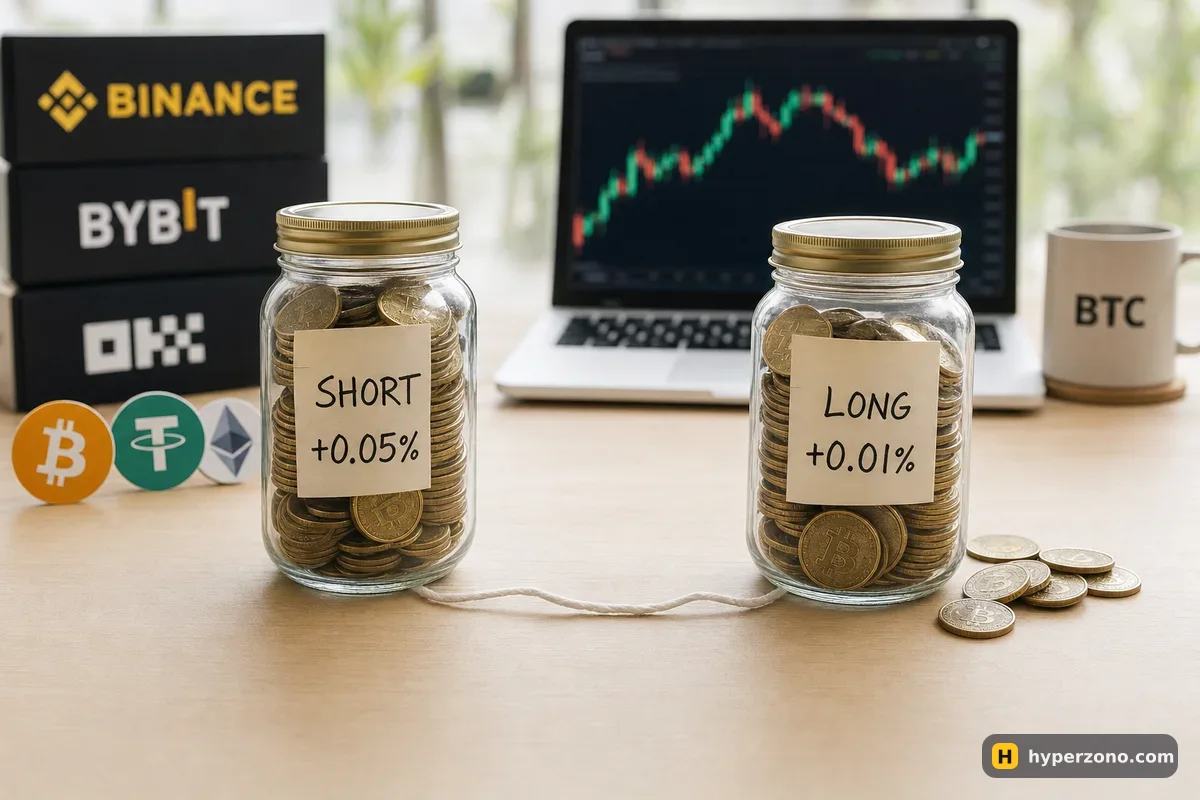
Two trades on two exchanges: one pays you, one costs you
You end up with two positions on two venues at the same time. Funding on a perpetual contract is a payment between traders, not a fee the exchange keeps: when the rate is positive, longs pay shorts, and when it is negative, shorts pay longs. The same coin can have very different rates on two venues at the same moment, because each venue has its own order book and its own crowd of traders.
So you take the side that gets paid where the rate is generous, and the side that pays where it is cheap. Say Bitcoin funding on Binance is running at +0.05% per 8 hours while on Hyperliquid the same contract is at +0.01% per 8 hours. You go short on Binance and collect, you go long on Hyperliquid and pay a little, and because the two positions are the same size in dollars, a move in the Bitcoin price gives you roughly as much on one side as it takes from the other. What is left over is the gap between the two rates. If one of the rates happens to be negative, even better — then both positions are receiving, and the gap is the sum of the two.
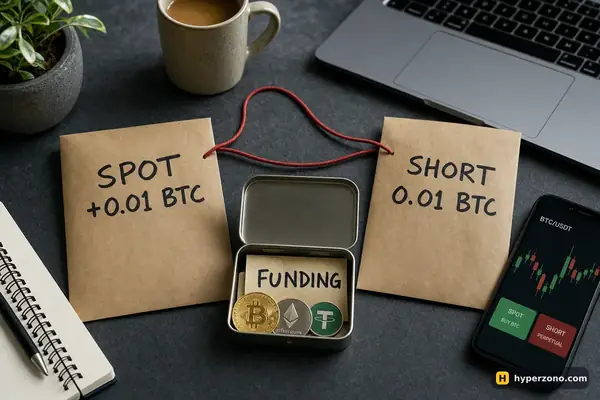
This is the cross-venue cousin of a strategy you may already have read about: holding a coin on spot and shorting the perpetual on the same exchange, which we cover in spot plus a short perpetual. The cross-exchange version does not need any spot coins at all, but it does need you to run two accounts in parallel and keep both of them healthy.
Bringing 1-hour and 8-hour rates to the same scale
This is where most people make their first mistake. Hyperliquid pays funding every hour, and its documentation says the rate formula is defined as an 8-hour rate with one eighth of it settled each hour. Binance settles every 8 hours by default — at 00:00, 08:00 and 16:00 UTC — though some contracts use 4 hours, and if a rate hits its cap the interval can become 1 hour. Two numbers that look alike can therefore describe very different amounts of money.
The fix is arithmetic you can do on your phone. To compare an hourly rate with an 8-hour rate, multiply the hourly one by 8, or divide the 8-hour one by 8. A rate of 0.00125% per hour is the same as 0.01% per 8 hours. For a daily figure multiply the 8-hour rate by 3; for a rough yearly figure multiply it by 1,095. If you want this spelled out with more examples, see comparing 1-hour and 8-hour funding, and if you want to see what the rates have actually done over months rather than today, the funding history tool shows Binance, Bybit, OKX and Hyperliquid side by side.
On Hyperliquid the payment is worked out from the size of your position and the price of the coin at that moment, so the amount moves a little as the price moves. Nothing is taken out of it by the protocol — it goes straight from one side to the other.
A worked week: your money, the fees and what is actually left
Here is an illustrative set of numbers — invented for teaching, not a forecast. You have 1,000 USDT in total and split it in half: 500 USDT sitting on Binance, 500 USDT sitting on Hyperliquid. On each venue you open 500 USDT of position on Bitcoin. That uses 250 USDT of your 500 as the deposit behind the trade — your margin — and leaves 250 USDT free on each venue as a cushion. Short on Binance, long on Hyperliquid, same dollar size, so a move in Bitcoin mostly cancels out.
Suppose Binance pays +0.05% per 8 hours and Hyperliquid's rate is the equivalent of +0.01% per 8 hours, and both stay there for a week. Your short receives three payments a day of 0.25 USDT each. Your long pays out the hourly equivalent, which adds up to 0.15 USDT a day. That is +0.60 USDT a day of net funding on 1,000 USDT of capital.
| Over 7 days | Amount |
|---|---|
| Funding received on the Binance short (3 payments a day) | +5.25 USDT |
| Funding paid on the Hyperliquid long (hourly) | −1.05 USDT |
| Binance entry and exit, base taker rate 0.05% on 500 USDT each way | −0.50 USDT |
| Hyperliquid entry and exit fees | check the current fee schedule in the app |
| Net before the Hyperliquid fees | ≈ +3.70 USDT |
Roughly 0.37% for a week — and that is still before Hyperliquid's own fees. Now look at what the number depends on. Opening and closing on Binance alone costs 0.50 USDT, nearly a full day of net funding. Add Hyperliquid's own entry and exit fees on top, so check them before you decide the gap is worth it. And the rates in this example were frozen for seven days, which almost never happens: funding is recalculated for every settlement, so a gap that was 0.04% this morning can be 0.00% tonight. The honest way to run this is to check the gap repeatedly and accept that you may close after two days, not seven. The easiest way to see the real numbers is to open a Binance Futures account and the Hyperliquid app side by side and compare the funding line for the same coin.
What can break, and how to keep it survivable
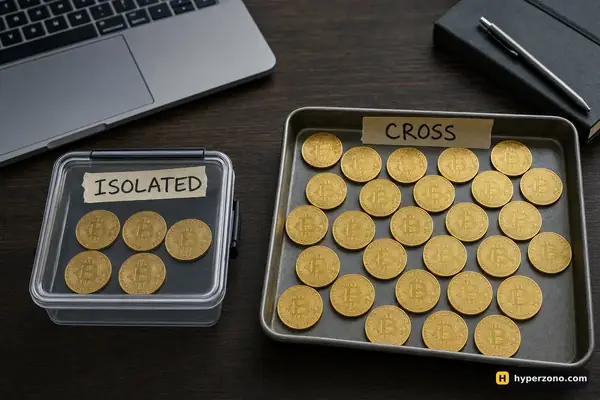
The biggest risk is not the funding — it is one of the two positions being liquidated. They cancel out in profit and loss, but they do not share money. If Bitcoin jumps 25%, the 500 USDT short loses 125 USDT, so your Binance balance drops from 500 to 375 and the trade survives on the cushion; the long is sitting on a matching gain, but that gain is stuck on the other venue and cannot help the short. Now imagine you had used your whole 500 at 5x and opened 2,500 USDT of position on each side: the same move takes 625 USDT off the short, more than the account holds, and you are left holding a one-sided long you never wanted. Low leverage and plenty of spare money on both venues are not optional here.
Moving money between venues is not instant. If one side needs more margin, you have to withdraw from one account and deposit to the other, which takes network time and can hit withdrawal limits or review checks. Keep the spare money sitting on each venue from the start, instead of planning to shuffle it when the market is already moving.
Next comes the exit. You want to close both legs within seconds of each other, because in the time between the two fills you are fully exposed to the price. On one venue that means a market order in an app; on the other it means a transaction from your wallet. Do a dry run first: open and close both sides at the smallest size each venue allows, just to feel how long the two closes take. It costs you the fees, and it is much cheaper than finding out during a fast move. Remember too that the two venues price off different sources, so your entry prices will never match exactly — that small difference is locked in from the first second.
Then there are the quieter problems. Rates flip: a positive Binance rate can turn negative, which turns your paid side into a paying side and the whole gap against you. The coin may not be listed on both venues, or the Hyperliquid market you want may be deployed by a third party with its own rules — the live Hyperliquid market table shows what is there and at what size it trades. And the two venues work very differently in practice: one is an account with verification, the other is a wallet connection, as described in Binance Futures or Hyperliquid. Check that both are available where you live before you plan anything.
Pick one coin and write down both rates
Open the same contract on both venues and note the funding rate and the settlement interval shown on each screen.
Convert to one scale
Multiply the hourly rate by 8, or divide the 8-hour rate by 8. Only then subtract one from the other to get your real gap.
Check the gap against all four fills
Work out how many settlements it takes for the gap to cover opening and closing on both venues. If it is more than a couple of days, there is very little in it.
Size small and equal
Same dollar position on both sides, low leverage, with clearly more money on each venue than the position needs.
Set a review time and an exit
Decide in advance at what gap you close, and close both legs together. Open Hyperliquid to see the hourly rate ticking while you plan it.
Can I lose money doing funding rate arbitrage between two exchanges?
Yes. Your price risk is reduced, not removed, because the two positions sit on separate accounts with separate money behind them, and one of them can be liquidated in a sharp move. You also carry the risk of the gap closing, of fees eating the gain, and of delays moving money between the venues.
How much money do I need to try it?
Enough to fund two accounts at once, plus a buffer on each. With a hundred dollars split across two venues the minimum order sizes and the four fills leave almost nothing, so most people find this only starts to make sense with capital they can comfortably split and still keep spare margin on both sides.
Do both sides have to be the same coin?
Yes, the same asset and the same dollar size. If you short Bitcoin on one venue and long Ethereum on the other, you are no longer hedged — you are betting on the relationship between two coins, which is a completely different trade.
Does the exchange take a cut of funding payments?
On Hyperliquid, the documentation states that funding is paid directly between traders and no fee is taken from the payment. Trading fees are separate and are charged when you open and close. Check the current fee schedule on each venue, because those four fills are your main fixed cost.
What happens if the funding rate flips while I am in the trade?
The side that was paying you can start charging you, and the gap can go from positive to negative. Nothing closes automatically — you have to notice and exit. That is why this needs a review schedule rather than being left alone for a week.
Can I do something similar on one exchange only?
Yes, by holding the coin on spot and shorting the perpetual on the same venue, which keeps everything in one account and removes the problem of money split across two places. It earns from one rate instead of a gap between two, and we explain it separately.
Sources and fact-check
Exchange terms were checked against official documents on October 22, 2026. Terms change — before you trade, check what matters to you in the exchange app and in your contract’s specs.
Hyperliquid Docs: FundingBinance: USD-M Futures Trading Fee Rate