Contents
Hyperliquid's restricted countries in one tableCountries not on the list where futures can still be closed to youWhat "restricted" means when there is no account to closeWhy the blog lists contradict each otherOther exchanges in the same countriesHow to check your own country before you depositHyperliquid's restricted countries in one table
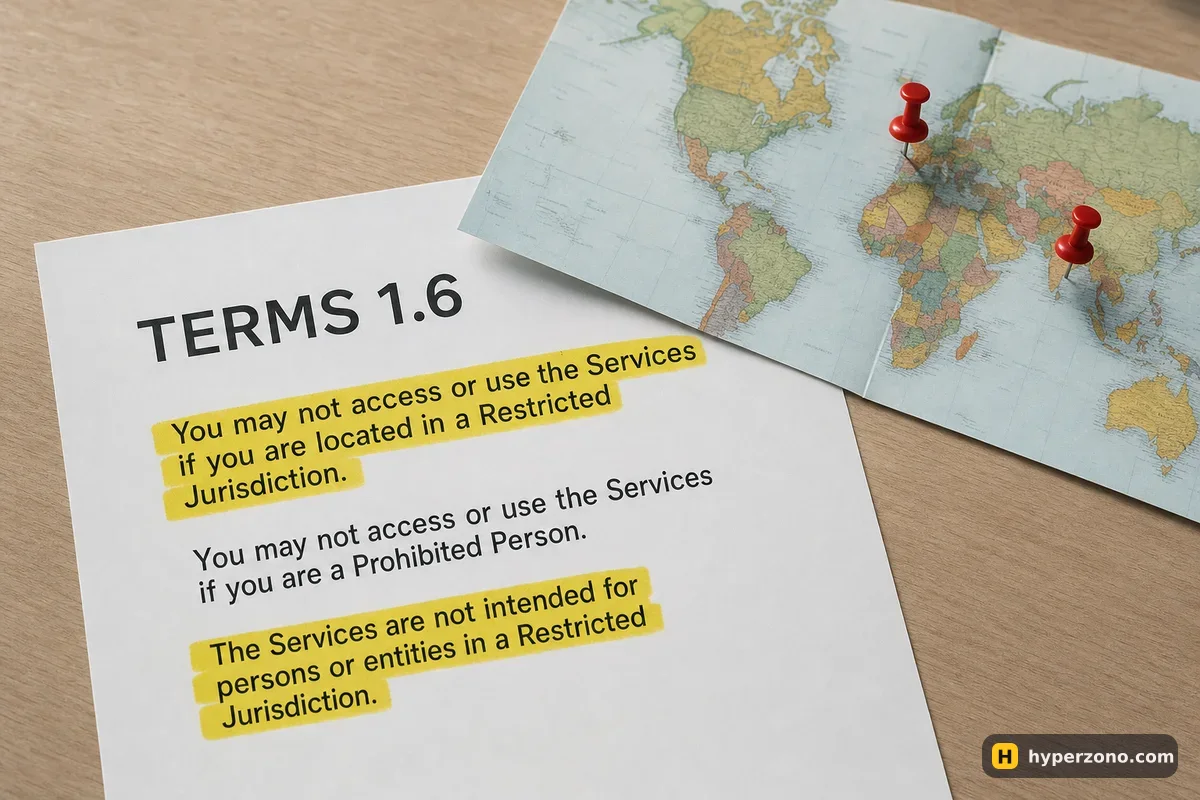
Section 1.6 of the Terms says the Hyperliquid website and app (the Terms call it the interface) are not available to people who live in the United States or Ontario, Canada, are physically there, or run a company registered there. It is also closed to anyone in a territory under comprehensive economic and trade sanctions, and to citizens of those territories no matter where they currently live.
That last part means places under full international sanctions. The Terms do not list them by name, so if you think your country or region could be one, check before you send any money. The document stops there. Section 1.7 adds one more exclusion, but it covers only prediction (outcome) markets — it does not change who may trade perpetual futures.
Here is the same list as our country table shows it, with the date of the document it comes from. If your country is in it, the honest answer is that this venue is closed to you and the rest of this page will not change that.
| Country or region | What the document says |
|---|---|
| United States | Persons who reside or are located there |
| Ontario, Canada | Not available |
| Territories under comprehensive economic and trade sanctions | Also citizens of those territories wherever they live |
The Terms name no other countries. Section 1.7 adds a separate exclusion for outcome (prediction) markets only, for jurisdictions Hyperliquid designates from time to time.
statuses checked 25 Oct 2026 in the exchanges’ own documents, Terms of Use, section 1.6 (15 Jun 2026).
Countries not on the list where futures can still be closed to you
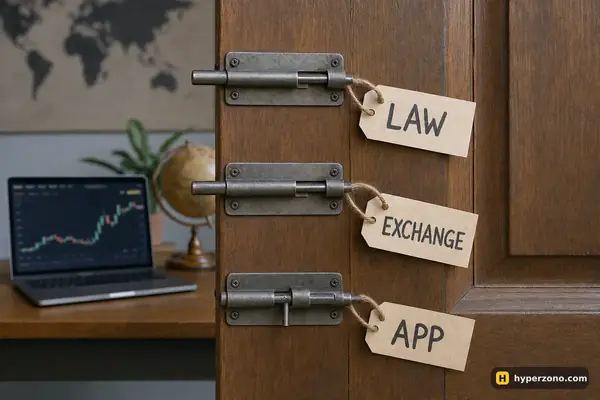
The Terms are only half the answer. The other half is the law in the country you are sitting in, and that half matters more. In Japan, the law lets individuals use only 2x leverage on crypto derivatives. In Singapore, licensed providers are told not to offer crypto derivatives or leverage to ordinary customers at all (since 19 June 2025).
Turkey banned leverage and derivatives on its licensed local platforms in March 2025. And in February 2026 the EU's markets regulator said retail perpetual futures are likely to fall under the same rules that already limit leveraged trading there. None of these countries appear in Hyperliquid's document — and none of them become allowed because of that.
When a country is not in the Terms, the correct reading is simply that Hyperliquid's documents do not name it — not that trading there is permitted. For the rules in your own country, start with the country guides, which cover the regulator, the local status and what residents usually do. For a broad view of which venue serves which region, there is a separate page on exchange availability by country.
What "restricted" means when there is no account to close
On a normal exchange, a restriction usually means one of three things: no new sign-ups, withdrawals only for existing users, or a move to a separate local company. Hyperliquid works differently. There is no registration and no identity check — you connect a wallet and deposit USDC, and the wallet stays yours. The restriction lives in the Terms you accept the moment you use the interface, and in whatever access controls the interface applies.
In practice that means the check is on you and it happens before the money moves. If your country is restricted, using the interface anyway breaks the agreement you accepted. And if the website or app stops letting you in while a trade is still open, you are stuck watching a position you cannot close from the usual screen. That is not a spot you want to be in. If you are new to how this venue is built, the Hyperliquid overview explains the wallet, the markets and the fees without repeating the list above.
There is no way around a closed door. Hiding where you are connecting from, or using someone else's address or documents, breaks the agreement you accept when you open the interface. It can cost you access to your funds, and it never changes the law in the country you are actually sitting in. If you are in a restricted place, the answer is simply no.
Why the blog lists contradict each other
The longer lists you see online usually name Cuba, Iran, Myanmar, North Korea, Syria and the occupied parts of Ukraine. Those names come from a Hyper Foundation page about its validator delegation program — a different document, over a year old, which itself says "including, but not limited to". It is not the trading agreement you accept when you open the app, so the two should not be mixed together.
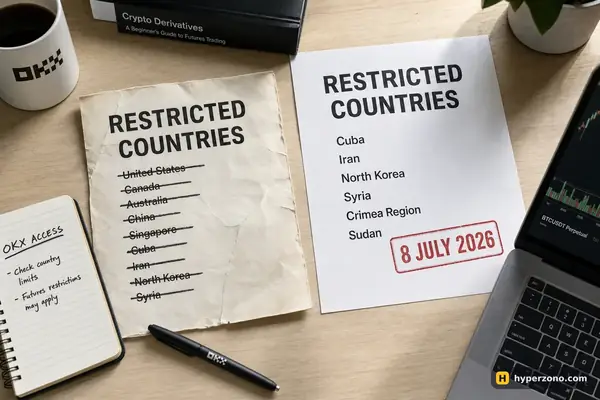
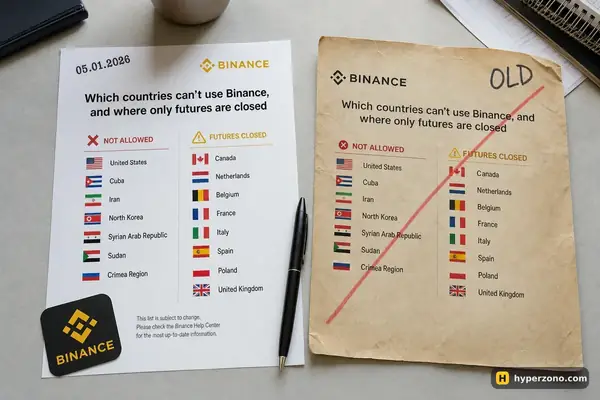
The other reason lists go stale is that venues quietly edit them. Binance's current list of prohibited countries, dated 5 January 2026, no longer names Syria, while plenty of older copies still do. The habit worth building is to read the venue's own page and look at the date on it. That is how the lists for Binance, Bybit and OKX on this site are put together: the venue's own page, with the date it carries.
Other exchanges in the same countries
If Hyperliquid is closed where you are, a centralised exchange is not automatically open, and the reverse is also true: several countries that Binance, Bybit or OKX restrict are not named by Hyperliquid at all. The table below puts the five venues side by side for the countries readers ask about most, each status taken from the venue's own document. Find your row first, then follow the link to your country page for the local law.
| Country | Binance | Bybit | OKX | Hyperliquid | Binance Wallet |
|---|---|---|---|---|---|
| Australia | Restricted | Not on its banned list | Restricted | Not on its banned list | Not on its banned list |
| Bangladesh | Not on its banned list | Not on its banned list | Not on its banned list | Not on its banned list | Not on its banned list |
| Canada | Not available | Not available | Not available | Restricted | Not available |
| Egypt | Not on its banned list | Not on its banned list | Not on its banned list | Not on its banned list | Not on its banned list |
| France | Not confirmed | Via a local company | Via a local company | Not on its banned list | Not confirmed |
| Germany | Restricted | Via a local company | Via a local company | Not on its banned list | Not on its banned list |
| Hong Kong | Restricted | Not available | Not available | Not on its banned list | Not confirmed |
| India | Not on its banned list | Not on its banned list | Not available | Not on its banned list | Not on its banned list |
| Indonesia | Not on its banned list | Not on its banned list | Not on its banned list | Not on its banned list | Not on its banned list |
| Japan | Via a local company | Not available | Not available | Not on its banned list | Not confirmed |
| Kazakhstan | Via a local company | Restricted | Restricted | Not on its banned list | Not on its banned list |
| Malaysia | Restricted | Restricted | Not available | Not on its banned list | Not on its banned list |
| Nepal | Not on its banned list | Not on its banned list | Not available | Not on its banned list | Not on its banned list |
| Netherlands | Not available | Via a local company | Via a local company | Not on its banned list | Not available |
| Pakistan | Not on its banned list | Not on its banned list | Not on its banned list | Not on its banned list | Not on its banned list |
| Singapore | Restricted | Not available | Restricted | Not on its banned list | Not confirmed |
| Sri Lanka | Not on its banned list | Not on its banned list | Not on its banned list | Not on its banned list | Not on its banned list |
| Thailand | Not on its banned list | Not confirmed | Not confirmed | Not on its banned list | Not on its banned list |
| Turkey | Not on its banned list | Restricted | Not on its banned list | Not on its banned list | Not on its banned list |
| United Kingdom | Not confirmed | Not available | Restricted | Not on its banned list | Not available |
| United States | Not available | Not available | Not available | Not available | Not available |
| Vietnam | Not on its banned list | Not on its banned list | Not on its banned list | Not on its banned list | Not on its banned list |
Status for residents, from the exchange’s own documents and the local regulator’s actions. “Not on its banned list” does not mean trading is legal where you live: check the local law above, and the app gives the final answer after KYC.
statuses checked 25 Oct 2026 in the exchanges’ own documents, Binance, Bybit, OKX, Hyperliquid, Binance Wallet (Aster).
How to check your own country before you deposit
Read section 1.6 yourself
Open app.hyperliquid.xyz/terms and look at the "last updated" date at the top. If the list has grown since 15 June 2026, trust the document, not this page.
Check the table above for your country
If it says restricted, stop here. If your country simply is not named, that means the documents are silent about it — go to step 3 before concluding anything.
Check your local rules
Open your country guide and see what the regulator says about crypto derivatives and leverage for residents. This is the part that decides whether the trade is legal for you, not the venue's list.
Test the interface with a small amount
If both checks are clear, connect your wallet and deposit a small amount of USDC first. A first deposit that arrives and a first small trade that closes properly tell you more than any list.
Once you have done those four checks and nothing blocks you, you can open Hyperliquid and connect your wallet with an amount you would not mind losing while you learn the interface. Keep the first position small enough that a mistake with the quantity field costs a dollar or two, not a week's budget.
Is Hyperliquid banned in the United States?
The Terms of Use (section 1.6, last updated 15 June 2026) say the interface is not available to people who live in the United States, are physically there, or run a company registered there. That is as plain as it gets, and this site does not serve readers in the US, Canada or mainland China anyway.
Can I use Hyperliquid in Canada if I am not in Ontario?
The Terms name Ontario specifically and no other province. But Canada's securities regulators told platforms in 2023 not to offer leverage, credit or margin to any Canadian client, and that applies country-wide. Canada is outside the readers this site writes for; the Canada page explains what the leverage ban means in practice.
Is Hyperliquid restricted in the UK, India or Nigeria?
None of those countries appear in Hyperliquid's Terms as of 25 October 2026. That is not the same as being available or legal there — the interface may still refuse access, and your national rules decide what you are allowed to trade. Check your country page before you deposit.
Does Hyperliquid ask for KYC or proof of address?
No. You connect a wallet and deposit USDC; there is no registration form and no document upload. That is why the responsibility for checking your country sits with you, before the money moves rather than during a sign-up.
What happens to my funds if my country gets added to the list later?
Hyperliquid has not published a procedure for that, so nobody can promise you a specific outcome. The practical approach is the same as with any venue: do not keep more on it than you are actively trading, and move your profit out when you are not using it.