Contents
Where each exchange stands for you right nowWhat the law says — and who it is aimed atMoney in and out, and the account you already haveWhat to do next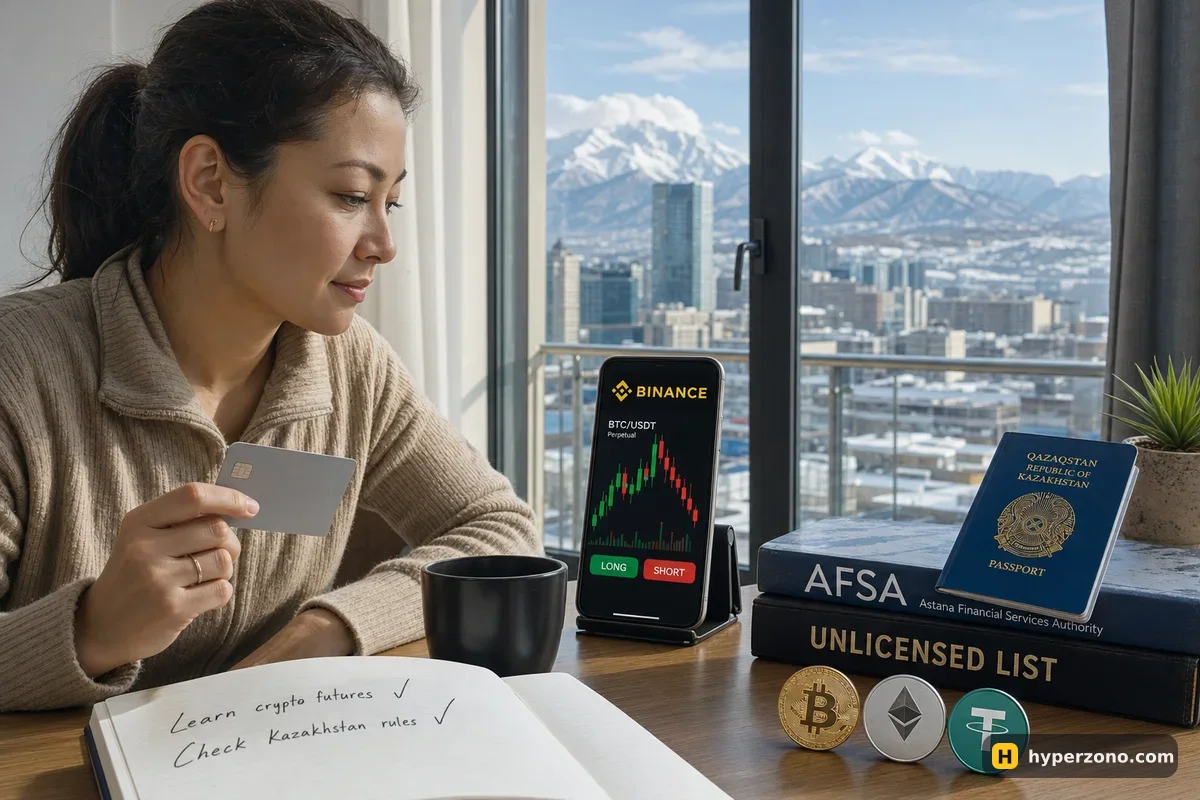
Where each exchange stands for you right now
Here is where each venue stands for a Kazakhstan resident as of 25 October 2026. Treat it as a starting point: after you verify your identity, the app itself shows which products are switched on for your account, and that is the only answer that counts for your money.
| Venue | Status | What it means |
|---|---|---|
| Binance | Via a local company | Residents are served by Binance Kazakhstan (AFSA licence) on the same site; futures, options and copy trading for eligible users since 13 Mar 2025. |
| Bybit | Restricted | Bybit names Kazakhstan among jurisdictions where derivatives trading is restricted (campaign terms, June 2026). |
| OKX | Restricted | Not on OKX’s list, but AFSA names OKX as an unauthorised platform in Kazakhstan. |
| Hyperliquid | Not on its banned list | Not named in Hyperliquid’s Terms. |
| Binance Wallet (Aster) | Not on its banned list | Open for Binance Kazakhstan accounts: the Perpetuals tab is visible in the app on a Kazakhstan account (checked 22 Oct 2026), and Binance Kazakhstan promotes it. |
Status for residents, from the exchange’s own documents and the local regulator’s actions. “Not on its banned list” does not mean trading is legal where you live: check the local law above, and the app gives the final answer after KYC.
statuses checked 25 Oct 2026 in the exchanges’ own documents, Binance, Bybit, OKX, Hyperliquid, Binance Wallet (Aster).
Binance is the clearest case. It runs a local Kazakhstan entity, and since 13 March 2025 eligible users there have had futures settled in USDT — the usual kind for a beginner, where your profit and loss are counted in dollars — plus futures settled in the coin itself, options and futures copy trading. "Eligible" is decided by the exchange, not by you: once your identity check is done, the app shows whether futures are open for your account. If you want to see what a futures order window looks like before deciding anything, you can open a Binance account, verify it and look at the screen without funding it.
Bybit is less certain. Its June 2026 campaign terms list Kazakhstan among the places where futures and other leveraged trading are restricted, though Kazakhstan is not on Bybit's main restricted-countries page. In practice Bybit may simply not show you the futures tab, so don't build a plan around it.
OKX does not name Kazakhstan on its own restricted list, so the app may well open for you. AFSA's warning names some platforms directly — OKX is one of them, along with HTX and MEXC. AFSA adds that this is not a ruling on any company's legal status, so if a platform has been named in that warning, look the company up in the AFSA Public Register and think it through before you send any money.
Hyperliquid names only the United States, Ontario and sanctioned territories in its Terms, and Kazakhstan is not there; it asks for a wallet rather than a sign-up, so there is nothing to verify — you can see how that route works on our Hyperliquid page or go straight to Hyperliquid. Aster's terms, which sit behind the Perpetuals tab in Binance Wallet, do not name Kazakhstan either, and that tab runs on your Binance account. Not being named is not approval — it only means nobody has published a rule about you.
A foreign address is not a workaround. Signing up with another country's details or with someone else's documents breaks the exchange's terms, and the usual result is a frozen account and a long argument about withdrawals — exactly the trouble AFSA describes. If a venue does not serve residents of Kazakhstan, use one that does.
What the law says — and who it is aimed at
The law here is about the platform, not about you. Running a crypto trading platform for people in Kazakhstan needs a licence — either from AFSA, the regulator inside the Astana International Financial Centre, or under national rules, where the National Bank and the Agency for Regulation and Development of the Financial Market are involved. That is Article 11(5) of the law on digital assets.
AFSA has published a warning about unlicensed platforms that advertise crypto trading to people in Kazakhstan. It says such platforms may offer spot, margin, futures, options, staking and P2P, often without proper safeguards or risk disclosures, and it lists what can go wrong for you: no legal mechanism to protect your rights, weak anti-money-laundering controls, aggressive bonus and referral promotions, data breaches, and restricted account access or trouble withdrawing money.
Two details matter for your own money. AFSA says it keeps no list of prohibited platforms — if a firm is missing from the AFSA Public Register, that only means AFSA has not authorised it, and its status under national law is for the state authorities to decide. The warning also names no penalty for ordinary users; it is written for consumers choosing where to put their money. You can look any company up yourself in the AFSA Public Register at publicreg.myafsa.com.
Keep two questions apart, because people mix them constantly. One is whether the exchange accepts residents of your country under its own terms. The other is whether your local rules allow what you want to do there. The general method for checking both is on our country check page, and how exchange availability works in general is explained in which exchanges are available where.
Money in and out, and the account you already have
Funding in tenge works on the local Binance entity: bank transfer with no fee or a Mastercard card, a USDT/KZT spot pair since 4 May 2026, and P2P in tenge with methods like Kaspi and Halyk. The list of methods changes often, so look at what the P2P screen offers you today. Buying USDT on spot and moving it to the futures wallet is an internal transfer inside your account, so the money arrives in seconds.
Got an older account from before all this? Finish identity verification first — the exchange sets your product access from your verified country, not from where you happen to be sitting at the moment. What documents that asks for is covered in our page on identity verification. Nothing official explains how an older global account moves to the local one, so don't trust a forum version of it; the support chat inside the app is the only place that can answer for your specific account.
What to do next
Look the company up
Open the AFSA Public Register at publicreg.myafsa.com and search the entity name. If a platform is missing there and AFSA has named it in its warning, your own judgement is the only protection your money has.
Verify first, deposit second
Finish identity verification before you send any tenge, so you learn what the account can and cannot do while your money is still in the bank.
Practise with no money at risk
Demo trading is not offered everywhere, and the contract you want may be missing from it. Our guide on learning without real money covers what to do if demo is unavailable.
Start with an amount you can lose
A first real trade of 50–100 USDT with a stop-loss teaches you more than a week of reading, and the loss stays close to what you planned — in a fast move a stop can fill a bit worse, so keep the size small.
Rules change, and so do exchange lists. The two documents worth re-reading in a few months are AFSA's warning page and Binance's own announcement about futures for Kazakhstan users; both are linked at the bottom of this page.
Is Binance available in Kazakhstan?
Yes — Binance runs a local Kazakhstan entity, and since 13 March 2025 eligible users there have had futures settled in USDT, futures settled in the coin itself, options and futures copy trading, plus tenge deposits. Whether any particular company is authorised, you can check for yourself in the AFSA Public Register at publicreg.myafsa.com.
Can I trade futures on Bybit in Kazakhstan?
Bybit's June 2026 campaign terms name Kazakhstan among the places where futures and other leveraged trading are restricted, although Kazakhstan is not on Bybit's main service-restricted page. In practice the futures tab may simply not appear for your account, so don't plan around it.
Is OKX banned in Kazakhstan?
AFSA's warning names some platforms directly, and OKX is one of them, along with HTX and MEXC. AFSA also says it keeps no list of prohibited platforms and that the warning is not a ruling on any company's legal status. OKX's own documents do not name Kazakhstan, so check the Public Register and judge for yourself before depositing.
Can I get in trouble as a user of an unlicensed exchange?
The AFSA warning names no penalty for individual users; it is aimed at platforms and written as consumer protection. The risk it describes is practical: if something goes wrong on an unlicensed platform, there is no local mechanism to help you get your money back.
Can I sign up with another country's details to reach an exchange that does not serve Kazakhstan?
No. Exchanges forbid getting around their restrictions, and the usual outcome is a locked account and blocked withdrawals. If a venue is closed to residents here, pick one that is open to them.
Can I deposit tenge directly?
Yes, on the local Binance entity: a fee-free bank transfer or a Mastercard card, the USDT/KZT spot pair since 4 May 2026, or P2P in tenge with methods like Kaspi and Halyk. The list of methods changes, so look at what the P2P screen offers you today. From spot, moving USDT to your futures wallet is an internal transfer.
Sources and fact-check
Exchange terms were checked against official documents on October 25, 2026. Terms change — before you trade, check what matters to you in the exchange app and in your contract’s specs.
AFSA: Warning on Unlicensed Digital Asset Platforms