Contents
The short answer for the United States (checked 25 October 2026)How to check a platform that offers you futuresBinance, Bybit, OKX, Hyperliquid and Binance Wallet: the detailMoney in and out, and an account you already haveWhat you can do nextThe short answer for the United States (checked 25 October 2026)
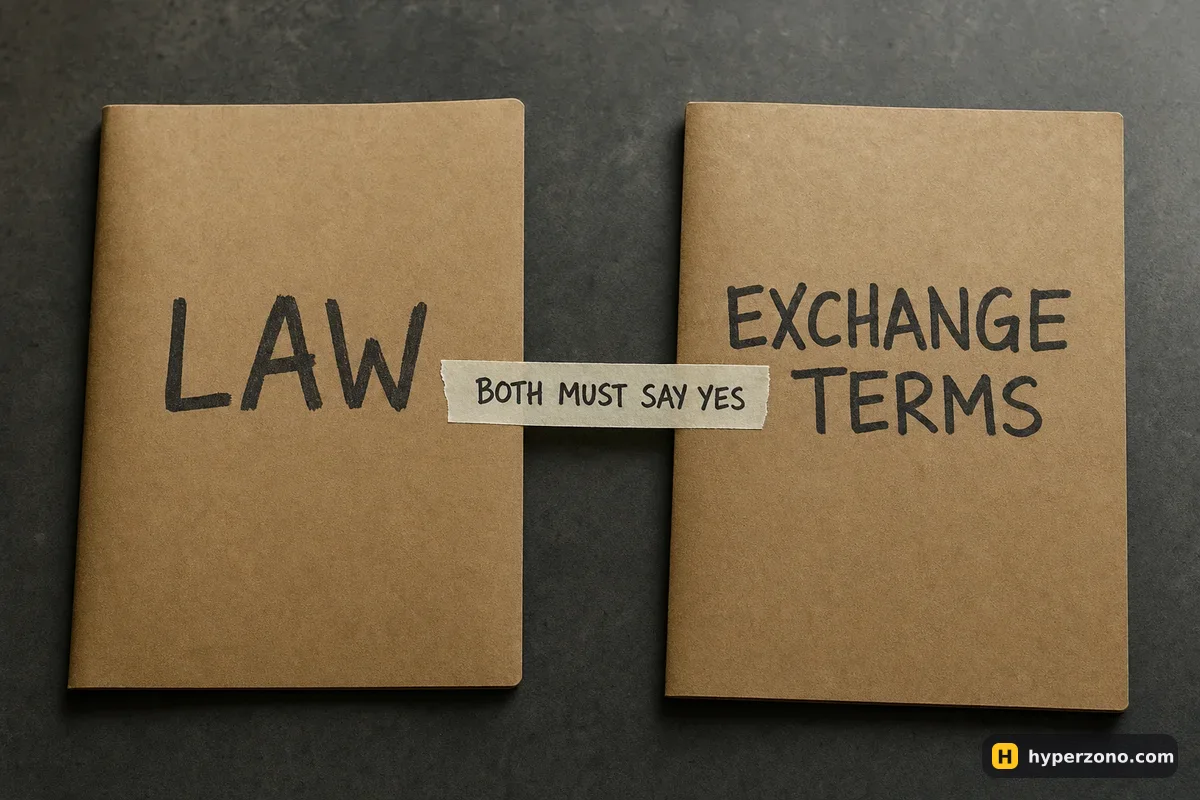
You hear "it's banned" from one person and "it's fine" from another because two things have to say yes before you can trade: the law where you live, and the exchange's own country rules. For the United States you can stop at the second one — every venue in this guide names the US itself. The big exchanges based outside the United States — Binance, Bybit, OKX and the rest the tutorials are written about — do not take people in the US, not after verification, not with a different email address, because their own terms say so.
Further down you will find each venue's wording, taken from its own restriction documents on 25 October 2026. If you are reading this from somewhere else, our page on which exchanges are available where explains how these country lists work in practice.
How to check a platform that offers you futures
Futures in the United States are the CFTC's area. The CFTC site is where the rulebook, the lists of registered venues and the approved contracts live. It does not post a simple yes or no on crypto perpetuals, so judge each platform by whether it is registered.
The "Learn & Protect" part of that site is the useful bit for a beginner. There is a registration and disciplinary-history check, and a public RED List of foreign entities the agency has flagged for soliciting US residents without being registered. If someone messages you offering a futures platform, type the company name into the CFTC's registration check and look at the RED List. If they won't tell you the legal company name, you already have your answer.
Wherever you eventually trade, the beginner questions do not change: leverage, liquidation, fees and funding work the same way under any regulator. Our basics section covers that mechanical side, and it is worth knowing before any money moves anywhere.
Binance, Bybit, OKX, Hyperliquid and Binance Wallet: the detail
The table below puts the venues we cover side by side: what each one's own restriction document says about the United States, and the date we last read it. Look at the status column first — if a venue names the US, there is nothing to try, no matter what a tutorial video shows.
| Venue | Status | What it means |
|---|---|---|
| Binance | Not available | The United States is on the List of Prohibited Countries — for residents and also for US citizens living abroad. |
| Bybit | Not available | The US is on Bybit’s restricted list. |
| OKX | Not available | “Certain jurisdictions within the United States” and all US territories are restricted; OKX US is a separate company with spot only. |
| Hyperliquid | Not available | The Terms block persons in the United States. |
| Binance Wallet (Aster) | Not available | The US is on Aster’s list of prohibited jurisdictions. |
Status for residents, from the exchange’s own documents and the local regulator’s actions. “Not on its banned list” does not mean trading is legal where you live: check the local law above, and the app gives the final answer after KYC.
statuses checked 25 Oct 2026 in the exchanges’ own documents, Binance, Bybit, OKX, Hyperliquid, Binance Wallet (Aster), CFTC.
Is Binance legal in the USA? The practical answer comes before the legal one: the global Binance platform will not open an account for you. The United States sits on its List of Prohibited Countries, and that entry covers three groups at once — people resident in the US, anyone located there, and US citizens wherever in the world they live. So a passport alone keeps you off the global platform even if you have not lived in the country for years. We have no checked facts about any separate US company, so we won't guess about one.
Bybit names the United States on its service-restricted list, and that list is explicitly "not exhaustive", so hunting for a "bybit usa" workaround leads nowhere useful. OKX restricts jurisdictions within the United States and all US territories — Puerto Rico, American Samoa, Guam, the Northern Mariana Islands and the US Virgin Islands — and a US resident is routed to OKX US, a separate company that offers buying and selling coins, not the perpetual swaps you see in tutorials about the global site.
Hyperliquid is the one people assume is different, because there is no sign-up form at all: you connect a wallet and deposit USDC. Its Terms of Use still say the interface is not available to persons who reside in, are located in or are incorporated in the United States. The same holds for the Perpetuals tab inside Binance Wallet, where the trading is provided by the Aster protocol: Aster's terms list the United States among prohibited jurisdictions. Holding your own keys changes who controls your coins, not whether a venue agrees to serve you.
The account survives until withdrawal day. Giving an address you don't live at, or connecting as if you were somewhere else, breaks the terms you accept at sign-up — Binance's terms say plainly that users must not get around its restrictions. The problem rarely shows up on day one. It shows up on withdrawal day, when a routine review matches your documents, your login history or your payment method to a prohibited country, and the account goes to withdrawal-only or stays frozen while you argue. There is no version of this where you keep both the trades and the money with any certainty.
Money in and out, and an account you already have
Because none of these venues accepts US residents, there is no deposit route to walk you through — no card, no bank transfer, no P2P. Identity checks are where the mismatch usually surfaces anyway: the documents and the address you submit decide your country, not the app language or where you happen to be standing when you tap the button.
If you already hold an account from a time when you lived elsewhere and you have now moved to the United States, expect the exchange to restrict it once your country is updated. The common pattern when a venue exits a market is that trading and new deposits stop first, and the account stays open for withdrawals and conversions for a period — that is how Binance handled its exit from the Netherlands, and how Bybit handled the United Kingdom in 2026. Nobody publishes that schedule for an individual account in advance, so the safe move is to close your positions and withdraw yourself before your residency changes, rather than finding out through a button that no longer works.
Exchange lists and national rules change without warning. The dates here are 25 October 2026 — check the venue's own restriction page before you act on any of it. If you want the general method for running that check for any country, we wrote it up on the countries hub.
What you can do next
There are futures venues registered with the CFTC in the United States. We don't cover them and have no checked facts about their crypto contracts, so look them up yourself in the CFTC's registration check rather than taking a stranger's word for it.
If the route through those foreign exchanges is closed to you, the useful thing left is understanding. Almost everything that decides whether a futures trader keeps their money has nothing to do with which exchange they used: how big the position is, where the stop sits, what leverage really does to a 100 USDT account, how a liquidation price is worked out, what fees and funding quietly take out of a trade you hold for a week. You can learn all of that for free, with no account anywhere.
Start with how a trade is built — what leverage actually means is the honest place to begin, because it is where most beginners go wrong — then run the same trade through the profit and loss calculator and the liquidation calculator until the numbers stop surprising you. If the rules where you live change later, or you move somewhere a venue will accept you, you will arrive already knowing what you are doing instead of learning it with real money on the line.
Is Binance legal in the USA?
For you the practical answer is simpler than the legal one: the global platform will not open an account for you, for the reasons in the section above. We have no checked facts about any separate US company, so we won't guess about one.
Can I use Bybit in the US?
No. The United States is on Bybit's service-restricted list, checked 25 October 2026, and Bybit says the list is not exhaustive and can grow. Signing up anyway means breaking the terms you accepted, which is the usual way an account ends up limited to withdrawals only.
Do US territories like Puerto Rico or Guam count as the United States here?
Treat them as a yes. OKX names all US territories — Puerto Rico, American Samoa, Guam, the Northern Mariana Islands and the US Virgin Islands — in its restrictions, and the other venues write their rules around US residency and citizenship, which covers territory residents too. Read the restriction page of the specific venue rather than assuming a territory slips through.
What about Hyperliquid — there is no registration, so who would stop me?
Nobody stops you at the door, but the Terms of Use say the interface is not available to persons residing in or located in the United States. Connecting a wallet does not create an exception, and "the contract let me" is not much help if an access check, a blocked front end or a later rule change catches up with your open position.
Is there any legal way to trade futures inside the United States?
Futures venues registered with the CFTC do exist in the US. We do not cover them and have no checked facts about what crypto contracts they offer, so we won't describe them second-hand. Use the CFTC's registration check to look up any company by name, and treat anything you were told in a chat group as unverified until you see it there.
How do I check whether a platform offering me crypto futures is allowed to?
The CFTC publishes a registration and disciplinary-history check, plus a RED List of foreign entities flagged for soliciting US residents without being registered. Look up the exact company name before you deposit anything. If a platform avoids giving you a legal company name, that is your answer already.
Sources and fact-check
Exchange terms were checked against official documents on October 25, 2026. Terms change — before you trade, check what matters to you in the exchange app and in your contract’s specs.
CFTC: Commodity Futures Trading Commission