Contents
The short answer for Pakistan, as of 25 October 2026What the law and PVARA actually sayWhat Binance's certificate means — and what it does notBinance, Bybit, OKX, Hyperliquid and Binance Wallet: status for residentsMoney in and out, and the account you already haveWhat to do next if you live in PakistanThe short answer for Pakistan, as of 25 October 2026
Pakistan is not on Binance's list of prohibited countries, and Bybit, OKX, Hyperliquid and Aster do not name it either. That means nothing in their published rules shuts the door on you — the app itself decides after you verify your identity. What nobody can tell you is whether leveraged futures are allowed under the new law, because PVARA has published nothing about derivatives.
So you really have two questions, and they have different answers. The first is whether you can get in at all, and that one is settled by the exchange once your documents are checked. The second is whether the platform is allowed to be here, and that one belongs to PVARA — Binance holds a no-objection certificate rather than a licence, so it is still open. Not being on anyone's block list is not the same as legal and approved, and the rules for leveraged products are exactly the part nobody has published. The safest thing you can do today is learn how a trade behaves on demo, before any money of yours is on an exchange.
What the law and PVARA actually say
PVARA — the Pakistan Virtual Assets Regulatory Authority — was set up under the Virtual Assets Act 2026 as an independent federal regulator. Its own site states the core rule plainly: a company that provides crypto services in Pakistan must hold a formal licence from PVARA before it offers them here. That is a rule about firms, not about you personally, but it decides which platforms can legally stand in front of you.
Two sets of rules came with the Act: the Pakistan Virtual Asset Services Regulations 2026 and the Pakistan Virtual Asset Activity Specific Regulations 2026. PVARA has announced that both exist, but nothing it has put out in public says a word about futures, leverage or any other derivative. That part is simply blank. The activity-specific rules would be the natural home for a rule on leveraged products, though that is only a guess — PVARA has not said so, and the text has not been published.
Firms that were already operating on or before 5 March 2026 are called transitional persons, and under Section 70 of the Act they had to apply for a no-objection certificate by 5 September 2026 or stop. That deadline is why the big exchanges moved when they did. There is also an advisory, PVARA/ADV/001/2026, dated 26 April 2026, on virtual asset-related announcements and activities; PVARA has published its title but not its text.
For you as a user, the practical effect of all this is more document checks, not fewer. A licensed platform has to confirm who you are to international anti-money-laundering standards, watch where your money comes from and keep records of it, so keep your own copies as well. The penalties PVARA lists — fines, suspended licences, action against unauthorised operators — point at platforms rather than at individual traders.
What Binance's certificate means — and what it does not
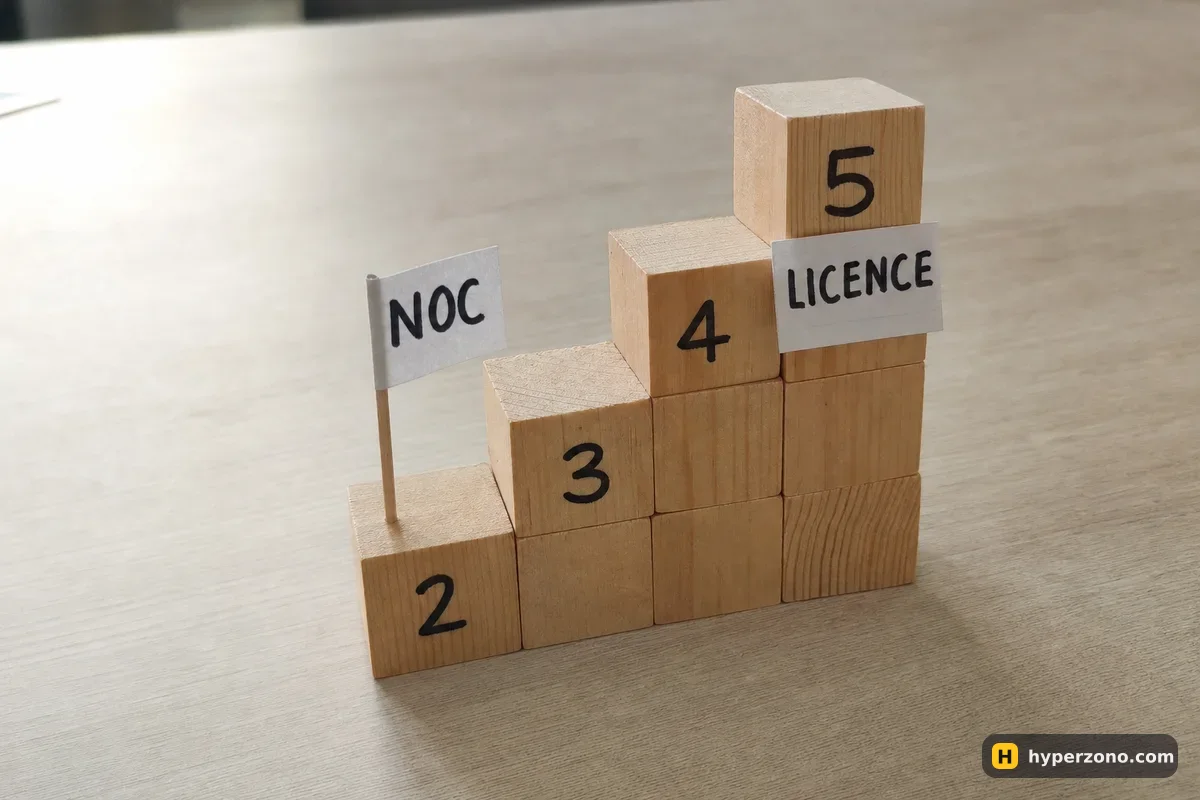
In December 2025 PVARA granted no-objection certificates to global exchanges including Binance and HTX. That is the news story people remember as "Binance is now legal in Pakistan". Read against PVARA's own route to a licence, it means something narrower. The certificate is step two of five: after it, the exchange still has to register with the financial-monitoring body, set up a local company and only then apply for the real licence — the one that would let it offer products here officially.
A certificate is a green light to keep going through the process, not a finished local permission to launch products. There is no published list of licensed providers, no statement that Binance's certificate covers futures or any other derivative, and no report of a derivatives licence being granted to anyone in Pakistan. Anyone telling you that leveraged crypto trading is now officially approved here is going well beyond what the regulator has published.
Binance, Bybit, OKX, Hyperliquid and Binance Wallet: status for residents
The table shows what each venue's own restriction document says about Pakistan as of 25 October 2026. Read it in one direction only: where a country is not named, that venue's published rules do not block it. Every one of those lists also says in writing that it is not exhaustive and can be changed without notice, so the row you see is today's status, not a promise.
| Venue | Status | What it means |
|---|---|---|
| Binance | Not on its banned list | Not on Binance’s List of Prohibited Countries. |
| Bybit | Not on its banned list | Not on Bybit’s list of service-restricted countries. |
| OKX | Not on its banned list | Not on OKX’s list of restricted countries. |
| Hyperliquid | Not on its banned list | Not named in Hyperliquid’s Terms (they block the US, Ontario and sanctioned territories). |
| Binance Wallet (Aster) | Not on its banned list | Not on Aster’s list of prohibited jurisdictions; the tab also needs a Binance account. |
Status for residents, from the exchange’s own documents and the local regulator’s actions. “Not on its banned list” does not mean trading is legal where you live: check the local law above, and the app gives the final answer after KYC.
statuses checked 25 Oct 2026 in the exchanges’ own documents, Binance, Bybit, OKX, Hyperliquid, Binance Wallet (Aster), PVARA.
A few details sit behind those rows. Hyperliquid has no sign-up at all — you connect a wallet, and its terms block only the United States, Ontario and sanctioned territories. The Binance Wallet Perpetuals tab is a different case again: it needs a working Binance account, so it inherits whatever Binance decides about your country, and on top of that Aster, the protocol that provides execution there, excludes its own list of jurisdictions — Pakistan is not among them. For the general logic of why one exchange opens futures in a country and another does not, see which futures exchanges are available in my country, and for the wider list of countries, the country hub.
If the futures section stays closed after your documents are approved, that is the platform's answer for your country and there is no appeal worth chasing. It is also not always permanent: products get switched on and off per region, so it is worth rechecking in a few months rather than hunting for a workaround. What that verification step involves, and what the exchange does with your documents, is covered in do I need to verify my identity to trade futures.
Country restrictions are not worth working around. Every venue here has a clause saying you must not get around its country rules, and breaking it gives the exchange grounds to freeze the account with your money inside — usually at the worst moment, when you try to withdraw. If a product is not offered where you live, treat that as the final answer and use what is actually open to you.
Money in and out, and the account you already have
In practice, rupees move through peer-to-peer trading. On 25 October 2026 there were plenty of live rupee offers on Binance P2P, with payment by Raast and normal bank transfer — so that is usually how money goes in and out. We have no confirmed information on how Pakistani banks treat transfers to and from crypto platforms, so do not assume yours is relaxed about it. Ask your bank, and keep every receipt — PVARA's whole framework is built on traceability.
If you already hold an account, nothing published says individual users face penalties, and the enforcement powers PVARA lists are aimed at operators and unauthorised platforms. What is unknown is what happens to accounts if a platform has to stop serving Pakistan. The pattern from other countries is advance warning followed by a withdrawal-only period — Bybit did this when it closed to UK users, and Binance did it in the Netherlands. Plan as if that could happen: keep only money you can afford to have locked for a few weeks, withdraw profits you do not need in the market, and keep your own record of trades rather than relying on the exchange's history forever.
What to do next if you live in Pakistan
The sensible order is boring and it works. First, learn how a futures trade actually behaves — margin, liquidation, fees, funding — somewhere that cannot cost you money. Learning to trade futures without using real money covers how to do that with demo accounts and paper trades, and it is the same skill set whatever the rules turn out to be. Second, check the legal side at the source rather than through headlines: PVARA publishes its advisories and regulations itself, and each exchange keeps its own restricted-country page.
Third, treat tax as a separate job. We have not checked Pakistani tax rules on this page, and tax is handled by the tax authority, not PVARA — so keep your trade records from the first day and ask a local adviser rather than a trading group. And keep expectations in proportion: even where futures are fully open, most of the work is small position sizes, a stop-loss and patience, not a quick way to grow a small deposit.
Is Binance legal in Pakistan?
Binance is not blocked for Pakistan on its own prohibited-countries list, and PVARA granted it a no-objection certificate in December 2025. That certificate is preliminary approval inside a five-step licensing process, not a full licence, so the accurate description as of 25 October 2026 is "accepted and part-way through local approval", not "fully licensed".
Is crypto futures trading legal in Pakistan?
No public document answers that. The Virtual Assets Act 2026 and PVARA's pages deal with licensing platforms, and nothing PVARA has published mentions futures, leverage or derivatives at all. No derivatives licence has been reported as granted to anyone in the country, so treat the question as genuinely unanswered rather than as a yes or a no.
Can I use Bybit in Pakistan?
Pakistan is not named on Bybit's list of service-restricted countries as of 25 October 2026. Bybit also states that the list is not exhaustive and that it can add jurisdictions at any time, and it has never published which countries its derivatives are unavailable in — so check the page itself on the day you sign up.
Will my account be frozen if the rules change?
Nothing published suggests individual Pakistani users are targeted. The risk is more mundane: if an exchange has to stop serving the country, it typically gives notice and limits the account to withdrawals for a period. Keep spare money off the exchange, withdraw profit you do not need, and save your own trade records.
Can I sign up with another country's address instead?
No. Giving an exchange a country you do not live in breaks its terms, and the problem usually surfaces at the worst moment — during a withdrawal or a document check — with your balance sitting inside a frozen account. That is a far bigger problem than not being able to trade futures today.
Where do I check all of this myself?
PVARA's own site (pvara.gov.pk) for the Act, the regulations and advisories, and each exchange's restricted-country page for access. Both change without warning — the status here is dated 25 October 2026, and the sources are linked at the bottom of this page.
Sources and fact-check
Exchange terms were checked against official documents on October 25, 2026. Terms change — before you trade, check what matters to you in the exchange app and in your contract’s specs.
PVARA: Pakistan Virtual Assets Regulatory Authority (licensing, NOC track, transitional persons)