Contents
Where the confusion comes fromWhat the law and the SPK sayWhat a licensed Turkish platform can give you insteadBinance, Bybit, OKX, Hyperliquid and Binance Wallet: status for residentsMoney in and out, and the account you already haveWhat to do next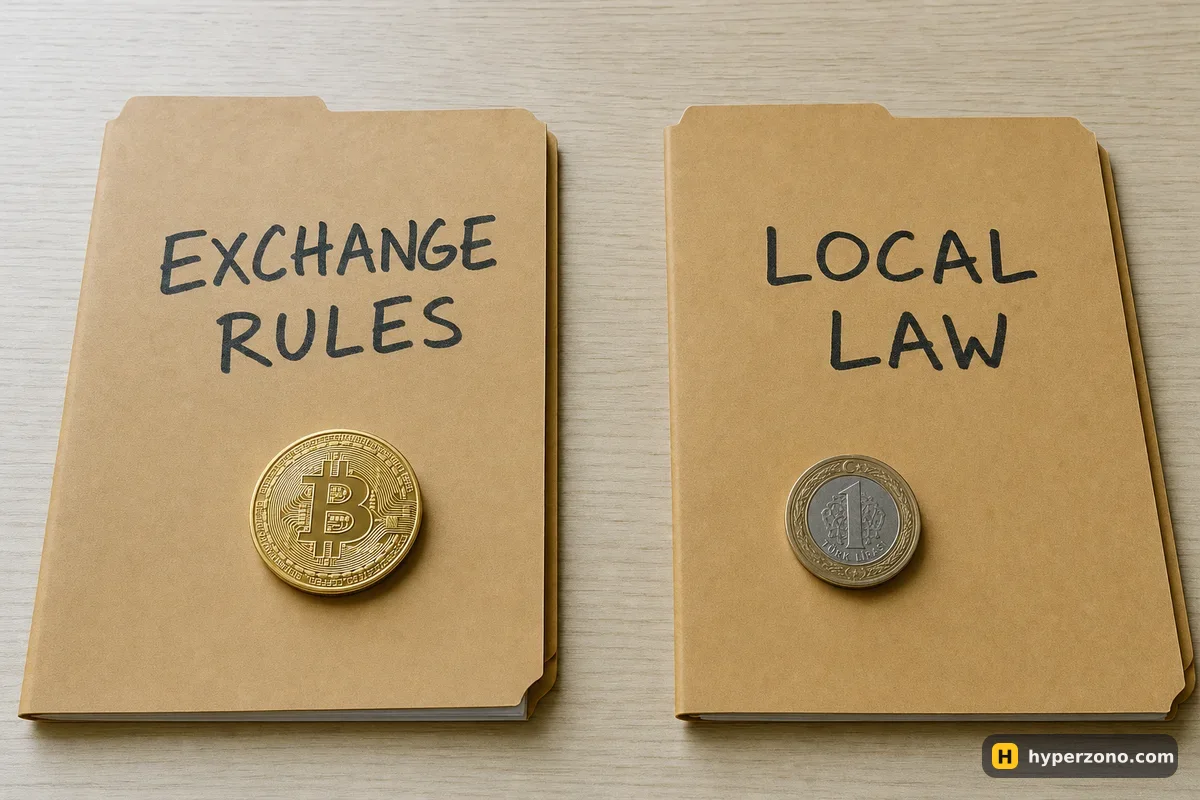
Where the confusion comes from
Here is where the confusion comes from: your friends are reading different documents, and both of them are right. One opened an exchange's terms and saw no mention of Turkey. The other read a news story about the Turkish regulator banning leverage on crypto. Two separate rulebooks, two honest answers — and the rest of this page keeps them apart.
If you do one thing today, do this: finish identity verification on the venue you are considering and open its futures section. No exchange publishes a list of countries where futures are switched on, so that screen — contracts, a leverage setting, an order window — is the only reliable test of whether your own account has access. It tells you nothing about Turkish law, but it settles the access question in a minute.
Two questions, not one. "Does the exchange accept me?" is answered by the exchange's own restriction list and by what the app shows after you verify your identity. "Am I allowed to do this where I live?" is answered by Turkish law and, for your personal situation, by a Turkish lawyer or licensed advisor. A yes to the first is not a yes to the second.
What the law and the SPK say
The key document is SPK Communiqué III-35/B.2, published in the Official Gazette on 13 March 2025. Article 14 says that crypto assets on licensed Turkish platforms may not be traded with leverage and may not be used in derivatives. That is why a Turkish-licensed exchange shows you buying and selling but no 5x button: it is not a missing feature, it is the rule they operate under.
Article 9 covers providers based abroad. Services a Turkish resident goes and finds entirely on their own initiative fall outside the communiqué — but only while that provider does not market itself in Turkey. That condition is about the exchange's behaviour: its advertising, its Turkish-language promotion, its local partnerships. You cannot control any of that, and nothing in the law spells out what the exemption means for you personally.
Turkish law does not say, in anything we can point you to, what happens to an individual who trades on a foreign exchange. If that matters for your money, ask a Turkish lawyer. One thing does follow without any guessing: if a platform operating inside Turkey offers you "leverage", stop and check who is actually behind the offer. And if you are still working out what is being offered in the first place, read how leverage works.
What a licensed Turkish platform can give you instead
Without leverage and derivatives, a licensed local platform is left with the simplest thing in crypto: you buy the coin itself and it is yours. You can hold it, sell it later, or send it to your own wallet. There is no margin to set aside, no funding payments every few hours, and no liquidation — the exchange cannot close your position, because you own the coins outright.
The trade-off is just as plain. If you buy 100 USDT of a coin and it rises 5%, you have 105 USDT. No multiplier, and no liquidation either. Your money only grows when the coin goes up, and you cannot make anything when the market falls. Many people who come looking for futures find that this is actually the product they wanted; others find it too slow. The difference between spot and futures is worth reading before you decide which of the two you are really after.
Binance, Bybit, OKX, Hyperliquid and Binance Wallet: status for residents
The table below collects what each venue has written in its own restriction documents, and the site refreshes it from those pages. Read the status column as "what the company has put in writing", not as "what your screen will show" — a venue that does not name Turkey has simply not named it, which is different from promising you access. The app makes the final decision after identity verification.
| Venue | Status | What it means |
|---|---|---|
| Binance | Not on its banned list | Not on Binance’s List of Prohibited Countries. |
| Bybit | Restricted | Bybit names Türkiye among jurisdictions where derivatives trading is restricted (campaign terms, June 2026). |
| OKX | Not on its banned list | Not on OKX’s list of restricted countries. |
| Hyperliquid | Not on its banned list | Not named in Hyperliquid’s Terms (they block the US, Ontario and sanctioned territories). |
| Binance Wallet (Aster) | Not on its banned list | Not on Aster’s list of prohibited jurisdictions; the tab also needs a Binance account. |
Status for residents, from the exchange’s own documents and the local regulator’s actions. “Not on its banned list” does not mean trading is legal where you live: check the local law above, and the app gives the final answer after KYC.
statuses checked 25 Oct 2026 in the exchanges’ own documents, Binance, Bybit, OKX, Hyperliquid, Binance Wallet (Aster), SPK Communiqué III-35/B.2.
Bybit is the one with a visible warning sign. Turkey is not on Bybit's Service Restricted Countries page, but Bybit's own campaign terms from June 2026 name Türkiye among jurisdictions where derivatives trading is restricted. Promotion wording is not an official country list, so treat it as a strong hint rather than a confirmed block — if you already have an account, the derivatives section itself will tell you.
Hyperliquid works differently, because you connect a wallet instead of registering. Its Terms (15 June 2026) name only the United States, Ontario in Canada, and places under full international sanctions, so Turkey is not listed — but those Terms still bind you, and Turkish law does not change just because there is no sign-up form. The Perpetuals tab in Binance Wallet runs on the Aster protocol, whose terms (25 February 2026) do not list Turkey either; that tab needs a working Binance account, so it inherits whatever Binance decides about your country. For the general method of checking any venue, see which futures exchanges are available in my country.
Money in and out, and the account you already have
Which deposit methods you get — card, bank transfer or lira P2P — is decided on your own deposit screen after verification. Open it and read what is there, rather than trusting someone else's screenshot. Check the reverse route before you send real money: make sure a withdrawal method works for you, ideally by moving a small amount back out once. Identity verification is a separate topic with its own page.
No exchange in the table above has announced that it is closing accounts for Turkish residents. When a venue does restrict a country, the pattern is usually visible in advance: an announcement, then no new sign-ups, then trading disabled with withdrawals left open for a period. Bybit did exactly that for the United Kingdom — access restricted from 21 October 2026 with withdrawals still allowed, and the UK site closing on 19 November 2026. So the practical habit is simple: keep only what you are trading on the exchange, keep your own records of deposits and trades, and read the announcements page now and then.
Giving an exchange a foreign address, or signing in through a service that hides where you really are, is not a way around any of this, and it is worth saying plainly why. Binance's Terms of Use (effective 21 July 2026) say users must not get around country restrictions, including by disguising their connection, and other venues use similar wording. The practical consequence is not a letter from a regulator — it is your own account frozen with your money inside it during a routine check, when your documents say one country and your activity says another. Nothing on this site is worth that.
What to do next
Re-check the documents for today's date
Binance's List of Prohibited Countries, OKX's Risk and Compliance Disclosure and the SPK communiqué are all linked in the sources below. Lists change without notice, and the date on this page is 25 October 2026.
Let the app answer the access question
Finish identity verification with your real Turkish documents and open the futures section. If the contracts and a leverage setting are there, the exchange has accepted you; if they are not, you have your answer without a support ticket.
Learn the mechanics while the legal side is unclear
Margin, liquidation, stop-loss, funding — none of that needs a funded account to understand. Learning now costs you nothing and means you are not working it out later with real money on the line.
Check your own position if you plan to trade seriously
A Turkish lawyer or licensed advisor can tell you where you stand under the communiqué and what to declare. A guide written for a global audience cannot.
If you want to compare Turkey with the way other countries handle the same products, the country hub has the same kind of checked status pages for the EU, the UK, the UAE and more.
Is Binance legal in Turkey?
Binance does not list Turkey among its prohibited countries as of 25 October 2026, so the exchange is not blocking residents at the company level. Whether your own use of a foreign provider fits the Article 9 wording depends on how that provider behaves in Turkey — a Turkish lawyer can answer that for your situation, a website cannot.
Can I use Binance Futures in Turkey?
There is no published list of countries where Binance Futures is switched on. Finish verification, open the futures section in the app and see whether contracts and a leverage setting appear — that screen is the test.
Is Bybit available in Turkey?
Turkey is not on Bybit's official restricted list, but its own promotion terms from June 2026 do name Türkiye for derivatives. Open the derivatives section in your account — that screen decides, not the marketing text.
Why can't Turkish crypto platforms offer leverage?
The SPK communiqué published in the Official Gazette on 13 March 2025 says crypto assets on licensed Turkish platforms may not be traded with leverage or used in derivatives. A local licensed platform offering you 10x would be breaking its own licence conditions.
What happens to my existing account if the rules change?
Exchanges that restrict a country normally announce it ahead of time and leave a window when withdrawals still work. Keep only your trading money on the exchange, save your deposit and trade records, and glance at the announcements page for your venue from time to time.