Contents
The short answer for Vietnam, as of 25 October 2026What the law sets up, and what it leaves openBinance, Bybit, OKX, Gate, Hyperliquid and Binance Wallet: where each one standsWhat a small trade actually looks likeMoney in and out, and what happens to an account you already haveIf a venue does not take you, hiding your location makes it worseWhat to do nextThe short answer for Vietnam, as of 25 October 2026
Two separate things decide whether you can trade: each exchange's own country rules, and Vietnamese law. On the exchange side, Binance, Bybit, OKX and Hyperliquid do not name Vietnam anywhere in their restriction documents, so nothing they have published blocks you in advance. That is not the same as a promise — the app decides during identity verification, and that is the only way to find out. Gate is the exception: it lists Vietnam, so expect that account not to open, or to open with only part of its services.
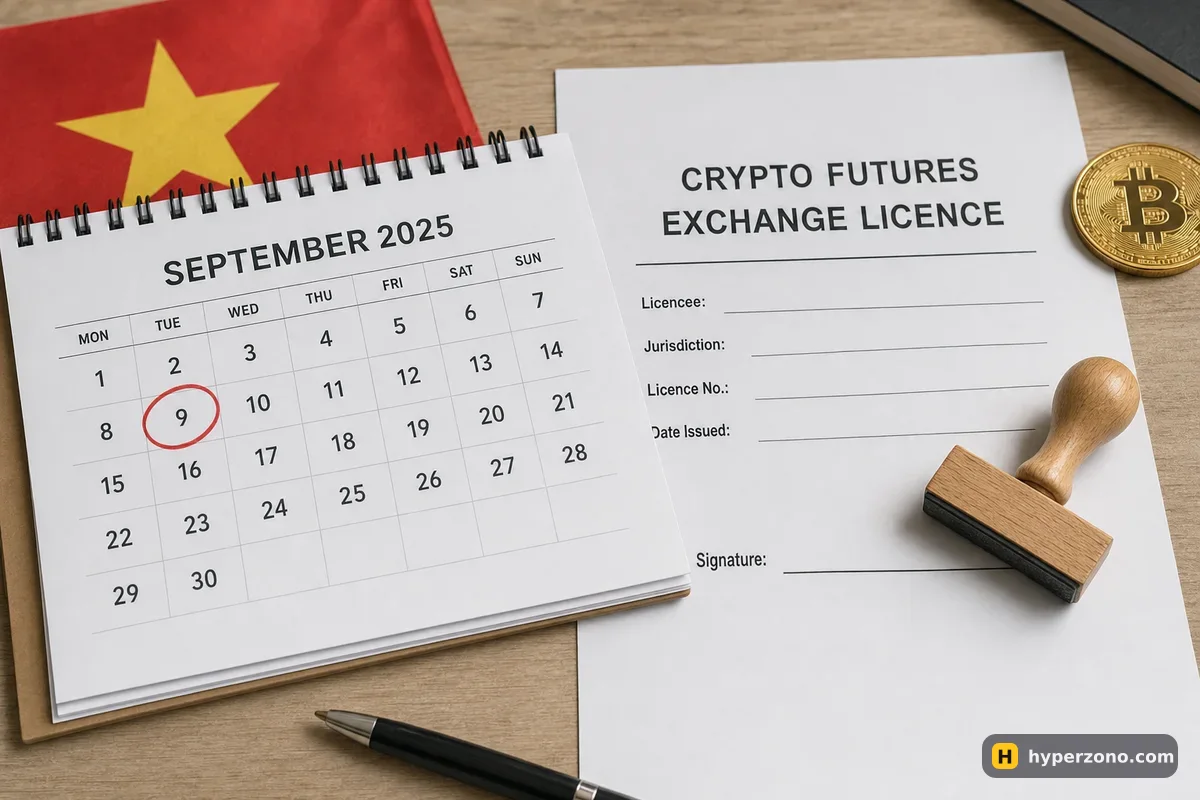
On the Vietnamese side, no exchange is licensed here, because the licence has not been handed out yet. The government signed Resolution 05/2025/NQ-CP on 9 September 2025, starting a five-year pilot for crypto services run by providers licensed by the Ministry of Finance, with trading in Vietnamese dong. As of February 2026 no provider had been licensed, so the pilot exists on paper and has not begun in practice.
What the law sets up, and what it leaves open
Resolution 05/2025 runs as a pilot for five years. Under it, only a provider licensed by the Ministry of Finance may offer crypto trading services to people in Vietnam, and trading is meant to happen in dong. The part worth remembering is the switch inside it: six months after the first licence is granted, trading through an unlicensed provider becomes an offence. Until that first licence appears, that six-month countdown has not started.
What the resolution clearly sets up is licensed trading in dong. What it does not spell out is leveraged futures and perpetuals, so nobody can tell you they are clearly allowed or clearly banned here — check the Ministry of Finance wording or a local adviser before you rely on either reading. Other countries have written down exactly what leverage a resident may use. Vietnam has not written that part yet.
The date to watch is not a date yet. When the Ministry of Finance announces the first licensed provider, write that day down and add six months. From that point, using an unlicensed provider becomes an offence under the resolution, and whatever the licensed venues may offer becomes the legal route. Nothing in the resolution changes for you before that announcement.
Binance, Bybit, OKX, Gate, Hyperliquid and Binance Wallet: where each one stands
The table below is pulled from each venue's own restriction pages and refreshes on its own. Look at two columns only: does the venue name Vietnam, and is the futures product listed separately from the rest of the account. Read "not named" as exactly that and nothing more — the venue has not written your country into its terms. Every one of these lists says plainly that it is not exhaustive and can change without notice.
| Venue | Status | What it means |
|---|---|---|
| Binance | Not on its banned list | Not on Binance’s List of Prohibited Countries. |
| Bybit | Not on its banned list | Not on Bybit’s list of service-restricted countries. |
| OKX | Not on its banned list | Not on OKX’s list of restricted countries. |
| Hyperliquid | Not on its banned list | Not named in Hyperliquid’s Terms (they block the US, Ontario and sanctioned territories). |
| Binance Wallet (Aster) | Not on its banned list | Not on Aster’s list of prohibited jurisdictions; the tab also needs a Binance account. |
Status for residents, from the exchange’s own documents and the local regulator’s actions. “Not on its banned list” does not mean trading is legal where you live: check the local law above, and the app gives the final answer after KYC.
statuses checked 25 Oct 2026 in the exchanges’ own documents, Binance, Bybit, OKX, Hyperliquid, Binance Wallet (Aster).
A few notes on the rows. Hyperliquid has no sign-up at all — you connect a wallet, and its Terms name only the United States, Ontario and sanctioned territories. The Perpetuals tab inside Binance Wallet runs on the Aster protocol, whose prohibited-jurisdiction list does not include Vietnam, but the tab still needs a Binance account, so whatever applies to Binance applies to it. Gate is the one venue that names Vietnam. For the general logic of how access is decided — entity, residence, product — see which futures exchanges are available in my country, and the method for checking any country yourself is on the countries hub.
One practical consequence of having no licensed venue: nobody local stands behind the trade. If an offshore exchange freezes your account, changes a contract's rules or closes a product for your region, there is no Vietnamese regulator to complain to, because the service was never registered here. That is the real cost of the current gap, and it is worth weighing before you move money rather than after.
What a small trade actually looks like
Say you set aside 100 USDT and open a 500 USDT position on bitcoin at 5x — your 100 USDT becomes the margin for that position. If bitcoin moves 2% your way, you make about 10 USDT, minus roughly half a dollar in fees for opening and closing. If it moves 2% against you, you are down about 10 USDT plus those same fees, and a stop-loss is what stops that number growing while you sleep.
That arithmetic is identical in Hanoi, Lagos or Berlin. What the licence question changes is not your profit and loss — it is who you can turn to if the exchange freezes your account or pulls a product. If you want to see the whole calculation written out, step through how a futures trade actually works and then how much you can lose.
Money in and out, and what happens to an account you already have
Money mostly moves peer-to-peer. On 25 October 2026 Binance P2P had roughly 280 live ads in dong: you buy USDT from another person inside the P2P screen of the app. Which payment methods sellers accept changes constantly, so look at the current ads rather than trusting a number from an article. Whatever method you use, keep the receipt and the P2P order ID — your bank may ask what the transfer was for, and a clean record of who paid whom is the only useful answer.
Binance, Bybit, OKX and Gate all verify your identity before they let you near futures; the exact documents are shown in the app during sign-up, and the general process is on our page about identity verification on a crypto exchange. Hyperliquid asks for nothing: you connect a wallet, and that is the whole sign-up. On the centralised exchanges, use your real address — an account opened with the wrong country is the account that gets stuck later, exactly when you want to withdraw.
If the rules change and an exchange decides to stop serving Vietnam, the usual pattern is not a sudden freeze. It is an announcement, then no new registrations, then a window in which you can close positions and withdraw, and finally a cut-off date. That is how it ran in the Netherlands and the UK, and it is the sequence to expect anywhere. Keep an email address you actually read attached to the account, and do not leave money there that you would hate to be slow in getting back.
If a venue does not take you, hiding your location makes it worse
It comes up in every chat group, so here it is plainly: Binance's Terms of Use say users must not get around restrictions, and they name location-hiding tools specifically. Other venues have similar clauses. Breaking one does not usually produce a warning — it produces a locked account, withdrawals held for review, and a conversation with support in which you have to explain why your documents and your logins disagree. Signing up with someone else's documents is worse again, because then the money is legally theirs.
If a venue does not serve you, that is the answer for that venue. The useful move is to re-read the official pages from time to time, not to hide where you are.
What to do next
With no licensed provider yet and no written position on leveraged futures, the calm step is to learn how a trade works before real money is involved. The mechanics are the same everywhere: a position size, a margin, a stop-loss, a funding payment every few hours. You can learn all of that without using real money, and none of it depends on which licence exists in which country.
Then keep an eye on three things that can change: the Ministry of Finance announcing a first licensed provider and the six-month clock that starts after it, any new rule that touches derivatives, and the restriction pages of the venues themselves, linked in the sources below. A reminder every couple of months is enough — these documents are short, and reading them takes five minutes.
Is Binance legal in Vietnam?
Binance is not a licensed provider in Vietnam, because as of February 2026 the pilot had licensed nobody at all. Vietnam is also not on Binance's list of prohibited countries, so nothing in Binance's own terms blocks you in advance. Using an unlicensed provider only becomes an offence under the resolution six months after the first licence is granted.
Can I use Binance futures in Vietnam?
Binance's published documents do not name Vietnam, so nothing it has written blocks you in advance — but that is all anyone can tell you. Whether the account and the futures section actually open is decided by the app during identity verification, and that is the only way to find out. Keep in mind that no venue is licensed in Vietnam and the pilot says nothing clear about leveraged products, so no local regulator stands behind the trade.
Is Bybit available in Vietnam?
Vietnam is not on Bybit's list of service-restricted countries, which was last updated on 16 October 2026. That list says plainly it is not exhaustive and can be extended at any time, so treat it as the current published position rather than a promise, and check during sign-up.
Why might a Gate account not work from Vietnam?
Gate's user agreement of 22 July 2026 lists Vietnam among its restricted locations. Gate defines those as places where it has decided not to offer all or part of its services, so the restriction can cover everything or only some products. In practice, expect the account or the futures section not to open.
What happens when the first licence is issued in Vietnam?
Six months after the first Ministry of Finance licence, trading through unlicensed providers becomes an offence under Resolution 05/2025. Watch for that announcement, write the date down, and read what the licensed venues are actually allowed to offer — the clear part of the resolution is trading in dong.
Can I deposit Vietnamese dong to buy USDT?
People mostly use peer-to-peer. On 25 October 2026 there were roughly 280 live ads in dong on Binance P2P, where you buy USDT from another person inside the app. Open the P2P screen to see which payment methods sellers accept right now, and keep the payment receipt and the order ID for every trade.