Contents
Where a Meta perpetual trades and which venue to pickWhat it costs to hold a Meta position: funding in moneyLeverage, weekends and earnings days: how big a position is safeOpening a first small Meta position step by stepWhere a Meta perpetual trades and which venue to pick
If you already use the Binance app, the simplest route is the Perpetuals tab inside Binance Wallet. Stock pairs there settle in USD1 or USDT, and some companies are listed in both currencies, with different volume in each. Open the Stock group or search META — or look at the live table below — to see which Meta pair is listed and in which currency. The wallet is the product you use; execution and the order book come from Binance's partner, the Aster protocol, which is why the screen says "Provided by Aster".
The second route is Hyperliquid, where the Meta market is called xyz:META. It is not run by Hyperliquid itself — another team, trade.xyz, put the market there, and they choose the price source and the leverage cap. You pay in USDC, and funding there is charged every hour.
Binance Futures also lists US stock perpetuals, so check whether Meta is in that list and what its funding interval and leverage cap are in the contract specification. All of it sits side by side, with the numbers refreshed from the venues' APIs, in the table below.
| Where | Contract | Price | Leverage up to | 24h volume | Open interest |
|---|---|---|---|---|---|
| Binance Wallet Perpetuals tab, Aster order book | METAUSD1 | $642.38 | 20x | $3.4M | $6.6M |
| Binance Wallet Perpetuals tab, Aster order book | METAUSDT | $642.38 | 20x | $165K | $943K |
| Hyperliquid (trade.xyz) HIP-3 market by trade.xyz | xyz:META | $641.09 | 20x | $55.6M | $95.7M |
| Binance Futures for comparison | METAUSDT | $642.28 | — | $40.9M | — |
Prices differ a little between venues: each has its own order book and price source. Liquidation and profit are counted on each venue’s mark price.
Updated 24 Oct 2026, 12:12 UTC from Binance Wallet Perpetuals tab (Aster order book), Hyperliquid API, Binance Futures API.
Read the 24-hour volume column first, because volume tells you how easily a market order fills near the price you see. If the same company shows up as both a USD1 and a USDT pair, pick the busier one. The contract follows Meta's share price, but the number on your screen comes from the venue's own price source, so it can sit a little away from the last price on the US market — especially when that market is closed. And you are not a shareholder either way: the difference between holding a tokenized share and trading a contract on it is explained in tokenized stock vs futures.
What it costs to hold a Meta position: funding in money
On a perpetual there is no expiry date, so instead of a settlement the two sides of the market pay each other a small amount at fixed times. That payment is called funding: when it is positive, longs pay shorts; when it is negative, shorts pay longs. The exchange does not keep it. The full mechanics are in what funding is and when you pay it; here is how to turn the rate into money on a Meta trade.
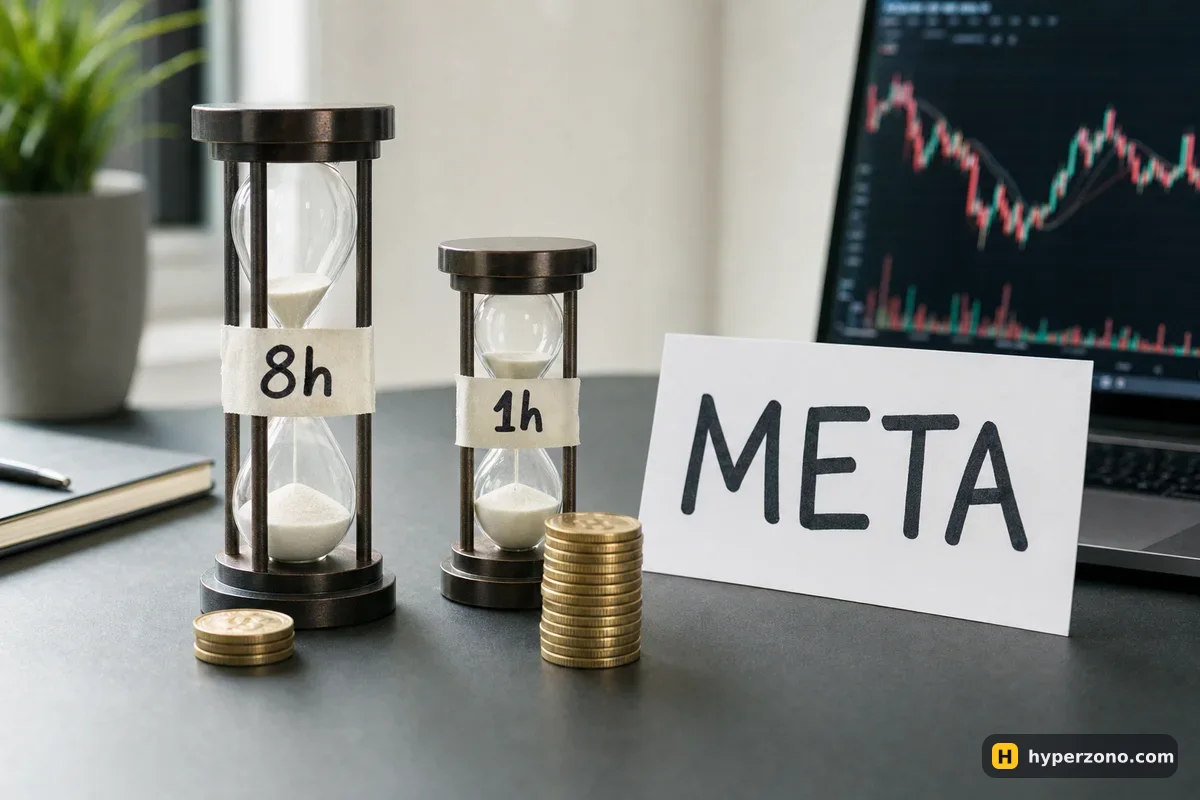
Funding is charged on the size of your position, not on your margin. Say the rate is 0.01% every 8 hours — that is an illustrative number, not today's. On a 500 USDT position that is 0.05 USDT per payment, three payments a day, so about 0.15 USDT a day and around 4.5 USDT over a month. A week is roughly a quarter of that, so divide the monthly figure by four: a little over 1 USDT. Read today's real rate in the funding table below, and remember it changes at every settlement and can pay you instead of costing you.
The interval matters as much as the rate. Funding in the wallet tab is paid every 8, 4 or 1 hours depending on the contract, so look at the payment time on the pair page before you hold overnight; on Hyperliquid it is hourly, and an hourly rate has to be multiplied by eight before you compare it with an 8-hour one. How to compare a 1-hour funding rate with an 8-hour one does that arithmetic step by step.
| Where | Contract | Paid | Rate now | A long over 30 days, per 1,000 USDT | Over 90 days |
|---|---|---|---|---|---|
| Binance Wallet | METAUSD1 | every 8 h | 0.0000% | pays 1.08 USDT | pays 1.08 USDT |
| Binance Wallet | METAUSDT | every 8 h | 0.0000% | pays 1.77 USDT | pays 1.82 USDT |
| Hyperliquid (trade.xyz) | xyz:META | every hour | +0.0006% | pays 6.04 USDT | pays 18.36 USDT |
| Binance Futures | METAUSDT | every 8 h | 0.0000% | pays 2.67 USDT | pays 6.67 USDT |
Plus means longs pay shorts, minus means longs receive. The period total is what a 1,000 USDT long would have paid holding the whole time (price changes aside); a short receives the same amount with the opposite sign.
Updated 24 Oct 2026, 00:57 UTC from Binance Wallet Perpetuals tab (Aster order book), Hyperliquid API, Binance Futures API.
Funding is not your only cost, just the one that grows with time. Stock and commodity contracts in the wallet tab are charged 0.0125% on a taker order, so entering and exiting a 500 USDT position with market orders costs about 0.13 USDT in total; the maker fee for these pairs is shown in the app, so check it there before you plan around limit orders. Hyperliquid has its own fee schedule, set out in Hyperliquid fees explained, and xyz:META sits alongside the other markets trade.xyz has put on Hyperliquid, which you can browse in the live Hyperliquid market table. If you are in and out the same day, fees and funding together are usually a fraction of a percent of your position — the price move is what decides your result.
Leverage, weekends and earnings days: how big a position is safe
The leverage badge sits next to the pair name in the app, and if Meta is listed in two currencies the caps can differ between them, so check it there rather than assuming. Whatever the cap is, the number you choose is the thing that decides how quickly a bad day ends your trade. At 20x, a move of around 5% against you eats your margin — and the exchange usually closes the trade a bit before that, because fees and the maintenance margin come out first. A single stock can travel that far in one session after an earnings report.
At 5x, a 500 USDT position needs 100 USDT of margin. If Meta moves 2% against you, that is about 10 USDT — one tenth of the money you put in. Painful, not a wipeout. If you are unsure what number to pick, what leverage a beginner should use walks through the trade-off, and the liquidation calculator shows where the exchange would step in.
The other thing to plan for is the clock. The Meta perpetual trades 24/7, including weekends, while the shares themselves only change hands during the US session — so outside those hours the contract price moves on expectations and on whatever trading is around, and it can jump when the underlying market reopens. Why stock futures on crypto exchanges trade at night and on weekends covers that in detail. The practical version is simple: check Meta's earnings date before holding a position over it, keep the size small if you will be asleep, and put a stop-loss on the trade rather than planning to watch the screen.
A gap can jump straight past your stop. A stop-loss is an instruction to close at market once a price is reached, not a promise of that exact price. If the contract moves far away from where it was while you were not looking, you will be filled at the first available price. That is one more reason to size the position so that even a bad fill is money you can afford to lose.
Opening a first small Meta position step by step
If you have a verified Binance account, the fastest path is the wallet. You can open Binance Wallet from inside the Binance app, create the keyless wallet in a minute, and back it up before anything else — without a backup the Perpetuals tab stays locked. There is no 12-word seed phrase to copy down here; backup means Quick Backup with biometrics, iCloud or Google Drive with a recovery password, or a QR code, and if you lose that recovery password and the device, nobody can restore the wallet for you.
Fund the wallet
Move USDT or USD1 from your Binance account into the wallet, matching the currency the Meta pair settles in. For a 500 USDT position at 5x you need 100 USDT of margin plus a little buffer, so 120 USDT is a comfortable starting balance.
Find the pair
Open the Perpetuals tab, use the Stock group or search for META, and see which pair comes up and whether it settles in USD1 or USDT. If both are listed, compare their 24-hour volume and take the busier one. The max leverage badge sits right next to the pair name.
Set leverage and margin mode
Choose 5x rather than the maximum, and use isolated margin so the trade can only ever cost you the margin you assigned to it.
Size the trade honestly
Type the position size, not the margin. The order window shows the minimum size for that pair — check it there, because it decides how small your first trade can be. A very small position is still real money, but it lets you see how the order, the funding time and the stop behave before you size up.
Add a stop-loss and a target before you confirm
Decide the price at which you accept you were wrong and the price at which you are happy to take the profit, and set both when you open the trade.
The same order window is described step by step, with gold as the example, in how to open a trade in Binance Wallet. If you would rather trade Meta from a self-custody wallet with no Binance account at all, the xyz:META market is reachable on Hyperliquid — you connect a wallet and deposit USDC instead of signing up. Either way, check that the venue is available where you live: Aster's terms exclude residents of, and people located in, Russia, Ukraine, the USA, Canada, the United Kingdom, China, North Korea, Cuba, Iran, Venezuela and Syria, and Hyperliquid blocks access from certain jurisdictions too.
Meta is one of dozens of stock perpetuals that now live next to crypto pairs — the broader picture is in stocks on a crypto exchange, and neighbouring single-name pages cover Nvidia, Tesla and Google with the same venue and cost breakdown.
Do I own Meta shares if I trade a Meta perpetual?
No. You hold a contract whose price follows Meta, settled in USDT, USD1 or USDC. You get no shares and no voting rights — your money comes from, or goes into, the difference between your entry and exit price.
Can I trade Meta perps at the weekend?
Yes. These contracts run around the clock, including Saturday and Sunday, even though the US stock market is closed. Trading is quieter at those times and the price can move further on fewer trades, so keep weekend positions small.
Which venue is cheaper to hold a Meta position on?
Whichever has the lower funding rate while you are actually holding, and that changes at every settlement. Open the live funding table above, convert each rate to the same time basis, multiply by your position size, and add the entry and exit fees if you only plan to hold for a few hours.
What is the smallest Meta position I can open?
The order window shows the minimum for the pair you picked, and it differs from pair to pair. Check it there before you fund anything, because that number tells you how small your first trade can be.
What happens to my position when Meta reports earnings?
The contract keeps trading while the shares do not, so the price can move sharply on the news and again when the US session opens. If you plan to hold through an earnings date, cut your size, use isolated margin and accept that a stop-loss may fill well past your chosen price.
Is high leverage on Meta a good idea for a first trade?
No. At 20x a move of around 5% against you ends the trade, and the exchange closes it slightly earlier once fees and maintenance margin are counted. Start at 2x–5x, see how the position behaves, and only think about more once you have closed a few trades by plan rather than by panic.