Contents
Where to look for an AMD perpetualWhat it costs to hold an AMD perpetualLeverage, weekends and earnings daysHow to open a small first position
Where to look for an AMD perpetual
Binance Futures lists perpetuals on US stocks and ETFs as part of a wider set of 217 traditional-market contracts — the same list also holds gold, silver, WTI and Brent oil, natural gas, copper and some Hong Kong and Korean stocks. It is the same kind of contract you already know, just held on your normal USDⓈ-M futures account instead of a wallet, and it trades around the clock including weekends. The maximum on stock contracts runs from 20x to 75x depending on the pair, with newly listed ones at 20x, and you search for AMD in the futures pair list in the app. The guide to trading Tesla, Apple and Nvidia on a crypto exchange shows how that stock section is laid out.
The second route is the Perpetuals tab inside the Binance app's wallet. You trade from your own wallet balance, in USDT or USD1 — two dollar-pegged coins; a pair settles in one or the other, and some companies have a pair in each. Open the Stock group or the search field and type AMD: if the pair exists, it shows its maximum leverage badge, and the current funding rate and the time of the next payment are on the contract's own screen — check the exact wording in the app. You can also see every listed pair side by side in the live table of Binance Wallet markets; execution and liquidity come from Binance's partner, the Aster protocol, which is why the screen says "Provided by Aster".
The third place to look is Hyperliquid, where the stock markets are not opened by Hyperliquid itself: a separate company, trade.xyz, deploys them and chooses the price source and the leverage limit. Open the live Hyperliquid market table and search for AMD — if it is there, the ticker will look like xyz:AMD. Funding on Hyperliquid is paid every hour rather than every few hours, and most stocks deployed by trade.xyz sit at 10x or 20x. The page on markets deployed on Hyperliquid explains who sets what.
Pairs get added and removed, so the only reliable check is the live list. The table below shows which venues carry AMD right now, the maximum leverage and how much it trades in 24 hours; it updates every hour. If a venue is missing from the list, the pair simply is not listed there at the moment.
| Where | Contract | Price | Leverage up to | 24h volume | Open interest |
|---|---|---|---|---|---|
| Binance Wallet Perpetuals tab, Aster order book | AMDUSDT | $517.15 | 50x | $213K | $370K |
| Hyperliquid (trade.xyz) HIP-3 market by trade.xyz | xyz:AMD | $516.21 | 10x | $13.0M | $18.8M |
| Binance Futures for comparison | AMDUSDT | $517.54 | — | $38.2M | — |
Prices differ a little between venues: each has its own order book and price source. Liquidation and profit are counted on each venue’s mark price.
Updated 24 Oct 2026, 12:12 UTC from Binance Wallet Perpetuals tab (Aster order book), Hyperliquid API, Binance Futures API.
Before you size an order, look at one number for the venue you picked: the 24-hour volume of that exact pair in the table above, which tells you how smoothly a 500 USDT order will fill. Where a company is listed twice, once settled in USDT and once in USD1, the two usually trade different amounts — pick the one with the larger volume.
| What you are comparing | Binance Futures | Binance Wallet, Perpetuals tab | Hyperliquid (market by trade.xyz) |
|---|---|---|---|
| Account | Your verified Binance account, USDⓈ-M futures | The same Binance account plus the wallet inside the app | No exchange registration: you connect a wallet |
| Money you trade with | USDT in the futures wallet | USDT or USD1 held in the wallet | USDC deposited to the venue |
| Maximum leverage | Stocks 20x to 75x depending on the pair; new stock listings 20x | A badge on the pair — see the live wallet table | Set by trade.xyz — most stocks 10x or 20x; see the live table |
| How often funding is charged | Usually every 8 hours, some contracts every 4 | Every 8, 4 or 1 hours depending on the contract | Every hour |
| Trading hours | Around the clock, weekends included | Around the clock, weekends included | Around the clock |
What it costs to hold an AMD perpetual
Two costs matter, and both are small on a small position. The first is the fee. In the wallet's Perpetuals tab, taking the price that is already on offer costs 0.0125% on stock and commodity pairs — about 0.06 USDT on a 500 USDT position, and the same again to close, so roughly 13 cents for the round trip. On Binance Futures the base level charges 0.05% when you take the offered price and 0.02% when you set your own and wait, which on the same 500 USDT is 0.25 USDT per side; the Binance Futures overview goes through those levels. Hyperliquid has its own schedule, covered on the Hyperliquid fees page.
The second cost is funding, and it is the one people forget, because it keeps ticking while you sleep. It is worked out on your position size, not on your margin, and the venue does not keep it — it moves between the people who are long and the people who are short. When the rate is positive, longs pay shorts; when it turns negative, a long receives the money instead. The funding explainer covers the mechanics.
The table below shows the funding rates running right now on different venues and contracts. Read two things in it: the sign, which tells you whether a long pays or receives, and the interval, because an hourly rate and an eight-hour rate are not the same number — one hourly payment of 0.01% on a 500 USDT position is about 0.05 USDT, and it repeats 24 times a day.
| Where | Contract | Paid | Rate now | A long over 30 days, per 1,000 USDT | Over 90 days |
|---|---|---|---|---|---|
| Binance Wallet | AMDUSDT | every 8 h | 0.0000% | pays 3.94 USDT | pays 5.97 USDT |
| Hyperliquid (trade.xyz) | xyz:AMD | every hour | +0.0006% | pays 5.34 USDT | pays 15.41 USDT |
| Binance Futures | AMDUSDT | every 8 h | 0.0000% | pays 5.87 USDT | pays 10.53 USDT |
Plus means longs pay shorts, minus means longs receive. The period total is what a 1,000 USDT long would have paid holding the whole time (price changes aside); a short receives the same amount with the opposite sign.
Updated 24 Oct 2026, 00:57 UTC from Binance Wallet Perpetuals tab (Aster order book), Hyperliquid API, Binance Futures API.
Funding is charged on the position, not on your deposit. With 100 USDT of margin at 5x you hold 500 USDT of the contract, and every funding payment is worked out on the 500. Raise leverage to 20x on the same 100 USDT and the position becomes 2,000 USDT — the holding cost grows four times over, along with the profit and the loss.
Put that next to the price move itself and the sense of scale becomes clear. A 2% move in AMD is 10 USDT on a 500 USDT position, win or lose, while a day of funding is usually cents. The cost of holding is rarely what ruins a beginner's trade — the size of the position is.
Leverage, weekends and earnings days
Whatever maximum the pair shows is a ceiling the venue allows, not a suggestion for your first trade. At 5x, a move of about 20% against you would use up the margin you put in — and the exchange closes the trade a bit before that, because it keeps a maintenance amount and charges fees along the way. At 20x that distance shrinks to about 5%. AMD is a semiconductor stock that can move several percent in a day on news, so low leverage plus a stop-loss is the sane starting point, exactly as the page on choosing leverage for your first trade describes. Use isolated margin so only the amount you assigned to this trade is at risk.
The contract trades around the clock, but the shares behind it do not. The main US session runs 9:30 to 16:00 New York time, and outside it the perpetual keeps moving on whatever buyers and sellers do on the venue. The page on night and weekend trading explains why the two prices can drift apart. In practice it means a position held over the weekend can jump when the US market reopens on Monday, so keep the size small if you plan to sit through it.
Earnings are the other date worth marking in advance. AMD reports quarterly, and the price can move hard in seconds when the numbers land after the US close. Check the company's own investor calendar for the date instead of trusting a chat group, and decide beforehand whether you want to be in the market that evening at all. If you do, cut the position size rather than relying on a stop to rescue you in a fast move.
One thing the contract is not: a share. You are not a shareholder, you get no voting rights, and how dividends are handled is set out in the contract's own specification, so read it there. If that distinction matters to you, the comparison of tokenized stocks and futures sets the two side by side, and the overview of stocks on crypto exchanges covers the wider picture.
How to open a small first position
Create and back up the wallet
Inside the Binance app, open Binance Wallet and create it. Finish the backup — Quick Backup, a cloud backup with a recovery password, or a QR code. Without a backup the Perpetuals tab stays closed. It is a keyless wallet, so there is no 12-word phrase to write down.
Fund it with a small amount
Move 20 to 50 USDT into the wallet. That is enough to open a real position and small enough that a bad first trade teaches you something instead of hurting.
Search for the AMD pair
Open the Perpetuals tab and use the Stock group or the search field. If the pair is listed, it shows its maximum leverage badge — read that before you size the order, and check the pair's 24-hour volume in the live table above. If it is not there, pick another listed company to practise the mechanics.
Set leverage and size before the direction
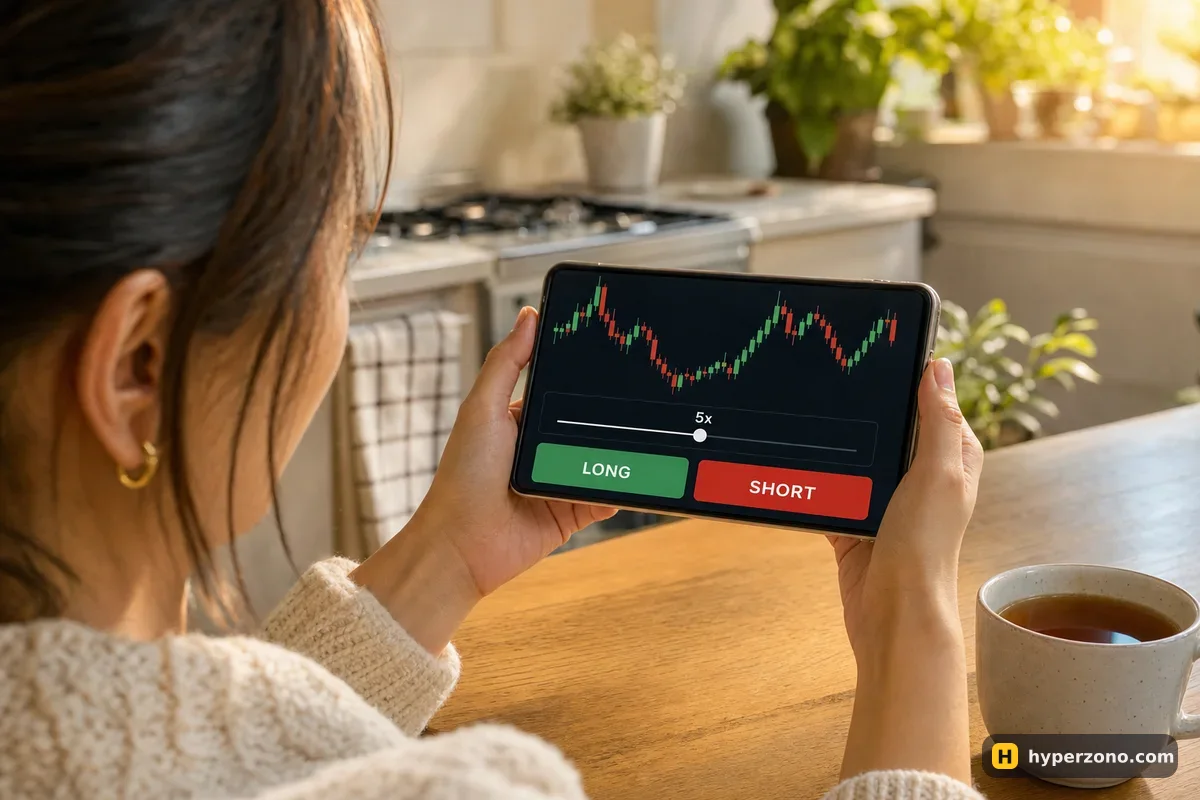
Pick 5x or lower, choose isolated margin, and type the amount. With 20 USDT of margin at 5x your position is 100 USDT. The smallest order the venue accepts is shown in the order window.
Add the stop-loss in the same order window
Decide the price at which the idea is simply wrong and put the stop there before you tap Long or Short. While you are in that window, look at the fee line for both ways of entering — taking the offered price and setting your own — so you know what each one costs you.
Watch one funding payment go through
Funding is settled every 8, 4 or 1 hours depending on the contract, and the contract's own details screen tells you which. Seeing the first payment hit your balance — cents on a small position — makes the cost real in a way no table does.
If you want the same sequence with every tap spelled out, the guide to opening a trade in Binance Wallet walks through it slowly, and you can open Binance Wallet and follow along with the pair in front of you.
Prefer the on-chain route? Then you connect a wallet to Hyperliquid, deposit USDC and search the market list for AMD — a separate account, a separate deposit, and funding ticking every hour.
Availability is worth one check of your own. Binance derivatives are not offered everywhere — among other places, they are unavailable in the United Kingdom, Brazil, Australia, South Korea, New Zealand and Hong Kong — and the wallet's Perpetuals tab follows Aster's terms, which exclude residents of, and people located in, Russia, Ukraine, the USA, Canada, the United Kingdom, China, North Korea, Cuba, Iran, Venezuela and Syria. The app will tell you during setup, so check before you plan a deposit.
Where can I trade an AMD perpetual?
Three places are worth checking: Binance Futures, which lists perpetuals on US stocks on your normal futures account; the Perpetuals tab inside Binance Wallet; and Hyperliquid, where stock markets are deployed by trade.xyz. The list of stock pairs changes as companies are added and removed, so search for AMD in the app and in the live tables on this site rather than trusting a fixed answer. If the pair is not there today, the mechanics are identical on any other listed stock.
Can I trade AMD 24/7?
A perpetual contract trades around the clock, weekends included, even though the shares themselves only trade during the US session, 9:30 to 16:00 New York time. Outside those hours the price keeps moving on the venue's own market. Expect sharper moves when the US market reopens.
Do I own AMD shares if I hold the perpetual?
No. You hold a contract that follows the price, and your profit or loss is paid in dollar-pegged coins like USDT. No shares are registered in your name and you get no voting rights. How dividends are reflected depends on the contract, so read its specification on the venue you use.
What is the smallest position I can open?
The minimum order size is shown in the order window when you type the amount, and it differs by venue and by pair. Start well below what you can afford to lose — on a small first trade the point is seeing the screens and the funding payment work, not the profit.
How much leverage can I use?
Read the maximum on the pair itself in the app, or the live market table for that venue. On Binance Futures stock contracts the ceiling runs from 20x to 75x depending on the pair, while on Hyperliquid the stock markets deployed by trade.xyz mostly sit at 10x or 20x. A higher ceiling is not a recommendation — your risk comes from the position size you choose.
Is funding on a stock perpetual expensive?
In money terms it is usually small: funding is a percentage of your position size paid at each settlement, often a few cents on a 500 USDT position. It also changes constantly and can turn negative, in which case a long receives the payment instead of paying it. The current rate and the settlement interval are shown on the contract's own screen, and the live funding table above lets you compare venues.