
Contents
Why they keep trading when the stock market is closedWhat actually changes in the quiet hoursWhen earnings hit: right after the 16:00 New York closeWhat happens when news lands on a SaturdayFunding keeps running through the weekendA simple weekend routine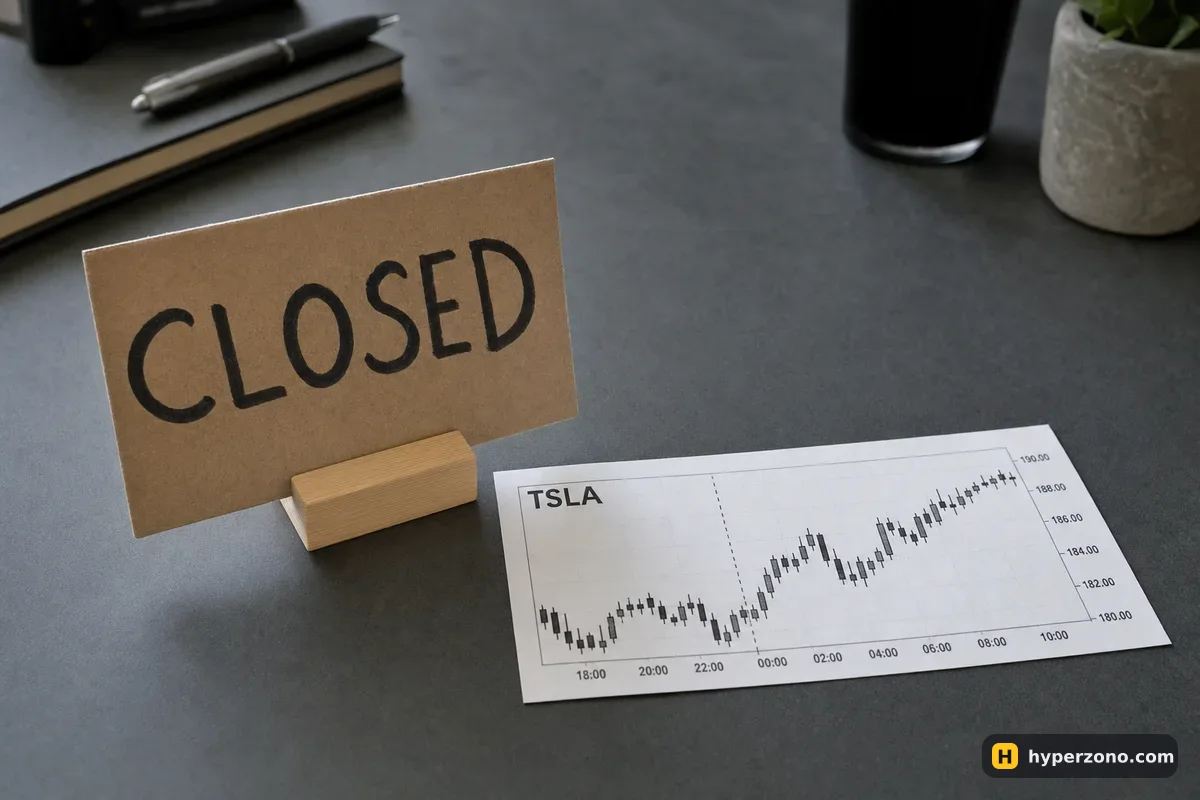
Why they keep trading when the stock market is closed
A stock contract on a crypto exchange is an agreement between traders on that exchange, settled in USDT. You are not holding a share, and nobody in New York has to open the stock exchange for the contract to have a price. As long as people are placing buy and sell orders, the price keeps moving — that's why these contracts run on Saturday as easily as on Tuesday. If this whole product is new to you, start with what stocks on a crypto exchange actually are, and with the difference between perpetual and dated futures, since almost everything here is the perpetual kind.
Index contracts work the same way. OKX, for instance, lists US100, US500 and JP225 perpetuals priced from OKX's own settlement indices rather than from a broker's futures contract — you can look at them on OKX or read more on the page about the S&P 500 and Nasdaq-100. The main session on the NYSE and Nasdaq is 9:30 to 16:00 New York time, and that's the window when the real shares behind the contract are changing hands. Everything outside it — the hours after the close, weekends, US holidays — is crypto traders pricing an asset whose home market is shut.
What actually changes in the quiet hours
The contract is open, but there are far fewer people trading it. With fewer orders waiting on both sides, the gap between the best buy price and the best sell price gets wider, and when you press Buy your order has to take a worse price to get filled. The same thinness is what lets one large order push the price 1–2% in seconds and then snap straight back. Those long thin spikes on the chart are called wicks, and they happen far more often when the market is empty.
A wick doesn't care that you were right about the direction. It can touch your stop level, close you out, and then the price returns to where it was. That's one reason a smaller position over the weekend is more comfortable than a big one — see how to work out your position size.
When earnings hit: right after the 16:00 New York close
Companies publish their quarterly results in the minutes and hours straight after the stock market closes at 16:00 New York time, and the contract reacts immediately, while the share itself has stopped trading. Work out once what that moment is on your own clock: 16:00 in New York is 20:00 UTC from March to November and 21:00 UTC in the winter months. In the summer period that's about 5 p.m. in São Paulo, 9 p.m. in Lagos, 10 p.m. in Berlin, midnight in Dubai, 1:30 a.m. in Mumbai and 4 a.m. in Manila.
Whether that lands in your evening or in the middle of your night, the result is the same: a contract on a single company can move several percent in that window, with far fewer traders around than during the session. If you are holding Tesla, Nvidia or any other single stock, check whether its results are due before that hour arrives, and keep the size small if they are. Index contracts are gentler here, because one company's news is diluted by the hundred others in the index.
What happens when news lands on a Saturday
While the stock market is shut, news keeps happening: a regulator says something, a product launch goes wrong, the CEO resigns. The contract does not stop — but with almost nobody placing buy orders, the price doesn't walk down to the new level. It falls in a few big steps, each one skipping over a stretch of prices where nobody was willing to trade. Then the US session comes back on Monday, real volume arrives, and the price can jump again as thousands of traders price the news properly.
Here's what that looks like with numbers, as an illustration. Say you hold a 200 USDT Tesla position over the weekend with your stop 3% below your entry. Bad news lands on Saturday, and almost nobody is trading. The price skipped from about 2% down to about 6% down in one step, so your stop filled there instead of at your 3% level — around 12 USDT lost instead of the 6 you planned. By Monday the contract settled about 7% below your entry.
This is not a flaw in your stop, and it is not a reason to trade without one. A stop is still the single best protection you have — it just isn't a promise, and there's a whole page on whether a stop loss really caps your loss, with the cases where it doesn't.
Funding keeps running through the weekend
While your trade is open, funding keeps ticking: every few hours buyers and sellers pay each other a small amount, and depending on which side you are on it either leaves your account or lands in it. That clock does not pause because the US market is closed — the interval is commonly every eight hours, sometimes more often, and you'll find it in each contract's specification. If you carry a position from Friday to Monday, you may go through several settlements over a weekend when the underlying stock has not traded at all. The payment is your position size multiplied by the rate, so a bigger trade held longer means a bigger number either way — how funding works in detail is worth ten minutes of your time before you hold anything overnight.
Small over the weekend, or nothing over the weekend. Pick one before Friday afternoon, not on Sunday night. Either cut the position down so a move of a few percent is an annoyance rather than a disaster, or close it and reopen on Monday, when there are plenty of traders again.
A simple weekend routine
Decide the margin mode before you open
In isolated margin only the money you put into that one trade is at risk; cross margin pulls from your whole balance and links your positions together. On most exchanges a new contract starts in cross, and you cannot switch once the trade is open — so set it in the order window, before you press Buy. If you use isolated, make sure auto-add margin is off.
Decide on Friday, not later
Before the US close, look at what you are holding and ask whether you want this position with no stock market underneath it for two days.
Cut the size or close
Halving the position halves the damage from a weekend jump. Closing it removes that risk and the weekend funding at the same time.
Keep the stop on anyway
It will not save you from every jump, but it catches the ordinary moves and the weekend wicks that come back.
Check the contract page
Funding interval, minimum size and whether that ticker even exists on your exchange — all of it is in the contract specification in the app.
The practical step now is to look at a real contract with its own schedule and funding interval in front of you. The easiest way to see this is to open a Binance Futures account and look at a stock or index contract in the futures list — Binance's TradFi contracts trade around the clock, weekends included. Check during sign-up that futures are available where you live, because availability differs by country and by exchange. If you want the order window explained button by button first, that's on the page about trading Tesla, Apple or Nvidia contracts.
Are crypto stock futures really open 24/7?
The contracts show a price around the clock, including weekends — Binance's stock, index and commodity contracts (the group it calls TradFi) are explicitly 24/7. What stops at 16:00 New York time is the real share market behind them, which is why the quiet hours behave so differently.
Can I open a Tesla or Nvidia contract on a Sunday?
On exchanges that list them, yes. Just expect a wider gap between buy and sell prices, and your order filling a bit away from the number you saw on screen, so size the trade smaller than you would during the US session.
What time do earnings move these contracts?
Results usually come out shortly after the 16:00 New York close — that's 20:00 UTC from March to November and 21:00 UTC in winter, so convert it to your own time zone once and remember it. The contract reacts right then, while the share itself is not trading, and moves of several percent on a single stock are normal in that window.
What is weekend risk on these contracts?
News lands while the stock market is shut. The contract still trades, but with so few orders waiting on both sides the price moves in a handful of big steps instead of walking, and it can jump again when the US session reopens with real volume. A stop sitting inside those steps fills on the far side, so your loss can be larger than the number you planned.
Do I pay funding on a stock contract over the weekend?
If you hold the position through a settlement moment, you either pay or receive — it depends on the sign of the rate and which side you are on. The schedule runs on its own, often every eight hours and sometimes more often, regardless of whether the underlying stock traded that day.
Does gold behave the same way at night?
Gold contracts also show a price 24/7, but gold's own market runs nearly round the clock on weekdays, so weekday night jumps are usually smaller than on single stocks. The weekend thinness still applies — more on the gold contracts page.