Contents
Where a Tesla perp trades todayWhat it costs to hold a Tesla positionHow big a position is safe on a 24/7 contractOpening your first small Tesla position, step by step
Where a Tesla perp trades today
The three venues are built differently, and that changes what you see on screen. Binance Wallet has a Stock group in the Perps list — open it or search TSLA and you will see which Tesla pair is there and whether it settles in USDT or USD1; the two can have different volume and different leverage caps. The badge next to the pair shows its maximum leverage, the order window shows the smallest size allowed and the funding timer, and our live pair table lists every pair the wallet carries.
On Hyperliquid the Tesla market is listed by an outside team called trade.xyz, which is why the ticker reads xyz:TSLA — Hyperliquid provides the plumbing, trade.xyz sets the market's rules. There's more in how stocks get onto Hyperliquid. Collateral there is USDC, leverage goes up to 20x, and funding is settled every single hour instead of a few times a day. Binance Futures lists a Tesla perpetual too, inside its USDⓈ-M futures list, with the cap at 25x; its funding interval is in the contract details.
Volume tells you how many people are trading that pair right now. The more there are, the closer your order fills to the price you tapped. On 22 October 2026 Tesla on Hyperliquid turned over about $117M in a day — comfortable for an order of a few hundred USDT. In the table below, look at the 24-hour volume and the leverage cap for each Tesla pair: for a 500 USDT trade the sensible choice is simply the pair with the bigger volume, not the one with the highest leverage number.
| Where | Contract | Price | Leverage up to | 24h volume | Open interest |
|---|---|---|---|---|---|
| Binance Wallet Perpetuals tab, Aster order book | TSLAUSDT | $371.38 | 50x | $530K | $751K |
| Hyperliquid (trade.xyz) HIP-3 market by trade.xyz | xyz:TSLA | $370.80 | 20x | $19.3M | $44.9M |
| Binance Futures for comparison | TSLAUSDT | $371.44 | — | $127.6M | — |
Prices differ a little between venues: each has its own order book and price source. Liquidation and profit are counted on each venue’s mark price.
Updated 24 Oct 2026, 12:12 UTC from Binance Wallet Perpetuals tab (Aster order book), Hyperliquid API, Binance Futures API.
Hyperliquid's full list of stock and commodity markets, with live volume, sits in our Hyperliquid market table.
What it costs to hold a Tesla position
Holding a perpetual costs you two things: the fee when you open and close, and funding while the trade is alive. Funding is not a charge the exchange keeps — it is a payment passed between traders, and when the rate is positive the longs pay the shorts. If that mechanism is new to you, how funding works explains it with the arithmetic.
Here is how to turn the rate on your screen into money. Say you hold a 500 USDT position and the rate shows 0.01% at the settlement moment: 500 × 0.0001 = 0.05 USDT for that payment. With three payments a day that is 0.15 USDT a day, so roughly 4.5 USDT over a month — about 0.9% of your 500 USDT position, if the rate stayed the same the whole time (it won't).
One funding payment on a 500.00 USDT position. Traders pay each other, not the exchange. Each contract has its own rate and interval.
The table below shows the funding rate running right now on each venue that carries Tesla, together with how often it is paid. The schedule is the part people miss. On 500 USDT, a 0.01% rate paid three times a day costs 0.15 USDT; the same 0.01% paid every hour costs 0.05 USDT an hour, which is 1.2 USDT a day. Same-looking number, eight times the cost, so always check how often the venue pays.
To compare two rates fairly, bring them to the same period. An hourly rate next to an 8-hour rate: multiply the hourly one by 8, so 0.01% an hour lines up with 0.08% per 8 hours. If you prefer to think in days, multiply the hourly rate by 24 and the 8-hour rate by 3. The same idea with more examples is in comparing a 1-hour rate with an 8-hour one. Check the sign too: a minus means a long receives the payment rather than pays it.
| Where | Contract | Paid | Rate now | A long over 30 days, per 1,000 USDT | Over 90 days |
|---|---|---|---|---|---|
| Binance Wallet | TSLAUSDT | every 8 h | 0.0000% | pays 6.28 USDT | pays 11.13 USDT |
| Hyperliquid (trade.xyz) | xyz:TSLA | every hour | +0.0003% | pays 7.07 USDT | pays 17.17 USDT |
| Binance Futures | TSLAUSDT | every 8 h | 0.0000% | pays 5.79 USDT | pays 11.06 USDT |
Plus means longs pay shorts, minus means longs receive. The period total is what a 1,000 USDT long would have paid holding the whole time (price changes aside); a short receives the same amount with the opposite sign.
Updated 24 Oct 2026, 00:57 UTC from Binance Wallet Perpetuals tab (Aster order book), Hyperliquid API, Binance Futures API.
The trade fee is smaller still. Stock and commodity pairs in the Perpetuals tab cost 0.0125% to the taker, so taking the market price on a 500 USDT position is about 6 cents in and about 6 cents out. The maker fee for these pairs is shown on the fee page in the app — check it there. Hyperliquid charges by tier, and what you actually pay per trade on Hyperliquid goes through it.
The direction of funding can flip. A positive rate means you pay as a long; a negative one means you get paid. On a quiet market the monthly total on a few hundred USDT is small change, but if you plan to hold through a period when everyone crowds onto one side, open the pair's funding line again and check the sign and the size before you assume the cost stays tiny.
How big a position is safe on a 24/7 contract
The contract runs around the clock, weekends included, while Tesla shares trade only during the main New York session, 9:30 to 16:00 local time. That gap is the whole reason people search for "Tesla 24/7" in the first place, and it is covered in do stock futures trade at night and on weekends. For sizing, it means news about the company can land while the share market is shut, and the perpetual takes it immediately, sometimes in one sharp move.
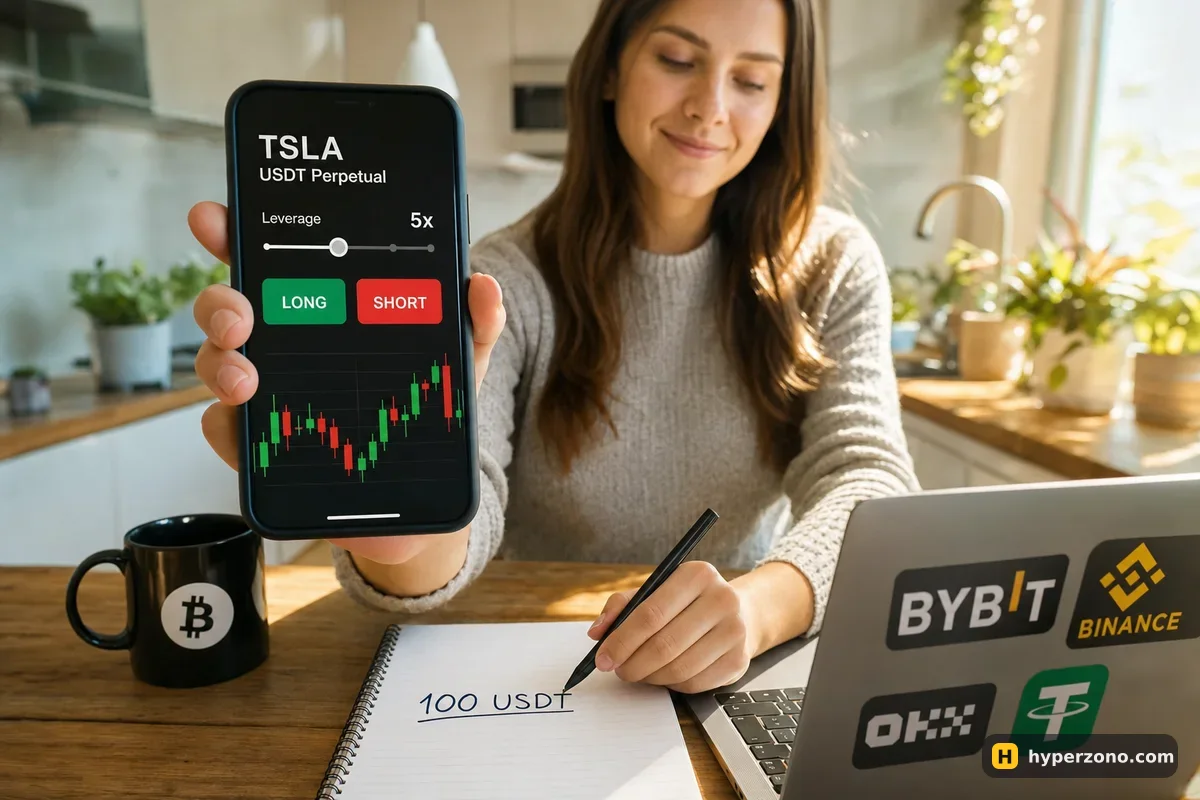
So treat the leverage badge as a limit, not an invitation. At 5x you put up 100 USDT of your own money as margin, and the trade moves as if you were holding 500 USDT of Tesla: a 10% fall costs you 50 USDT — half your margin. Another 10% in the same direction and the exchange closes the trade for you, because the margin is gone. That closing is called liquidation, and in practice it lands slightly earlier than the full 20%, since the exchange keeps a small maintenance amount and fees come out too.
At 50x the same picture shrinks to almost nothing: 1% against you eats half the margin and 2% takes the lot. That is the real difference between the two settings — not the profit, but how much room the price has to breathe before your trade ends. Our guide to choosing leverage for a first trade walks through picking the number instead of dragging the slider.
Results days deserve their own rule. Companies often publish results outside the main trading session, and the perpetual keeps trading through the reaction with no pause. Check the results date yourself before you plan to hold over it, and if you do hold, cut the size first rather than leaning on a stop — a stop is an instruction to close at market once a level is hit, not a promise about the price you get.
Opening your first small Tesla position, step by step
Open the wallet and back it up
Binance Wallet lives inside the Binance app and has no seed phrase — it is a keyless wallet. You have to complete a backup (biometrics, cloud with a recovery password, or a QR code) before the Perpetuals tab will let you trade.
Fund it
Move funds into the wallet. You do not need much to see the whole mechanism work end to end — the order window shows the smallest size allowed on the pair.
Find the Tesla pair
Open the Perps list, use the Stock group tab or type TSLA in the search field, and check which pair comes up and what it settles in. Each pair shows its maximum leverage badge; glance at the 24-hour volume before you pick, since one company can have two pairs with very different activity.
Set leverage and margin mode
Choose isolated margin so only the money you assign to this trade is at risk, and keep leverage low — 2x to 5x while you are learning.
Size the trade and add a stop
Enter the position size you worked out, not the one the percentage slider suggests, and attach a stop loss in the same order window. Then confirm.
The full walkthrough of each field is in how to open a trade in Binance Wallet, and you can open Binance Wallet and look at the Tesla screen before you fund anything.
If you would rather trade from your own on-chain wallet with no exchange account, you can connect to Hyperliquid and look for xyz:TSLA — same company, USDC collateral, hourly funding, a 20x cap.
Two boundaries so you know what you are holding. You own no shares and you get no vote at the company: what you hold is a contract that follows Tesla's price, and your profit or loss comes out in USDT or USDC. How that differs from a tokenized share is explained in tokenized stock vs futures, and for the wider picture start with trading Tesla, Apple or Nvidia.
One practical check before you plan anything. The Perpetuals tab is executed through Binance's partner Aster, and Aster's terms exclude people in a number of countries — among them the USA, Canada, the UK, Russia, Ukraine, China, Cuba, Iran, Venezuela, North Korea and Syria. Check in the app that the venue and the pair are available where you live.
Can I really trade Tesla 24/7 on a crypto exchange?
Yes. The perpetual runs around the clock, weekends included, while the shares themselves trade only during the main New York session, 9:30 to 16:00 local time. Weekend volume is lower than on a weekday, so expect a slightly wider gap between the buy and the sell price.
Is a TSLA perp the same as owning Tesla stock?
No. You hold a contract whose result follows the price; you are not a shareholder and you have no voting rights. The money result is settled in USDT or USDC, and going short is as easy as going long.
How do I compare Hyperliquid's hourly funding with an 8-hour rate?
Put both on the same clock. Multiply the hourly rate by 8 and you can read it straight against an 8-hour rate; multiply the hourly one by 24 and the 8-hour one by 3 if you want the cost for a full day. On a 500 USDT position, 0.01% an hour works out at 1.2 USDT a day, while 0.01% every eight hours is 0.15 USDT a day.
Which venue is cheapest for a Tesla perpetual?
It depends on the day, because funding changes at every settlement and each venue has its own schedule and fee tiers. Compare today's funding rate and today's 24-hour volume on each pair's screen; on a position of a few hundred USDT the fill you get usually matters more than a fraction of a cent in funding.
What is the smallest Tesla position I can open?
The order window shows the smallest size allowed on the pair you picked, and it is small enough to practise with. Open the pair, type a tiny amount and the app will tell you straight away if it is below the limit.
What happens to my position on a results night?
Nothing is paused — the contract keeps trading while the stock market is closed, and the reaction to the numbers arrives straight into the price. Check the date in advance, decide whether you want to hold through it, and cut your size if you do.