Contents
Where an Apple perpetual tradesWhat it costs to hold an Apple position, in moneyHow much leverage, and what the weekend changesOpening a first small Apple position, step by step
Where an Apple perpetual trades
Start with the Perpetuals tab inside Binance Wallet. It carries more than a hundred company pairs, so open the Stock group or type AAPL into the search field and see whether an Apple pair is listed today — and whether it settles in USDT or in USD1, because both currencies exist and stock pairs in USD1 top out at 20x. You stay in your own wallet the whole time; execution and the order book come from Binance's partner, the Aster protocol, which is why the screen says "Provided by Aster". A verified Binance account and a wallet backup are needed before the tab opens for you.
Hyperliquid is the other route. There the stock markets are deployed by a separate team, trade.xyz, your collateral is USDC and funding is paid every hour; how Hyperliquid works explains the wallet-based setup, and the live Hyperliquid market table shows which company tickers are live and what leverage each allows. Binance's own USDⓈ-M futures also carry a long list of stock perpetuals, so search there too before you decide where to trade.
Check the pair before you plan the size, not after. The table below is filled from the venues themselves and refreshes through the day: look at whether an Apple pair appears at all, which currency it settles in, the maximum leverage and the 24-hour volume of each listing. For a 500 USDT order any of these markets is comfortable; the volume column matters when a company has both a USDT and a USD1 pair, because the busier one will fill a market order closer to the price you saw.
| Where | Contract | Price | Leverage up to | 24h volume | Open interest |
|---|---|---|---|---|---|
| Binance Wallet Perpetuals tab, Aster order book | AAPLUSDT | $346.86 | 20x | $422K | $423K |
| Hyperliquid (trade.xyz) HIP-3 market by trade.xyz | xyz:AAPL | $346.54 | 20x | $19.7M | $83.9M |
| Binance Futures for comparison | AAPLUSDT | $346.75 | — | $52.3M | — |
Prices differ a little between venues: each has its own order book and price source. Liquidation and profit are counted on each venue’s mark price.
Updated 24 Oct 2026, 12:12 UTC from Binance Wallet Perpetuals tab (Aster order book), Hyperliquid API, Binance Futures API.
A quick note on what you are actually buying: the price follows Apple, but nothing is registered in your name. You are not a shareholder, so no dividend lands in your account. How each contract handles a dividend date differs from venue to venue — on Binance's own stock perpetuals there is an adjustment to the contract; for the pair you actually pick, read its contract details in the app. If you want the difference between this and holding a tokenized share, it is covered in tokenized stock vs futures.
What it costs to hold an Apple position, in money
Three things take money from an open trade: the fee when you open, the fee when you close, and funding while you hold. On stock and commodity pairs in the wallet tab the taker fee is 0.0125%, so on a 500 USDT position that is about 6 cents to get in and 6 cents to get out — around 0.13 USDT for the whole trip. The maker fee, the one you pay when your limit order waits in the book instead of filling instantly, is shown on the order screen; check it there.
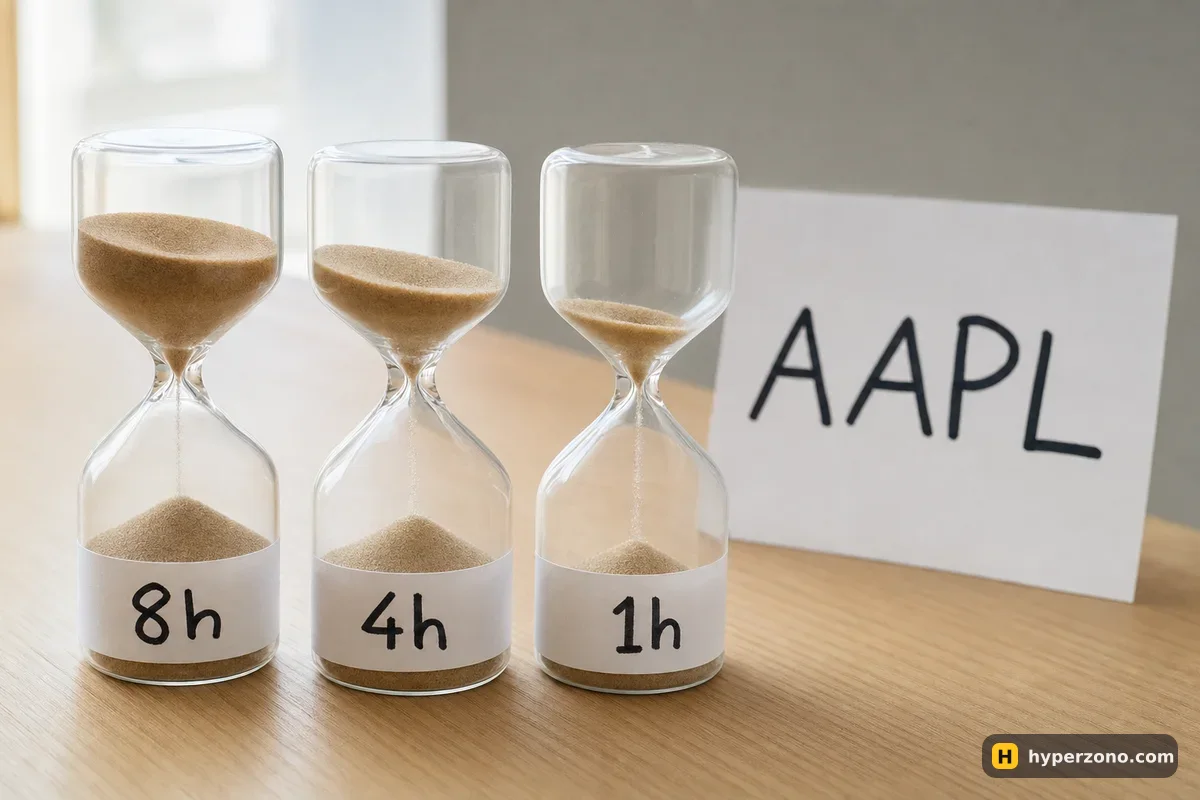
Funding is the payment that passes between longs and shorts to keep the perpetual near the share price; the venue does not keep it, and you only pay or receive if you hold the position at the moment it settles. On a 500 USDT position a rate of 0.01% per payment is 5 cents; three payments a day add up to about 4.5 USDT in a month. The current rate and the countdown to the next payment sit on the order screen of the pair itself — in the wallet tab the schedule is set per contract and can be every 8, 4 or 1 hour, while on Hyperliquid it is hourly.
The next table shows those rates live, side by side. Read the sign first: a positive rate means longs pay shorts, so a long position is paying rent while it waits; negative means the opposite. Then multiply by your position, not your margin — on 500 USDT, 0.01% is 5 cents per payment, and a rate ten times higher is 50 cents a time, which is real money over a week.
| Where | Contract | Paid | Rate now | A long over 30 days, per 1,000 USDT | Over 90 days |
|---|---|---|---|---|---|
| Binance Wallet | AAPLUSDT | every 8 h | 0.0000% | about zero | receives 0.35 USDT |
| Hyperliquid (trade.xyz) | xyz:AAPL | every hour | +0.0006% | pays 2.32 USDT | pays 4.27 USDT |
| Binance Futures | AAPLUSDT | every 8 h | 0.0000% | receives 0.06 USDT | pays 3.67 USDT |
Plus means longs pay shorts, minus means longs receive. The period total is what a 1,000 USDT long would have paid holding the whole time (price changes aside); a short receives the same amount with the opposite sign.
Updated 24 Oct 2026, 00:57 UTC from Binance Wallet Perpetuals tab (Aster order book), Hyperliquid API, Binance Futures API.
Treat whatever you see today as today's number: funding flips sign when the balance of longs and shorts changes. An hourly schedule is not more expensive by itself. You simply pay or receive smaller amounts more often — the same 0.01% a day costs the same whether it arrives in one payment or in several. If the mechanics are new to you, how funding works explains it with a simple example. At 500 USDT these costs stay in cents. What actually decides whether you make or lose money is where Apple goes.
How much leverage, and what the weekend changes
The leverage badge next to the pair name is a ceiling, not a suggestion, and the minimum order size is on the order screen — check both before you plan a size, because they differ from pair to pair. At 5x, a 500 USDT position needs 100 USDT of margin, and if Apple moves around 20% against you the exchange closes the trade on its own, so in normal conditions you lose the 100 USDT of margin and not more. In a sharp jump the close can land worse than that level, which is one more reason not to size the trade so that losing the margin hurts. That automatic close is called liquidation, and it usually arrives slightly earlier than the round number because fees and the venue's minimum margin eat into the cushion. If the badge allows 20x and you use it, the same 500 USDT position holds only 25 USDT of margin and a 5% move is already enough to finish it — what leverage to pick for a first trade walks through the trade-off.
The second thing to respect is the clock. Apple shares trade on Nasdaq from 9:30 to 16:00 New York time, while the perpetual keeps running 24/7, weekends included. Company results are often published outside the main session, so the first big reaction can happen while the share market is shut and only the perpetual is trading — check the company's own calendar for the date and time. A smaller position and a stop-loss placed before the release handle those hours far better than watching the screen. Why these contracts trade at night and at weekends covers the mechanism.
Set the stop before you need it. On a results night the price can travel several percent in minutes. A stop-loss attached when you open the trade keeps the loss near the size you chose; a stop you plan to place "if it starts moving" usually arrives after the move.
Opening a first small Apple position, step by step
Open the Perpetuals tab
In the Binance app, go to Binance Wallet and switch to Perpetuals. You need a verified Binance account and a wallet backup — without a backup the perpetuals section stays closed. Open Binance Wallet and check the tab is there before you fund anything.
Look for the Apple pair
Use the Stock group in the perps list or search for AAPL. If it is listed, note which currency it settles in — USDT or USD1 — and read the maximum leverage badge next to the name. If it is not there, check the Hyperliquid market table instead of picking a different ticker that merely looks similar.
Choose isolated margin and modest leverage
Isolated keeps the risk inside the margin you assign to this trade. At 5x, a position size of 500 USDT holds about 100 USDT as margin. Check the minimum order size on the same screen if you want to start smaller.
Add a stop-loss and a take-profit
Decide both levels before you confirm. The step-by-step screens are in how to open a trade in Binance Wallet.
Check the cost line after a day
Look at the funding payments and the fees already realised on the position. On a 500 USDT Apple trade they should be small — if they are not, funding has turned expensive and the position deserves a review.
If you would rather trade from a self-custodial wallet with no exchange account at all, Hyperliquid is the other route: you connect your wallet and deposit USDC instead of registering. You can open Hyperliquid and look at the markets list before moving any money.
Country rules differ by route. The perpetuals in the wallet run on Aster, whose terms exclude residents of Russia, Ukraine, the USA, Canada, the UK, China, North Korea, Cuba, Iran, Venezuela and Syria; Hyperliquid blocks some places too and shows a message if you are in one. The only reliable check is to open the app and see if the screen works for you.
The same company has a USDT pair and a USD1 pair — which one do I take?
Take the one with the larger 24-hour volume, because that is where a market order fills closest to the price on screen. The two are separate markets with their own funding rates and their own leverage ceilings, so compare both numbers before you choose. Whichever you pick, your profit and loss are counted in that pair's settlement currency, and you need a balance in it to open the trade.
What happens to my position on a US market holiday?
Nasdaq closes on holidays and for shortened sessions, and the perpetual does not automatically close with it. Some contracts keep trading on their own price source while the share market sleeps, others handle the pause differently, so read the contract details for the pair you opened. Thin hours plus no live share price is a poor time to hold a large position — this is exactly the kind of stretch to shrink size for.
Will my stop-loss still work while I am asleep at 3am?
Yes. The stop sits on the venue's side, not inside your phone, so it watches the price even if your battery dies or your internet drops. What it does not do is promise your exact price: the stop is a trigger, and in a fast jump the actual fill can be worse. Does a stop guarantee your loss goes through what can change between trigger and fill.
What is the wallet backup the app keeps asking for?
Binance Wallet is keyless, so there is no 12-word phrase to write down. You back it up with a quick biometric option, with iCloud or Google Drive plus a recovery password, or with a QR code. Keep the recovery password somewhere you will still have it in a year: if you lose both it and your device, Binance cannot bring the wallet back — and without a backup the Perpetuals tab does not open at all.
Is an AAPL perp the same as owning Apple stock?
No. You are trading a contract whose price follows Apple and settles in USDT, USD1 or USDC depending on the venue. Nothing is registered in your name and you cannot vote at a shareholder meeting. What you get is the price move, in cash, up or down.
What if Apple is not in the list at all?
Then it is simply not listed on that venue right now — the sets of company pairs differ and they change over time. Check the Stock group in the wallet perps list, the Hyperliquid market table and the stock perpetuals on Binance's own USDⓈ-M futures. Do not substitute a ticker that only looks similar; open the contract details and confirm which company it tracks.