Contents
Can you buy Polymarket shares before the IPO?Where the Polymarket contract trades todayWhat a 500-dollar position actually meansWhat it costs to hold the positionOpening a first small position, step by stepWhat happens if Polymarket goes public
Can you buy Polymarket shares before the IPO?
No, not in the ordinary sense. Polymarket is a private company, so its shares change hands in private funding rounds and in occasional deals between existing holders. Those deals are for funds and large investors, and nobody is offering you a small slice of them. There is also no confirmed IPO date anyone can point you to, so a website offering you "Polymarket pre-IPO shares" for a small deposit is selling you something else.
What exists for a normal person is a different thing with a similar name: a perpetual futures contract whose price reflects what traders think the company is worth. You are trading a price, not a share — no ownership, no voting, no claim on the company. If you want to see how one of these contracts behaved over a full cycle, the pre-IPO perpetuals guide follows one contract from launch to a real Nasdaq listing.
Where the Polymarket contract trades today
The route we can describe in detail is the Perpetuals tab inside Binance Wallet, where Polymarket sits among the pre-launch pairs — contracts on companies before they go public. Leverage on pre-launch pairs runs from 5x to 20x, and the cap, the exact ticker and the smallest order size for this particular pair are shown on its own screen in the app; the same numbers are in the live table of wallet pairs. Execution and the order book come from Binance's partner, the Aster protocol — the screen says so — and trading runs around the clock, weekends included, because there is no stock exchange session behind it.
The table below is filled from the venues' own data and refreshed every hour, so it shows where a contract on this company is listed right now, with the leverage cap and the 24-hour volume for each place. For a 500 position the volume column is the one to read first: a venue turning over tens of millions a day will usually let you in and out near the price you see, while a quiet row means your order can move the price against you. Then check that the venue actually opens for you where you live.
| Where | Contract | Price | Leverage up to | 24h volume | Open interest |
|---|---|---|---|---|---|
| Binance Wallet Perpetuals tab, Aster order book | POLYMARKETUSD1 | $21.40 | 5x | $16K | $379K |
At this price the market values the company at roughly $21.4B: price × 1 billion shares (the count in the Aster contract terms). This is arithmetic, not an official valuation; the share count at the IPO may differ. Prices differ a little between venues: each has its own order book and price source. Liquidation and profit are counted on each venue’s mark price.
Updated 24 Oct 2026, 12:12 UTC from Binance Wallet Perpetuals tab (Aster order book), contract terms: Aster.
One thing to settle before any arithmetic: pairs in the wallet tab settle either in USDT or in USD1, a dollar-pegged token, and the pair screen tells you which one you need. Treat 1 of either as 1 dollar — every figure on this page is in dollars, so the maths works the same whichever unit your pair uses.
On the pair screen, glance at the 24-hour volume before you do anything else; if a company has both a USDT and a USD1 pair, the one with the bigger volume is usually the easier one to get in and out of. Whatever that number says, a limit order lets you choose your price instead of taking whatever is on offer at that second.
If you want to see what is genuinely sitting on the book right now, the fastest way is to open Binance Wallet, go to the Perps list and search for Polymarket. The price, the leverage badge, the minimum order and the order book are all there before you deposit anything.
The contract price is the market's own number. Do not multiply it by a share count to work out what Polymarket is "worth". There is no official share price before an IPO, so the figure on screen is simply the level at which buyers and sellers of this contract currently agree to trade. Treat it as the price of the contract, nothing more.
What a 500-dollar position actually means
Say you put 100 of your own money in as margin and set the slider to 5x. That gives you a position of 500 — five times your margin. Your profit and loss are counted on the 500, not on the 100: if the contract price rises 10% you are up 50, half your margin back as profit; if it falls 10% you are down 50 and half the margin is gone. A fall of roughly 20% wipes out the margin, and in practice the exchange closes the trade a bit earlier than that, because it also takes its fees and always keeps a small part of your margin aside. The app shows your liquidation price — check it before you confirm.
Both sides of that move are the same size — that is why even 5x on a young contract is already quite a lot. If you are unsure what number to put on the slider, the page on what leverage a beginner should use walks through picking it from your stop distance instead of from how confident you feel. You can also start far smaller than 500 — check the minimum order on the pair screen and build the position from your margin, not from the leverage.
What it costs to hold the position
Two costs matter. The first is the trading fee, charged on the size of the trade each time you enter and each time you exit, not on your margin. If your limit order waits in the book until someone trades against it, the fee is 0% on the crypto pairs; for stock-type pairs check the fee line in the order window. Taking a price that is already there costs 0.04% on crypto pairs and 0.0125% on stock and commodity ones — the app shows which rate applies to this pair. On a 500 trade, 0.04% is 20 cents going in and 20 cents going out.
The second is funding, a payment between the two sides of the market: when the rate is positive longs pay shorts, when it is negative shorts pay longs, and the exchange keeps none of it. It is charged every 8, 4 or 1 hours depending on the contract, and only if you are holding the position at the moment the payment is settled.
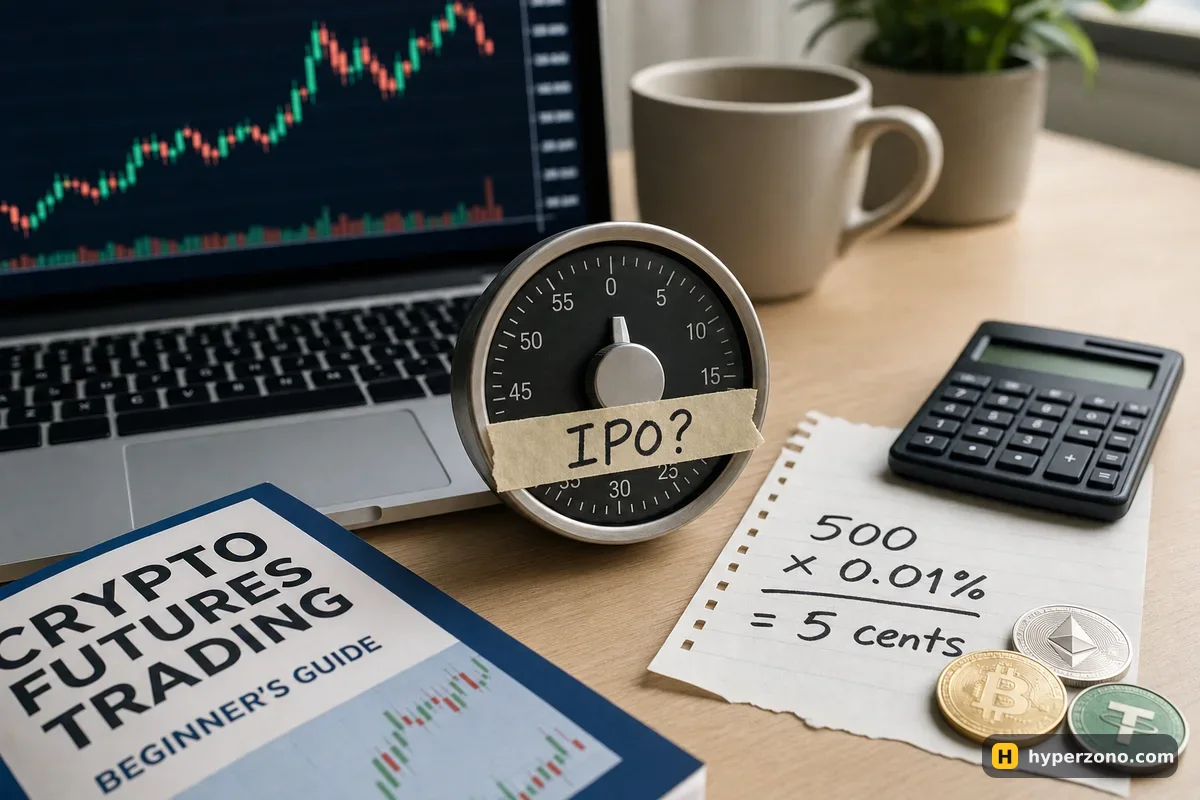
The funding table below refreshes every hour from the venues themselves. Look at the sign first — a plus means a long position pays and a short position receives — then at the interval, because a rate charged every hour adds up to far more over a day than the same number charged every eight. To turn it into money, multiply the rate by your own position: 0.01% on a 500 position is 5 cents, so three payments a day come to about 15 cents, while the same rate every hour would be closer to 1.20 a day.
| Where | Contract | Paid | Rate now | A long over 30 days, per 1,000 USDT | Over 90 days |
|---|---|---|---|---|---|
| Binance Wallet | POLYMARKETUSD1 | every 8 h | +0.0050% | pays 4.50 USDT | pays 5.05 USDT |
Plus means longs pay shorts, minus means longs receive. The period total is what a 1,000 USDT long would have paid holding the whole time (price changes aside); a short receives the same amount with the opposite sign.
Updated 24 Oct 2026, 00:57 UTC from Binance Wallet Perpetuals tab (Aster order book).
Do that calculation before you decide to hold overnight, not after. If the idea of paying a small amount several times a day is new to you, how funding works lays out the arithmetic step by step.
Opening a first small position, step by step
Get the wallet ready
Binance Wallet lives inside the Binance app and needs a backup before perpetuals will work. The full setup, including funding it and swapping into the settlement token the pair uses, is on the how to trade in Binance Wallet page.
Find the pair
Open the Perps list, tap the Pre-launch group or search for Polymarket. Note the exact ticker, the leverage badge and the minimum order shown on that screen — those are the numbers your trade has to fit.
Check the book, not just the price
Look at the 24-hour volume and at how many orders sit near the current price. If the gap between the best buy and the best sell looks wide, a limit order lets you name your price instead of accepting the next one available.
Size it before you size up
Decide your margin first, then let the leverage decide the position. Start with an amount you would not mind losing while you learn the buttons — even 20 is enough to feel a real move.
Set the exit when you set the entry
Add a stop-loss and a take-profit in the same order window. Prices here move on news and rumours at any hour, including the weekend, and you will not be watching the screen.
What happens if Polymarket goes public
Nobody can promise you the date, but there is one public precedent for how a contract like this gets handled. Binance's pre-IPO perpetual on SpaceX kept trading through the company's Nasdaq listing without a break: the contract was moved to a standard TradFi perpetual and went on reflecting live market prices instead of expectations. Binance also said that if an IPO is postponed or cancelled it gives advance notice of a delisting and settles contracts through a transparent process.
Two honest caveats. That example was on Binance Futures, not the Perpetuals tab in the wallet, so treat it as a precedent rather than a guarantee for the Polymarket pair — the announcements in the app are what count. And the day a company lists is a day of sharp moves in both directions, which is exactly when a leveraged position with no stop is at its most uncomfortable.
One practical point before you start: Aster's terms exclude residents of, and people located in, Russia, Ukraine, the USA, Canada, the United Kingdom, China, North Korea, Cuba, Iran, Venezuela and Syria, and availability can differ by country, so check in the app that the tab and this pair open for you. If Polymarket is not the only name you are curious about, there are pages on OpenAI and Anthropic built the same way.
Can I buy Polymarket pre-IPO shares as a small investor?
Realistically, no. Shares in a private company are sold in private rounds and in deals between existing holders, aimed at funds and large investors, and there is no public offering open to you. If a website offers you "Polymarket pre-IPO shares" for a small deposit, be very careful about what you are actually being sold.
Is there a Polymarket pre-IPO price?
There is a contract price, which is not the same thing. The pair in the Binance Wallet Perpetuals tab trades at whatever buyers and sellers agree on, and that number reflects expectations rather than any official valuation. Check the live price in the app, and don't turn it into a company valuation.
How much money do I need to try it?
That depends on the minimum order shown on the pair's own screen, which you can read before depositing anything. Pick a margin amount you would not mind losing while you learn the buttons — even 20 is enough to feel a real move — and let the leverage decide the position size.
What leverage can I use on this contract?
Pre-launch pairs in the wallet run from 5x to 20x, and each pair has its own cap shown as a badge next to it in the Perps list and in the live markets table. Whatever the cap is, you do not have to use it — a lower number gives your trade more room before the margin runs out.
How often do I pay funding on this contract?
Depending on the contract it settles every 8, 4 or 1 hours, and the interval and current rate are both on the pair's screen in the app and in the funding table above. If the rate is positive and you are long, you pay; if it is negative, you receive. You only pay or receive if the position is open at the moment of settlement.
Does the Polymarket contract trade at weekends?
Yes. There is no stock exchange session behind it, so the pair runs around the clock, weekends included — though volume is usually lower outside busy hours, which is another reason to use a limit order.
What happens to my position if the IPO is cancelled?
Binance has said that for pre-IPO perpetuals it gives advance notice of any delisting and settles contracts through a transparent process. That statement was made about its SpaceX contract, so watch the announcements in the app for this pair rather than assuming the same wording applies automatically.
Sources and fact-check
Exchange terms were checked against official documents on October 24, 2026. Terms change — before you trade, check what matters to you in the exchange app and in your contract’s specs.
Binance: Launches Perpetual Futures for Pre-IPO Market Exposure, Starting with SpaceX (21 May 2026)Binance: SpaceX perpetual futures become Binance's No. 2 traded product (13 June 2026)