Contents
Can you buy Oura shares before the IPO?Where the Oura contract trades right nowWhat the "Oura pre-IPO price" actually meansWhat it costs to hold the position, in moneyOpening a small first positionWhat happens to the contract if Oura actually lists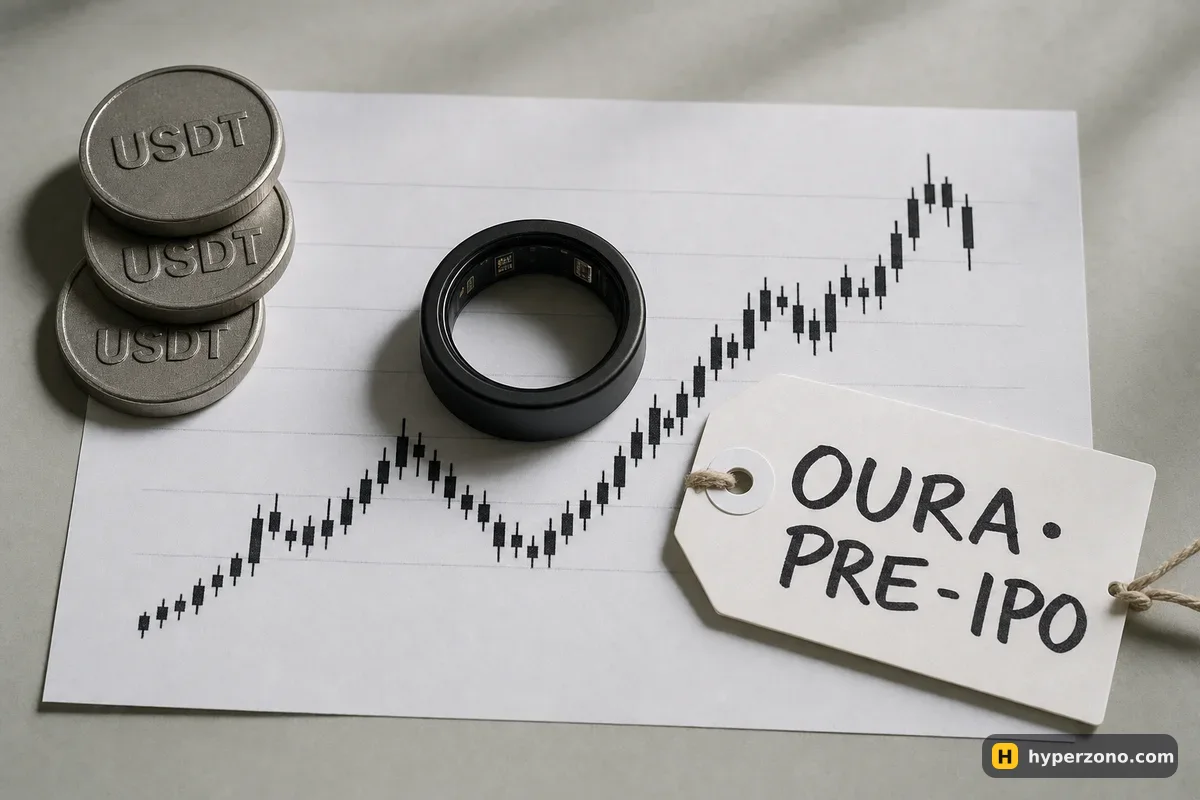
Can you buy Oura shares before the IPO?
No, not in the normal sense. Shares in a private company like Oura, the maker of the Oura smart ring, move between the company, its early investors and funds in private deals — not through an app you can open on your phone with 50 dollars. That is the part most people get stuck on, and it is why searches for the "Oura pre-IPO price" lead to contracts rather than to a broker.
A pre-IPO perpetual works differently. You put up stablecoins as margin, you make or lose money on the price difference, and you never hold a share. When Binance launched its first pre-IPO perpetual on SpaceX it said this plainly: these contracts do not represent ownership of the underlying share, they are not affiliated with or endorsed by the company, and there is no guarantee the IPO will go ahead. You are trading a price, not a stake in the business. The general mechanics are covered in the guide to pre-IPO perpetuals in Binance Wallet.
Where the Oura contract trades right now
Oura trades in the Perpetuals tab inside Binance Wallet, which you reach from the Binance app or at web3.binance.com. If you see the name somewhere else, check that the pair really exists in that app yourself before you plan a trade around it. Execution and the order book come from Binance's partner, the Aster protocol, and the screen tells you so.
The table below is filled from live venue data, so it shows where a pair on this name is listed right now and what each listing looks like. Read three columns: the 24-hour volume, the maximum leverage and the settlement unit. If the same company appears twice — once in USDT and once in USD1 — a 500 USDT trade is easier to get in and out of on the line with the larger volume, and the leverage number there is a ceiling the venue allows, not a suggestion.
| Where | Contract | Price | Leverage up to | 24h volume | Open interest |
|---|---|---|---|---|---|
| Binance Wallet Perpetuals tab, Aster order book | OURAUSD1 | $48.84 | 20x | $1.2M | $1.8M |
| Hyperliquid (trade.xyz) HIP-3 market by trade.xyz | xyz:OURA | $48.73 | 5x | $4K | $799K |
| Binance Futures for comparison | OURAUSDT | $48.79 | — | $153K | — |
At this price the market values the company at roughly $15.7B: price × 320,945,459 shares (the count in the Binance contract terms). This is arithmetic, not an official valuation; the share count at the IPO may differ. Prices differ a little between venues: each has its own order book and price source. Liquidation and profit are counted on each venue’s mark price.
Updated 24 Oct 2026, 12:12 UTC from Binance Wallet Perpetuals tab (Aster order book), Hyperliquid API, Binance Futures API, contract terms: Binance.
In the app itself, search for OURA or look under the Pre-launch group in the list of pairs. The pair screen is where you check everything before sizing anything: the current price, the 24-hour volume, the funding countdown, the leverage badge and the smallest order the pair accepts. It also shows which stablecoin that pair settles in — some pairs are quoted in USDT, others in USD1, which is simply another dollar stablecoin where one unit is meant to be worth one dollar. Your profit or loss arrives in that unit.
What the "Oura pre-IPO price" actually means
The number you see is the market's own number: what buyers and sellers in that order book agree on right now. It is not a share price published by Oura, and it does not tell you what the whole company is worth. Nobody has audited it, and it can move fast on a single piece of news.
Binance says the price follows whatever public information exists about the IPO — the price range the company announces, and later the final offering price. In between those, the number moves on what traders expect. That is why one headline can shift it a long way, and why two venues can show different prices for the same company at the same moment.
What it costs to hold the position, in money
Say you open a position worth 500 USDT at 5x. About 100 USDT of your own money sits as margin, and 500 USDT of price moves for or against you. A 4% move in the contract is 20 USDT — a fifth of your margin, up or down. Entry and exit each cost a small fee on the full 500, not on your 100 of margin: in the wallet tab the maker fee is 0% and the taker fee is a few hundredths of a percent, so on 500 that is cents either way. The exact figure for this pair is on the order screen.
Then there is funding, a payment that passes between longs and shorts, settled every few hours depending on the contract. How much that costs depends on the rate shown on the pair screen. If the rate is positive and you are long, you pay it at every settlement, and those payments add up the longer you hold; if the rate is negative, a long receives instead. Check the rate and the countdown before you leave a position open overnight — and remember that on a pre-launch contract, where there is no spot market to anchor it, the rate can be much bigger than on bitcoin. The mechanics are explained in what funding is and who pays it.
The live table below shows current funding rates so you can turn a percentage into money before you commit. The arithmetic is just position size × rate: on a 500 USDT position, a rate of 0.01% is 5 cents at that settlement, and a rate of 0.3% is 1.50 USDT — small per payment, real if you hold through a dozen of them. Check whether the rate is quoted per 8 hours or per hour before you compare two lines.
| Where | Contract | Paid | Rate now | A long over 30 days, per 1,000 USDT | Over 90 days |
|---|---|---|---|---|---|
| Binance Wallet | OURAUSD1 | every 8 h | +0.0050% | pays 2.39 USDT | pays 2.54 USDT |
| Hyperliquid (trade.xyz) | xyz:OURA | every hour | -0.0001% | pays 0.50 USDT | pays 0.51 USDT |
| Binance Futures | OURAUSDT | every 8 h | +0.0050% | pays 4.50 USDT | pays 4.65 USDT |
Plus means longs pay shorts, minus means longs receive. The period total is what a 1,000 USDT long would have paid holding the whole time (price changes aside); a short receives the same amount with the opposite sign.
Updated 24 Oct 2026, 00:57 UTC from Binance Wallet Perpetuals tab (Aster order book), Hyperliquid API, Binance Futures API.

The fees are small; the leverage is not. Trading fees on a 500 USDT position are cents. A leveraged price move is not: at 20x a 5% move against you wipes out the margin behind the position. The honest first setting for a contract like this is low leverage and a stop-loss placed at the same time as the entry, not after the price has already moved. If you are unsure what number to pick, read what leverage a beginner should use first.
Opening a small first position
Open the Perpetuals tab in Binance Wallet
It sits inside the Binance app and on web3.binance.com. Your wallet needs a backup before perpetuals work. The full walkthrough is in how to open a trade in Binance Wallet.
Find the Oura pair
Search for OURA or look under the Pre-launch group. Note the exact pair name and which stablecoin it settles in, and look at the badge beside it with the maximum leverage — that is a ceiling, not a recommendation.
Set leverage and size before you tap anything else
Choose a modest leverage, then enter the position size. A 500 USDT position at 5x holds about 100 USDT of margin. You don't have to start at 500. The order screen shows the smallest size the pair accepts — open something near that minimum first, just to see how the buttons behave.
Add a stop-loss and a take-profit with the order
Decide the price at which the idea is wrong and put the stop there. A stop can fill worse than your trigger price in a fast move, so treat it as a limit on the damage, not a guarantee.
Write down what you paid
Entry price, size, margin, fee. In a month you will want to compare your result against the funding you paid, and the only way to do that honestly is to have the numbers.
Because the contract runs around the clock, you can be holding it while the rest of the stock world is asleep — worth understanding before you leave a position open over a weekend, and covered in do stock futures trade at night and on weekends. If you would rather look at the screen before risking anything, you can open Binance Wallet and simply watch the Oura pair for a few days. The full list of what trades there is in the live wallet market table.
What happens to the contract if Oura actually lists
The worry behind most searches like this is that the contract quietly vanishes on IPO day and takes your money with it. The one case we can point to is SpaceX, and it happened on Binance Futures, not in the wallet tab. Binance launched a pre-IPO perpetual there in May 2026; when SpaceX listed on Nasdaq on 12 June 2026 at $135 a share, Binance moved the contract into its standard perpetual framework and trading continued without a break. You can read that whole sequence on the SpaceX page.
Binance said the same thing about that SpaceX contract on Binance Futures: advance notice and settlement under a transparent process if an IPO were postponed. The Oura pair in the wallet is matched by Binance's partner Aster, so the rules that apply to your money are the ones in that pair's own announcement in the app — read it before you hold through an IPO date. Oura is one of several pre-IPO names in the tab, alongside OpenAI and Anthropic.
One last practical point: availability. Aster's terms exclude residents of, and people located in, Russia, Ukraine, the USA, Canada, the United Kingdom, China, North Korea, Cuba, Iran, Venezuela and Syria, and an exchange can restrict a product in other places too. Check in the app whether the Perpetuals tab and this pair are open to you before you plan anything around them.
Can I buy Oura shares before the IPO?
Not as a retail buyer. Private shares move through private deals you are not part of. What you can trade today is a perpetual contract on the Oura price, settled in stablecoins, which gives you no ownership, no vote and no dividends.
What is the Oura pre-IPO price right now?
It changes every minute, so there is no fixed number to print here. The price in the Binance Wallet Perpetuals tab is what buyers and sellers in that order book agree on at this moment — not a share price published by the company, and not a valuation of the business.
How much do I need to try the Oura perpetual?
The smallest order the pair accepts is shown on the order screen in the app, and it is usually small enough to open something tiny just to see how the screen behaves. For a modest but real trade, a 500 USDT position at 5x holds about 100 USDT of margin.
What leverage can I use on the Oura contract?
The maximum is shown as a badge next to the pair in the Perpetuals tab, and pre-launch pairs are usually capped lower than big crypto pairs. Treat that number as a ceiling: at 20x a 5% move against you takes out the margin behind the position, which is why a low setting plus a stop-loss is the sensible start.
Which stablecoin does the Oura contract use?
Pairs in the tab settle either in USDT or in USD1, another dollar stablecoin where one unit is meant to be worth one dollar. The pair screen shows which one applies, and that is the unit your margin, your fees and your profit are counted in.
Will the contract disappear when Oura goes public?
On Binance Futures, the SpaceX pre-IPO contract was moved into the standard perpetual framework after listing and trading carried on — that is the precedent people point to, and Binance said there that it would give advance notice and settle under a transparent process if an IPO were postponed. The wallet pair is matched by Aster, so read that pair's own announcement in the app before holding through an IPO date.
Sources and fact-check
Exchange terms were checked against official documents on October 24, 2026. Terms change — before you trade, check what matters to you in the exchange app and in your contract’s specs.
Binance: Binance Launches Perpetual Futures for Pre-IPO Market Exposure, Starting with SpaceX (21 May 2026)Binance: SpaceX perpetual futures become Binance's No. 2 traded product (13 June 2026)