Contents
What you are actually buyingWhy the first days swing so hardpredict.fun, the Prediction tab and PREDICTUSDT are three different thingsWhat it costs to keep the trade openHow to find PREDICTUSDT and place the orderAnd when the token finally lists?
What you are actually buying
Say you open a PREDICT position in the wallet. No tokens arrive anywhere — you just have a position on the screen, and your money moves with the price. If the price goes up, USDT is added to your balance; if it goes down, USDT comes off. There is no delivery date on which someone hands you coins.
Here is an illustrative example with round numbers. Say you set aside 20 USDT and choose 5x, so your position is worth 100 USDT. Go long at 1.50 and close at 1.65 — that is 10% up, so 10 USDT in your favour. Close at 1.35 instead and 10 USDT comes off your 20; another 10% down and there is nothing left to hold the trade open, so the exchange closes it itself, usually a little before your margin reaches zero.
You are trading the price, and only the price. You can take either side — long if you think the token will be worth more later, short if you think it will be worth less. The token itself never becomes yours, which is why this contract can exist before the token trades anywhere. The pair screen keeps the chart, the leverage setting and the funding rate in one place, so you can see all of it before you tap anything.
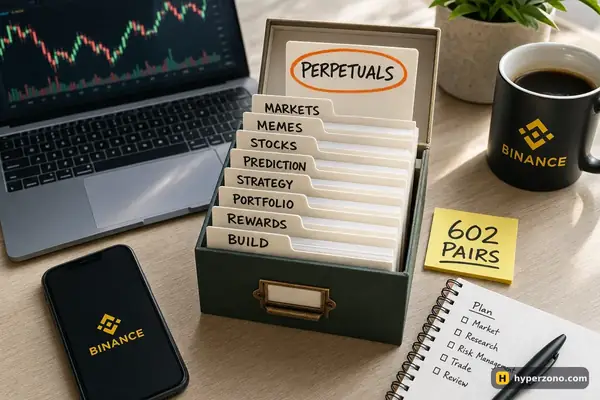
On 21 October 2026 the Perpetuals tab held more than 600 pairs, of which eight were pre-launch: companies before their IPO (OpenAI, Anthropic, Moonshot AI, Oura, Polymarket) and one token before listing, PREDICT from predict.fun. The company side of that list has its own page, trading pre-IPO companies in Binance Wallet, and every pair with its current numbers sits in the live markets table.
Why the first days swing so hard
With an established coin, the perpetual has a spot price to lean on. A pre-launch token has none, so the price is simply what the traders in that one order book agree on right now — expectations, rumours, the size of whoever just clicked buy. A single large order moves it much further than it would move bitcoin.
On its first day, 21 October 2026, PREDICTUSDT traded around 1.54 USDT, up more than 200% in 24 hours, with about $3.6M changing hands and leverage capped at 5x. That cap is the lowest in the pre-launch group together with Polymarket — the OpenAI and Oura contracts allow up to 20x, Anthropic up to 10x.
It is the same price on all three switches, just over different stretches of time: All history shows everything since the pair opened, while 30 days and 7 days zoom you into the recent swings, and the mark on the line is the day trading started. Under the chart there is a line showing what 100 USDT put in at the start of the chosen period would be worth now — move between the switches and watch how far that number travels in both directions, because that is exactly what a brand-new pair does to your money.
Those are the first hours of trading, not today's price — open the pair in the app and you will see different numbers. The 24-hour volume sits right on the pair screen, and it is worth a look before you trade: the busiest pairs in the same tab turn over much more, gold for example at around $330M in 24 hours, and the smaller a pair's volume, the further your own order can push the price and the further from your plan an exit can fill. If a project has both a USDT and a USD1 pair, pick the one with the bigger 24-hour volume. Open the pair, watch it for a day, and notice how far it travels between its high and its low before you decide anything.
predict.fun, the Prediction tab and PREDICTUSDT are three different things
predict.fun calls itself the BNB-native prediction market: people place predictions on future outcomes — election results, Fed decisions, sports matches, even five-minute "BTC up or down" markets. On predict.fun itself you back an outcome — no leverage and no perpetual contract on the page we looked at. The outcome eventually resolves, and that settles it.
PREDICTUSDT is something else entirely: a leveraged price contract on the project's token, sitting in the Perpetuals tab of your wallet. Binance Wallet also has its own separate Prediction menu item, which we describe on the page about Alpha, prediction markets and other wallet features. Your profit on PREDICTUSDT does not depend on whether any prediction comes true — only on where the token's price goes while your position is open.
What it costs to keep the trade open
The price swing is the big number; the costs are small next to it but worth knowing. In the Perpetuals tab the crypto fee for a market order is 0.04% of the position value, so on the 100 USDT position from the example above that is about 0.04 USDT going in and 0.04 USDT coming out. On top of that, holding a perpetual means paying or receiving funding every 8, 4 or 1 hours depending on the contract — on a new pair the rate can be unusually large in either direction, so check it on the pair screen before you leave a position open overnight.
What really ends a trade early is liquidation: the exchange closing your position because the margin behind it has run out. On a fast-moving new pair it can happen at a worse price than the one you see on screen, and there is no way to argue with it afterwards. Keeping the position small enough that a bad close still leaves you calm is the one thing fully in your control.

How to find PREDICTUSDT and place the order
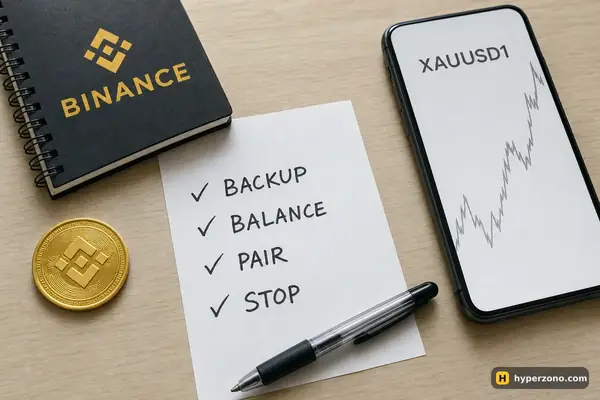
Everything below happens inside the app itself: you open Binance Wallet, go to the Perpetuals tab and work in the order window there. Nothing has to be installed, and no separate account is needed.
Finish the wallet backup first
Binance Wallet is keyless — there is no twelve-word phrase. You back it up with Quick Backup, with iCloud or Google Drive plus a recovery password, or with a QR code. Until the backup is done, the Perpetuals tab stays closed to you.
Open the Perpetuals tab and search
Type PREDICT in the search field. With 600+ pairs in the list, check the full project name (predict.fun) and that the pair is quoted in USDT before you tap anything.
Fund it with an amount you can lose completely
For a first look at a brand-new market, that usually means tens of dollars, not hundreds. The minimum order size differs by pair, so check what the order window accepts.
Set the leverage low, not at the cap
5x is the highest this pair allows, not a recommendation. Pick the smallest setting the window offers and type in the margin yourself instead of dragging the slider to the maximum.
Prefer a limit order where you can
When a pair moves this fast, a market order can fill noticeably away from the price you saw. A limit order lets you name your price and wait. Check which order types your window shows for this pair.
Decide your exit before you walk away
Write down the price where you take the profit and the price where you admit the idea was wrong, and set them as protective orders if the pair supports them. The full walkthrough of the order window is on how to open a trade in Binance Wallet.
A stop is a request, not a promise. On a market this new the price can jump straight past your level with nobody in between, and your order then fills at the next available price — worse than you planned. That is one more reason to keep the position small enough that even a bad fill is survivable.
And when the token finally lists?
What happens to the contract when the token actually lists is set by Binance, and the details live in the pair's own announcement in the app — read that one rather than assuming. There is a useful precedent from the company side: when SpaceX listed on Nasdaq on 12 June 2026, Binance moved its pre-IPO perpetual to a standard contract, trading carried on without a break and nothing was force-closed. A token listing is a different event with its own rules, so the announcement for your pair is the only place that answers this for PREDICT.
Execution in the Perpetuals tab is supplied by Binance's partner Aster — the screen says "Provided by Aster" — and Aster's terms exclude residents of, and people located in, Russia, Ukraine, the USA, Canada, the United Kingdom, China, North Korea, Cuba, Iran, Venezuela and Syria. Availability can also differ for your Binance account, so the honest answer is to check it during sign-up rather than take anyone's word for it.
Do I get PREDICT tokens if I hold the perpetual?
No. A perpetual settles in USDT, so you end up with more or less USDT than you started with and never with the token itself. If you want the coin, you buy it on a spot market once it lists.
Is PREDICTUSDT the same as the Prediction tab in Binance Wallet?
No, they are separate menu items and separate products. The Prediction section is about outcomes of events; PREDICTUSDT is a leveraged contract on the price of the predict.fun token. Winning one has nothing to do with the other.
How much money do I need to try it?
Less than most people think — a position of a few tens of USDT is enough to feel how the market behaves. The exact minimum order differs by pair, so check what the order window accepts before you transfer anything.
Can I short a pre-launch pair?
Yes, you can open a short just as easily as a long. A short is not the safer side, though: with nobody able to sell the token on spot yet, the price can run upward just as easily as it can drop.
Why is leverage capped at 5x here when other pairs allow 20x or more?
Because a brand-new market moves in much bigger steps. A lower cap keeps you and the exchange away from positions that one ordinary swing would liquidate. Treat the cap as a warning sign about the pair, not as a target.
Where can I see all the pre-launch pairs and their current numbers?
In the Perpetuals tab itself, and in our live table of every Binance Wallet pair, which updates with the current price, 24-hour change, volume and leverage cap.
Sources and fact-check
Exchange terms were checked against official documents on October 21, 2026. Terms change — before you trade, check what matters to you in the exchange app and in your contract’s specs.
Binance Wallet: PREDICTUSDT Perpetuals — price chart and trading pagePredict — the BNB-native prediction market (predict.fun)Binance Wallet: Perpetuals tab (live pair data, 21 October 2026)