Contents
Aster funding and Binance Wallet: one and the same paymentAster vs Binance Futures: what holding actually costHow Aster calculates funding and how often it paysWhich venue is cheaper to hold onChecking the rate before you open the positionAster funding and Binance Wallet: one and the same payment
Binance Wallet is a self-custodial wallet inside the Binance app, and it has its own Perpetuals tab where you can trade crypto, stocks, gold, oil and pre-IPO companies. The orders you send there are matched against the buy and sell orders sitting on the Aster protocol — its own list of offers, separate from the one on Binance Futures — and the screen tells you so with the line "Provided by Aster". The funding rate shown next to a pair, and the payment that lands on your balance, is Aster's.
Funding itself works the same way in both places: it is a payment between traders, not a fee the venue keeps. A positive rate means longs pay shorts, a negative rate means shorts pay longs, and you only pay or receive if you are holding the position at the moment the payment is taken — that moment is called settlement. If the mechanism is new to you, how funding works covers it properly; here we stay on the comparison.
Aster vs Binance Futures: what holding actually cost
The table updates every hour, so the numbers you see are today's, not last month's. Read a row like this: it shows what a long position worth 1,000 USDT would have paid in funding if it had been held for the whole period, leaving aside whether the price went up or down. Funding is counted on the size of the trade, so if you put up 500 USDT and set leverage to 5x, your position is worth 2,500 USDT and you multiply the row by 2.5.
| Coin | Paid in Binance Wallet | Binance Wallet: 30 days | Binance Futures: 30 days | Binance Wallet: 12 months | Binance Futures: 12 months |
|---|---|---|---|---|---|
| BTC | every 8 h | 4.23 USDT | 2.91 USDT | 39.15 USDT | 34.23 USDT |
| ETH | every 8 h | 5.11 USDT | 3.17 USDT | 42.52 USDT | 25.28 USDT |
| XRP | every 8 h | 4.48 USDT | 2.48 USDT | 22.46 USDT | 0.48 USDT |
| BNB | every 8 h | 1.26 USDT | 1.59 USDT | 24.72 USDT | 22.66 USDT |
| SOL | every 8 h | 3.21 USDT | 2.63 USDT | 3.02 USDT | −3.89 USDT |
| HYPE | every 4 h | 3.92 USDT | 3.54 USDT | 32.56 USDT | 53.65 USDT |
| DOGE | every 8 h | 4.26 USDT | 4.10 USDT | 47.33 USDT | 30.41 USDT |
| ENA | every 4 h | 8.01 USDT | 6.42 USDT | 58.33 USDT | −3.42 USDT |
Binance Wallet trades perpetuals through the Aster order book, so its funding is Aster funding. Totals are for a 1,000 USDT long; minus means the long received.
Updated 24 Oct 2026, 20:12 UTC from the exchanges’ public APIs.
To make sense of what you are looking at, it helps to know the quiet case. When a perpetual trades close to the ordinary spot price of the coin, the rate settles on the fixed piece built into the formula: 0.01% every 8 hours, which is 0.03% a day. At that baseline a 1,000 USDT position costs about 9 USDT of funding over 30 days — about 22.5 USDT on a 2,500 USDT position. Both venues use the same 0.01% piece, and on bitcoin it is the single most common setting on Binance Futures, so a calm month tends to land near that figure on either side.
Anything much above or below that in the table comes from how one-sided the crowd is on that particular venue. Do not expect the coins to point the same way either: some come out dearer in the wallet, some on Binance Futures, and it is not the same coin from month to month. The two columns in the row for your coin, read right before you open, are worth more than any general verdict.
None of this includes the price move, the entry and exit fees or the spread. It is only the holding cost of the contract. To put your own numbers in, use the funding calculator with the rate you can see on the pair screen at that moment.
How Aster calculates funding and how often it pays
Aster builds the rate from two pieces. The first is how far the contract is trading above or below the ordinary spot price of the coin, taken from an index of other exchanges. The second is the fixed 0.01% per 8 hours described above, set to 0% on BNBUSDT. The two are combined, and the fixed piece is split in proportion when a contract settles more often than every 8 hours.
If that sounds familiar, it is because Binance Futures uses the same shape of formula — the difference in your bill comes from the two separate markets, not from the maths. Aster measures the buying and selling on its own venue, Binance measures its own. If more traders on one venue want to be long, the rate on that venue goes up, and only while that lasts. The other venue has its own crowd, so its number can be lower at the same moment.
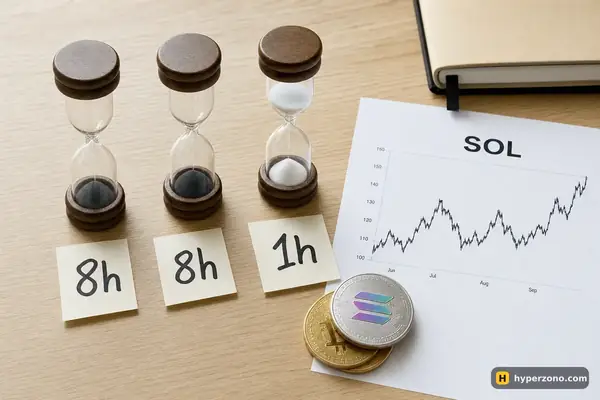
On timing, most pairs settle every 8 hours on both venues, but not all of them: in the wallet tab the interval can be 8, 4 or 1 hour depending on the contract, and on Binance Futures HYPE and ENA settle every 4 hours. A 4-hour or 1-hour rate is not comparable to an 8-hour one at face value, so check the countdown as well as the number — how to compare funding intervals shows the arithmetic.
Funding does not always come out of spare cash. On both venues the payment is taken from your available balance first. If there is not enough there, it comes out of the margin sitting under your position, and that moves your liquidation price closer. Keeping a little free balance, and not stacking leverage on top of a position you plan to hold for days, is the simple protection — see what leverage to pick.
Which venue is cheaper to hold on
The honest answer is that it depends on the coin and on the month, and today's cheaper side is not promised to stay cheaper next month. What you can do is check before you open: look at the current rate and the interval on the pair screen, then look at the 30-day, 90-day and 12-month columns for your coin in the table above rather than at a single payment. If you want one coin in detail across all five venues, the BTC funding page does that, and the twelve-month study explains how these totals are built.
One more thing worth holding in your head: funding only bites if you hold through settlements. For a trade that lasts an hour or two, the entry and exit costs matter more — in the wallet tab the maker fee on crypto pairs is 0% and the taker fee 0.04%, so a round trip on a 2,500 USDT position taken at market twice is about 2 USDT. For a position you intend to keep for a week, funding is usually the bigger line.
Checking the rate before you open the position
Open the Perpetuals tab in Binance Wallet
You will need a Binance account with the wallet created and backed up; the tab lists crypto, stock, commodity and pre-IPO pairs. How the Perpetuals tab works walks through the screen.
Find the funding rate and the countdown on the pair screen
Next to the price the exchange uses for your position (it is labelled mark price) you will see the current funding rate and a countdown to the next payment moment. A positive number means longs pay at that moment. If you are wondering why one contract shows several prices at once, here is the short version.
Turn the rate into money
Multiply the rate by your position size, not by your margin. On 2,500 USDT, a 0.01% payment is 0.25 USDT — small on its own, three times a day for a week it adds up.
Decide whether to hold through the payment
If you hold nothing at the settlement moment, you neither pay nor receive. Plan that exit with a few minutes to spare instead of a few seconds: Aster's own documentation notes the charge can land up to about 15 seconds away from the scheduled time, and closing then reopening costs you two taker fees anyway.
If you want to see the Aster rate and the Binance Futures rate on the same coin with your own eyes, the quickest route is to open Binance Wallet, look at the Perpetuals tab for a pair you know, and compare the number there with the one on the Binance Futures screen for the same contract. Check too that the wallet's perpetuals are available where you live — Aster's terms exclude residents of several countries, including Russia, Ukraine, the USA, Canada, the United Kingdom, China, North Korea, Cuba, Iran, Venezuela and Syria.
Is the Aster funding rate the same as the Binance Wallet funding rate?
Yes. The Perpetuals tab in Binance Wallet is matched on the Aster protocol, so the rate quoted there is Aster's rate for that contract. It is not the same as the rate on your Binance Futures account, which is a separate venue with its own buyers and sellers.
Where can I see Aster funding rate history?
The pair screen in Binance Wallet shows the current rate and the countdown to the next payment, and Aster's own documentation describes how the rate is built. The table on this page turns the last 30 days, 90 days and 12 months into money per 1,000 USDT of position, and it refreshes every hour.
How is the Aster funding rate calculated?
From how far the contract trades above or below the ordinary spot price of the coin on other exchanges, plus a fixed piece of 0.01% per 8 hours, with BNBUSDT set to 0%. If the contract settles more often than every 8 hours, that fixed piece is split in proportion — for example 0.005% on a 4-hour interval.
What does funding cost if the market is calm?
When the contract tracks spot closely, the rate tends to sit on the fixed 0.01% per 8 hours, which is 0.03% a day — roughly 9 USDT over 30 days on a 1,000 USDT position, on either venue. Busy, one-sided markets push it well above that, and a negative rate pays longs instead, so check the live table rather than assuming the quiet case.
Does funding apply to the gold, oil and stock pairs in Binance Wallet?
Yes, those are perpetual contracts too, so they have a funding rate, and the interval can be 8, 4 or 1 hour depending on the contract. Check the rate and the countdown on each pair's screen before holding one over a weekend.
Can I avoid funding by closing just before settlement?
If you hold no position at the payment moment you neither pay nor receive, so yes, in principle. Leave yourself a few minutes rather than a few seconds, and remember that closing and reopening costs two taker fees, which can easily be more than the payment you were avoiding.
Does a negative funding rate mean I earn money by going long?
You do receive the payment, but only on the position you are holding, and the price can move against you by much more than the funding is worth. People who trade funding on purpose hold an offsetting spot position — see how that works on the funding-rate page — rather than going long just because the rate is negative.
Sources and fact-check
Exchange terms were checked against official documents on October 24, 2026. Terms change — before you trade, check what matters to you in the exchange app and in your contract’s specs.
Aster Docs: Funding RateBinance: Introduction to Binance Futures Funding Rates