
Contents
Where each of the three prices comes fromMark price is the number your money followsWhy your stop fired at a price you never sawChoosing which price triggers your stopWhy mark price is quietly on your side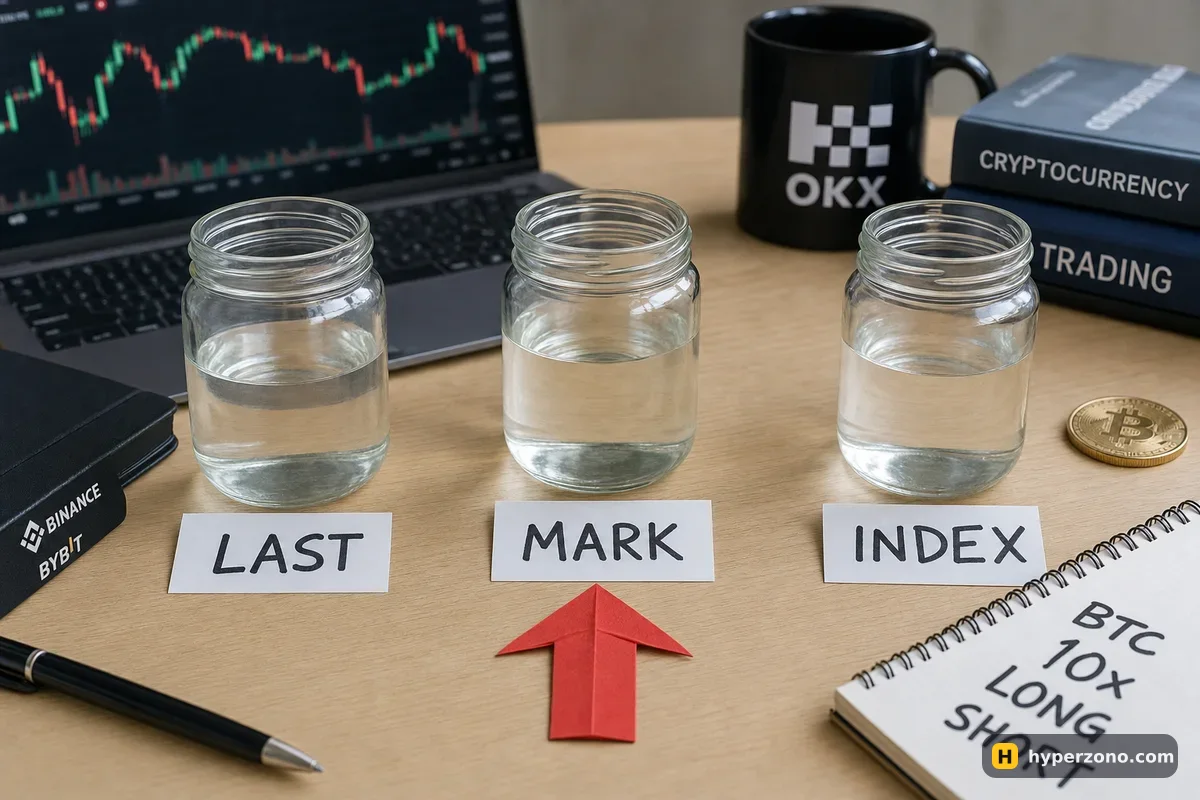
Where each of the three prices comes from
The last price is the simplest one: somebody bought and somebody sold on this exchange a moment ago, and that was the price. It is what the candles on your chart are drawn from. When you tap Buy or Sell with a market order, your order is matched with the people who are already offering to buy or sell at that moment, so you fill close to that number rather than exactly at it — and your own trade becomes the new last price.
The index price looks outside the exchange. It takes the spot price of the coin on several large venues and averages them, so one exchange having a strange minute does not move it much. The mark price then takes that index as its base and adds a small adjustment for what is happening in the futures market itself. Think of the mark price as the exchange's "fair price" for your contract — a calm number that one trader on one exchange cannot push around.
| Price | Where it comes from | What it decides for you |
|---|---|---|
| Last price | The most recent futures trade on this exchange | Your chart, and roughly what you pay when you trade right now |
| Index price | An average spot price across several big exchanges | The base that the mark price is built from |
| Mark price | The index plus a small futures adjustment | The profit or loss shown next to your open trade, and when the exchange closes it for you |
Mark price is the number your money follows
Say you put 100 USDT in and opened a long on 0.01 BTC at 83,000 — made-up numbers, but the mechanics are real. The chart prints 82,900, so you expect to be about 1 USDT down. The mark price at that second is 82,940, and the number next to your position is counted from that, so the screen shows a loss of about 0.60 USDT instead. Small, slightly confusing, and completely normal.
Most of the time those two numbers sit within a few dollars of each other and the difference is pocket change. When the price moves fast, the gap widens for a minute or two — and that is exactly the moment it matters, because that is when stops fire and positions get closed.
The mark price also decides when the exchange steps in and closes your position, before the loss eats up the margin you put behind it. In a fast market that close can land worse than the level you expected, so treat the margin you set aside as the amount you should be ready to lose, not a wall. That is why people search "why was I liquidated at a different price" — the chart touched one level, the mark price never did, or the other way round. How that closing works in detail lives on the page about what liquidation actually is; if you want to know your own number in advance, see how to find your liquidation price.
The money that actually lands in your balance when the trade closes is a different matter. When your position closes — by you, by a stop, or by the exchange — your order is matched with real buyers and sellers around the last-price level, and those fills are what you keep. While the trade is open, the exchange measures it with the mark price. When it closes, what counts is the price your closing order actually filled at. If you want to see all of it added up, including fees, there is a page on working out your real profit.
Why your stop fired at a price you never saw
Here is the classic situation, and it almost always happens on a smaller coin rather than on bitcoin. You are long an altcoin from 2.00 with a stop at 1.90. At three in the morning one big sell order goes through, there are hardly any buyers awake to absorb it, the price prints 1.88 for a few seconds and snaps straight back to 2.01. Your stop is gone and your position is closed.
That happens because your stop was watching the last price, and the last price really did touch 1.88 for a moment. The mark price, pulled toward the average spot price across several exchanges, may never have gone below 1.93 — so a stop watching the mark price would have survived the same spike. On a big contract like bitcoin these gaps are far smaller, because there is always someone on the other side; on thin coins one order is enough to move the screen.
Choosing which price triggers your stop
Most exchanges let you choose. When you set a stop loss or take profit, there is a small setting next to the trigger price where you pick the price source — usually last price or mark price, sometimes index. The default is not the same everywhere, so look at it once instead of assuming.
Open the stop settings for your position
In the order window, or on the open position itself, find where you enter the stop loss and take profit levels.
Find the trigger price source
Near the price field there is a small selector, often written as something like "trigger by: last / mark / index". Tap it and you will see the options.
Pick mark price for overnight trades
If you are holding through the night or trading a smaller coin, the mark price trigger ignores one-exchange spikes. If you are watching the screen and trading exactly what you see on the chart, last price is fine.
A trigger price is not a fill price. Whichever source you choose, the trigger only tells the exchange to send your order. The actual fill can be a little worse in a fast market — that part is covered in does a stop loss guarantee my loss, and the difference between a stop-market and a stop-limit is explained on its own page.
Why mark price is quietly on your side
It can feel unfair that a price you never saw on the chart decides your position. In practice it protects you far more often than it hurts. If liquidations were based on the last trade, that same three-in-the-morning sell order could close thousands of positions at a price that exists nowhere else in the market. The mark price, anchored to spot prices across several exchanges, makes that much harder to do.
The easiest way to make all this concrete is to watch it live: open a Bybit account, look at a BTC perpetual contract and compare the last price on the chart with the mark price shown next to the contract. For long stretches they sit a few dollars apart, then a fast move pulls them further and they come back together. You can also do this in demo mode, with no money at risk, before you place a real stop — see how to set a stop loss once you are ready.
Why was I liquidated at a price the chart never reached?
Because liquidation is calculated on the mark price, not on the last trade you see in the candles. The mark price is tied to spot prices across several exchanges, so it can sit a little above or below the chart, especially during a fast move. The full picture is on the page about liquidation.
Should my stop loss use mark price or last price?
Mark price is the safer default if you leave trades open overnight or trade smaller coins, because one short spike on one exchange will not trigger it. Last price matches exactly what you see on the chart, which some traders prefer for short trades they watch all the way through. Either way, check the setting rather than guessing the default.
How far apart are the last price and the mark price normally?
On a big contract like BTC they usually sit within a few dollars of each other, and the difference barely shows in your profit or loss. The gap widens when the price moves quickly or when the coin is thin and few people are trading it. Open the contract and watch the two numbers for a while — you will see the pattern in minutes.
Why is the futures price different from the spot price at all?
Futures trade on their own supply and demand, so when many traders want to be long, the contract drifts above spot. On perpetual contracts a regular payment between longs and shorts pulls it back — that is funding.
Does mark price change how much money I actually make?
No. It changes the profit or loss you see next to your open trade, but the money that lands in your balance comes from the prices your entry and exit orders actually filled at, minus fees. Counting your real profit uses those fill prices.
Is the mark price the same on every exchange?
No. Each exchange builds its own index from its own list of spot venues and its own formula, so the numbers differ slightly. If the exact details matter to you, open the contract specification for that pair in the exchange app.