Contents
What that number actually measuresHow 8% turns into 100%: one exampleWhy yours is rising: the five usual causesCross or isolated: the same move, a different numberHow to bring it down right nowSet your own limit before the next trade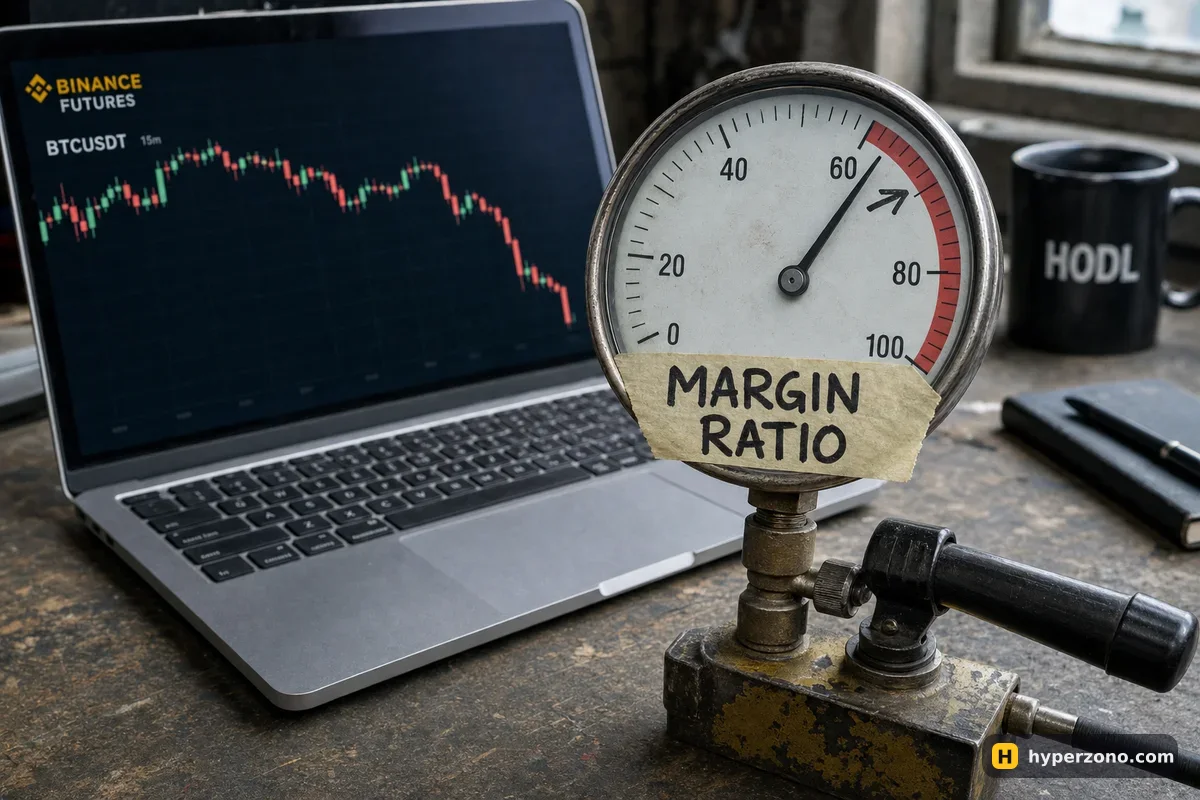
What that number actually measures
Binance defines it simply: margin ratio = maintenance margin ÷ margin balance. Maintenance margin is the minimum amount the exchange insists stays behind the position; margin balance is what you actually have backing it right now. When those two numbers meet, there is nothing left to absorb a further move, and the position is closed.
You don't choose the maintenance margin. Binance works it out from the size of your position — the bigger the position, the bigger the requirement — and it does not care which leverage you picked; your exact figure is in the position details. That is the part that surprises people: a 1,000 USDT position has the same maintenance margin at 10x as at 20x. What leverage changes is how much of your own money you put in at the start, which is the other half of the fraction.
The money side moves with the mark price, not the last traded price. Binance uses the mark price for unrealized profit and loss and for liquidation, which is why your ratio can creep up while the last price on the chart looks unchanged. If that distinction is new to you, the page on index, mark and last price explains where each one comes from.
One more thing before you compare notes with anyone. Go by the Margin Ratio in your own USDⓈ-M position panel, where it sits right next to the position — easiest to see if you open a Binance Futures account and look at the Positions tab. There, 100% means liquidation. If a guide or another screen shows a health number where bigger means safer, it is not this one — check the label before you relax.
How 8% turns into 100%: one example
Say you open a 1,000 USDT position on BTCUSDT in isolated mode and assign 50 USDT of margin to it. Your panel shows a maintenance margin of about 4 USDT — that figure is illustrative here, because the requirement depends on the contract and the size of the position, and yours is shown right there in the position details. The ratio at that moment is 4 ÷ 50, or 8%.
Now the price moves against you. On a 1,000 USDT position, every 1% move is 10 USDT. A 3% move against you takes your margin balance from 50 to 20, and the ratio jumps to 20%. A 4.5% move leaves 5 USDT, which is 80%. A touch further and you are at the level where Binance closes the trade.
| Margin balance | Margin ratio | What you are looking at |
|---|---|---|
| 50 USDT | 8% | Just opened, lots of room |
| 20 USDT | 20% | Price moved 3% against you |
| 5 USDT | 80% | The level Binance says to stay under |
| 4 USDT | 100% | Liquidation |
Notice how fast the last stretch goes. From 20% to 100% you only need to lose another 16 USDT — on a 1,000 USDT position that is a price move of about 1.6%, an ordinary hour on bitcoin. That is the honest reason the number feels like it "keeps going up": the fraction accelerates as the bottom of it gets small. What happens at the end is covered in what liquidation actually is, and how the liquidation price is worked out shows the price side of the same event.
Why yours is rising: the five usual causes
Most of the time it is simply the mark price going the wrong way for your position, and there is nothing broken about it. Before you touch any button, check which of the other four is adding to it, because the fix is different for each.
If you are in cross margin, your other open positions share the same balance. A second trade bleeding money lowers the margin balance behind the trade you are watching, so a position you have not touched can drift toward liquidation because of a different coin. Binance's cross liquidation formula literally includes the maintenance margin and unrealized profit and loss of your other contracts.
Funding payments and trading fees come out of your futures balance too. On bitcoin a single funding payment is usually tiny — the most common rate is 0.01% per 8 hours. On smaller coins one settlement can be far larger: Binance caps a single payment at 0.30% on BTCUSDT and ETHUSDT, but most USDⓈ-M contracts are capped at 2%, and some settle every 4 hours instead of every 8. On a position already sitting near 80%, a couple of those payments matter. If you saw an unexplained deduction, the funding fee page shows where to find it in your history.
Adding to a position raises the top of the fraction. A bigger position size means a bigger maintenance margin, and past a certain size Binance puts the contract in a tier with a higher requirement, so the minimum grows faster than the position does. Maintenance margin follows position size, not the leverage you selected — which is also why your ratio can rise after you average down, even though the price has stopped falling.
Last one: in cross mode, money you move out of the futures wallet is money that was holding up your ratio. Binance caps how much you can withdraw precisely so you cannot pull the maintenance margin out from under an open trade, but a transfer that is allowed can still push the ratio up a long way.
Cross or isolated: the same move, a different number
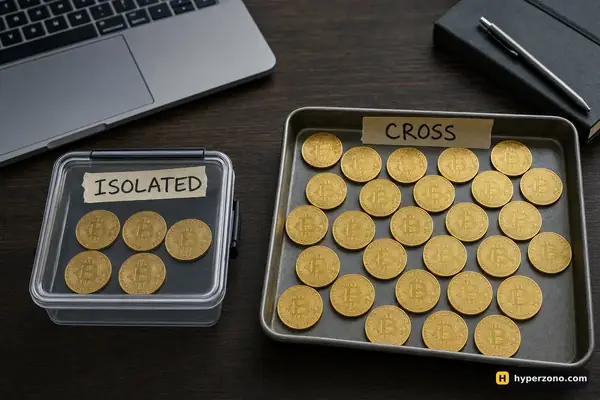
In isolated mode the only money in the calculation is the margin you assigned to that position, so the ratio climbs quickly on a small move — and the amount at stake stops there. In cross mode the whole cross balance of that asset stands behind the position, so the same price move shows a much calmer percentage, while a larger part of your account is quietly involved. A comfortable-looking 25% in cross mode can mean more real money at risk than 70% in isolated. Which one suits you is a separate decision, and cross vs isolated margin walks through it.
How to bring it down right now
Binance's own instruction is short: add more margin or reduce positions before your collateral drops below the maintenance margin. In the app, both start from the Positions tab.
Decide about the trade first, not the number
Ask whether the reason you opened this position is still true. If it is not, the cheapest action is closing, and the ratio problem disappears with it.
Close part of the position
In the Positions tab, choose to close the position and type in only part of the quantity instead of all of it. A smaller position size means a smaller maintenance margin, so the ratio falls immediately — and you take less risk, not more.
Isolated mode: add margin
In the Positions tab, tap the edit icon next to the margin figure, enter the amount to add and confirm. Binance limits the amount to what is genuinely free in your account, so if the field refuses your number, that is why.
Cross mode: move USDT in
There is no per-position edit in cross. Transfer USDT from your Spot wallet into the USDⓈ-M futures wallet; the whole balance is the backing, so the ratio drops as soon as the internal transfer lands.
Cross mode: close your worst other position
Because the balance is shared, closing a different losing cross trade frees up margin for the one you care about. Check the full list before deciding which one to let go.
Two things that do not help. Changing leverage does not change the maintenance margin, and on an open isolated position Binance does not let you reduce leverage at all — more on that in why you can't change leverage mid-trade. And adding margin lowers the percentage without improving the trade: you now have more money exposed to the same idea. If the idea was wrong, you have made the eventual loss bigger, not smaller.
Don't wait to be warned. Binance says it makes reasonable efforts to send margin call and liquidation notifications by email and internal message, but it has no obligation to, does not guarantee they arrive on time, and states plainly that acting is the trader's responsibility. If the two events are close together, the margin call is skipped and only the liquidation notice goes out.
Set your own limit before the next trade
By the time that number reads 80% you are deciding in a hurry, with the worst possible information: the price is already far from your entry and every option costs you something. Pick your own alarm level well below it — around 50 to 60% works for most people — and treat reaching it as a signal to sit down and review the trade while you still have choices.
Better still, decide where you are wrong before you enter, and put that level in as a stop loss so the trade closes long before the ratio becomes interesting. Then size the position so an ordinary daily move cannot drag you near liquidation in the first place. Running the numbers once takes a minute:
If you prefer to work backwards from a price you believe the market will not reach, the liquidation calculator page walks through the inputs with an example. The most useful habit is to check that price before confirming the order, not after the margin ratio starts moving.
Is a high margin ratio the same as high leverage?
No. Leverage decides how much of your own money went in at the start; the margin ratio tells you how much of that money is left relative to the minimum Binance requires. You can sit at 90% margin ratio on a 3x position if the price has moved far enough against you.
Does 100% margin ratio mean I lose my whole balance?
It means the position is liquidated. In isolated mode the loss is limited to the margin assigned to that position; in cross mode the whole cross balance of that asset is backing the trade. Binance also cancels your open orders at liquidation and charges a liquidation clearance fee, and it may first try a partial liquidation — if what is left then covers the maintenance margin, the rest of the position survives.
Why did my margin ratio change when the price looks the same?
Unrealized profit and loss follows the mark price, not the last traded price, and the two can differ for a while. Funding payments and fees also come out of your balance, so the fraction moves even on a quiet chart.
Can I lower the margin ratio by reducing leverage?
Not on an open isolated position — Binance does not allow leverage to be reduced there. And in general, changing leverage does not change the maintenance margin, since that is calculated from position size. Reducing the position does change it.
What margin ratio is safe?
Binance recommends staying below 80%, but that is the edge of the cliff, not a comfortable place. Pick your own ceiling around 50 to 60%, and treat it as a prompt to review the position rather than a number to tolerate.
My ratio rose even though this position is in profit. How?
Almost certainly cross margin: another cross position on the same margin asset is losing and draining the shared balance. Open the positions list and check all of them, not just the one on screen.
Sources and fact-check
Exchange terms were checked against official documents on October 31, 2026. Terms change — before you trade, check what matters to you in the exchange app and in your contract’s specs.
Binance: Binance Futures Liquidation ProtocolsBinance: Leverage and Margin of USDⓈ-M FuturesBinance: How to Adjust Margin Balance in Cross/Isolated Margin Mode?