Contents
What actually happened to your tradeWhy your position and not someone else'sWhere to see it coming: the ADL indicatorWhat you can do about it, and what does not helpAfter an ADL: check your own numbers
What actually happened to your trade
Nothing went wrong on your side. Your margin was fine, your stop was still sitting where you left it, and the price was moving your way. What happened took place on the opposite side of the market, and it reached you through a chain the exchanges write down in their own help pages.
- A trader on the other side runs out of margin and gets liquidated.
- The exchange tries to close that position in the order book. In a violent move there may not be enough buyers or sellers at or better than the bankruptcy price — the price at which the liquidated trader's margin balance is exactly zero.
- The exchange keeps a reserve pot for exactly this — money it puts in itself, plus the leftovers from liquidations that closed better than expected. That pot pays the difference first.
- If the pot cannot take that loss, the exchange closes positions on the opposite side — the profitable and highly leveraged ones — so the books balance. Binance calls ADL the final step of the liquidation process, used only when the futures insurance funds cannot accept a bankrupt position.
Here is what that looks like with illustrative numbers. You are long bitcoin from 60,000 with 500 USDT of margin at 20x, so your position is worth 10,000 USDT. Price shoots up to 66,000 in a few minutes, shorts are liquidated, the book above is thin, and the reserve runs short. Your long, up about 1,000 USDT on paper, is closed by the exchange — on Binance at the bankruptcy price of that liquidated short order, which Binance says may sit outside the contract's market price range.
The profit up to that closing price is yours and stays in your balance. What you lose is everything the price did afterwards — the trade just ends there, and the rest of the move happens without you.
This is not the same thing as your own position being liquidated, where your margin ran out and the exchange closed you to stop the loss growing. ADL picked you precisely because you were on the winning side.
Why your position and not someone else's
Every exchange keeps a running order of who gets closed first, and all three below sort that queue the same way: how much profit your trade is showing, compared with the money behind it. Binance, Bybit and Hyperliquid each publish their own formula, and they all point in the same direction.
That is why a large, very profitable position at high leverage is near the front of the queue and a modest 3x position with a small gain is near the back. A 1,000 USDT gain on a 500 USDT account ranks far higher than the same 1,000 USDT gain on a 10,000 USDT account. Bybit also notes that positions sitting in loss on the opposing side can still be selected, but profitable ones get priority.
| Binance | Bybit | Hyperliquid | |
|---|---|---|---|
| When it kicks in | Only when the insurance fund cannot take on a bankrupt position | When that pair's safety pot loses too much in 8 hours, or drops to zero | When an account's value, or an isolated position's value, goes negative |
| Who is picked first | Biggest profit compared with the money in your account | Biggest percentage gain on the opposite side, profitable positions first | Biggest profit compared with your account value |
| Price your position closes at | The bankruptcy price of the liquidated order, which can sit outside the market range | A bankruptcy price worked out from the same trigger | The previous mark price |
| Fee charged to you | No trading fee | The lower maker fee; the liquidated trader pays the higher one | Not stated in the docs |
Notice the closing price. It is set by the rules, not by the screen you were watching, and it can sit away from the last traded price — which is one reason the result can feel wrong even when the arithmetic is exactly what the exchange described. If the different prices on a futures screen are new to you, mark, index and last price explains which one does what.
Where to see it coming: the ADL indicator
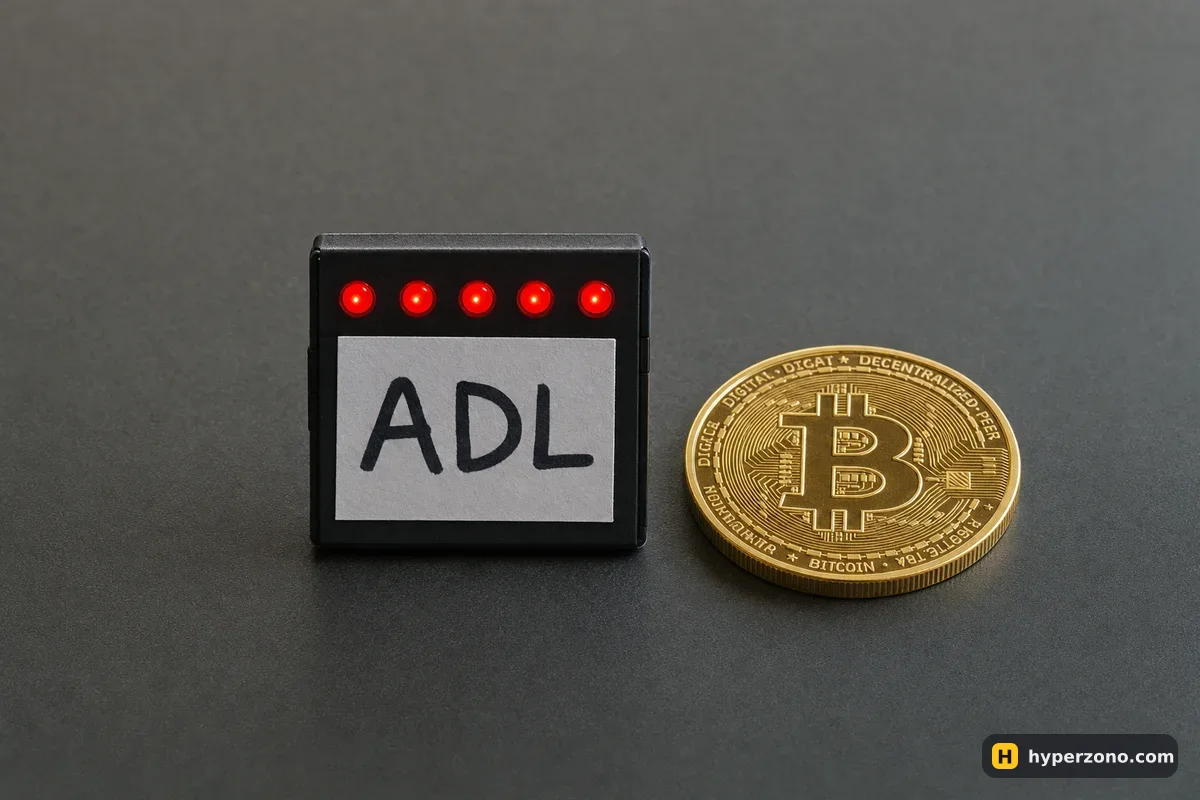
Binance says every futures position's interface includes an indicator of the likelihood of ADL and that it clearly shows when ADL is imminent, and the exchange encourages traders to watch it. Bybit shows the ADL ranking on the Positions tab in both the app and the website; in Bybit's own example the top 20% of the ranking is drawn as five lit lights and the bottom group as one, so five lights means you are first in line. A lot of people first saw this indicator during the crash of 10 October 2025.
The indicator is not a fixed badge. It follows your profit, your leverage and your account value, so it moves while the trade is open — a position that showed one light this morning can show four after a strong run in your favour. Bybit also points out that after a partial ADL you keep the same margin with a smaller position, so you may no longer be top-ranked afterwards.
There is a difference between contract types here. Binance says contracts settled in the coin itself face ADL more often than USD-margined ones, because every coin-settled contract backed by the same coin shares one insurance fund, and those funds are smaller. Bybit splits its funds differently: some pairs share an insurance pool while others have an isolated one depending on project risk, and the numbers are published on the Auto-Deleveraging tab of its Insurance Fund page.
What you can do about it, and what does not help
The useful lever is leverage. Bybit says directly that lowering the leverage of a position lowers its ADL ranking in real time, and Binance's published formula depends on effective leverage too, so a smaller position relative to your account balance sits further back in the queue. If you are not sure what level fits you, what leverage a beginner should use walks through it with examples.
Taking profit in parts helps in a different way. Bybit is specific here: partially closing a highly leveraged profitable position reduces the number of contracts exposed to ADL, but it does not lower the ranking itself. So you shrink what can be taken, not your place in the line. If the indicator is high in a market that is moving violently, closing fully is the only way to be sure the trade ends on your terms rather than the exchange's.
You can move back in the queue, not leave it. Binance says plainly that it is not possible to completely avoid ADL, given crypto volatility and the leverage on offer, and that it strives to minimise it. None of the three exchanges publishes an opt-out. A stop loss does not help either: it is an instruction to close at a price you chose, while ADL closes the position directly.
Something else catches people out afterwards: your open orders are cancelled. Binance says this covers all tokens in cross margin mode and the same token in isolated mode, and that you can immediately open new positions in that token again; Bybit says all active orders are cancelled and you can re-enter at any time. So your take profit and stop loss are gone — if you open a new trade, set them again before you walk away from the screen.
After an ADL: check your own numbers
Read the notification
Binance sends the deleveraged trader a notice immediately, stating the amount and the liquidation price. Bybit notifies by email and/or SMS. Keep it — it is your reference point for everything below.
Find the closing record
Open the order and trade history for that contract at that minute in the app and find the record that closed your position, with its price and quantity. Compare that price with what the exchange's rule says it should be.
Check whether it was partial
ADL does not always take the whole position. Compare the closed quantity with what you were holding; the rest may still be open with your original margin behind it.
Check the fees
Binance states that no trading fee is charged to the trader who is deleveraged. Bybit charges you its lower fee rate — the one for orders that waited in the book, called the maker fee — while the trader whose liquidation set this off pays the higher one. Those lines should match what you see in the history.
Reset your protection before reopening
Your active orders were cancelled. If you go back into the market, place the stop and the target again as part of opening the trade, not afterwards.
Contact support only with specifics
If the record in your history does not match the notification, or you cannot find the closing record at all, write to support with the contract, the exact time and the order ID. ADL is part of the published rules, so expect an explanation of how the price was derived rather than a reversal.
It also helps to separate this from a different worry. Being deleveraged happened on the profitable side, so it is not the scenario people have in mind when they ask whether you can end up owing the exchange. That is a different situation with different mechanics, and it is covered on its own page.
Knowing where you sit in this queue costs you one glance per trade, and it is worth taking before the market gets wild rather than after. If you do not have a futures account yet, you can open one on Binance and check during sign-up whether futures are available where you live.
Did the exchange steal my profit with ADL?
No. The profit your trade had made by the closing price stays in your balance, and ADL itself is described openly on the exchanges' own help pages, including how the queue is sorted and at what price positions are closed. What it did take from you is the rest of the move: the trade ended earlier than you planned, at a price set by the rule rather than by your target.
Can a stop loss or a take profit prevent ADL?
They cannot. A stop loss and a take profit are orders waiting at prices you chose, while ADL closes the position itself and then cancels your pending orders. The only thing under your control is how far forward in the queue you stand, and how much of the position is sitting there.
Can an ADL be reversed or compensated?
The pages that describe ADL do not mention reversals or compensation, and you should not plan on either. What is reasonable is to check that the closing record matches the notification you received, and to ask support about any difference, with the contract, time and order ID in hand.
Which contracts are more exposed to ADL?
Mostly the coin-settled ones — those contracts share a smaller safety pot, so it runs out sooner. On a normal USDT contract it is rarer, but not impossible, especially in a fast move on a small altcoin.
Will I get a warning before it happens?
You get a gauge, not an alarm. Binance shows an indicator of how likely ADL is on the position interface, and Bybit shows your ranking as lights on the Positions tab. Look at it whenever you check the trade: in a quiet market it barely moves, and in a violent one it can climb within minutes.
Sources and fact-check
Exchange terms were checked against official documents on October 20, 2026. Terms change — before you trade, check what matters to you in the exchange app and in your contract’s specs.
Binance: What Is Auto-Deleveraging (ADL) and How Does It Work?Bybit: Auto-Deleveraging (ADL) MechanismHyperliquid Docs: Auto-deleveraging