Contents
What the halving actually cutsIt is a block number, not a date you can tradeYour trade lasts days; the supply change lasts yearsWhat else is pulling the price in the same weekHow to turn this into something you can actually test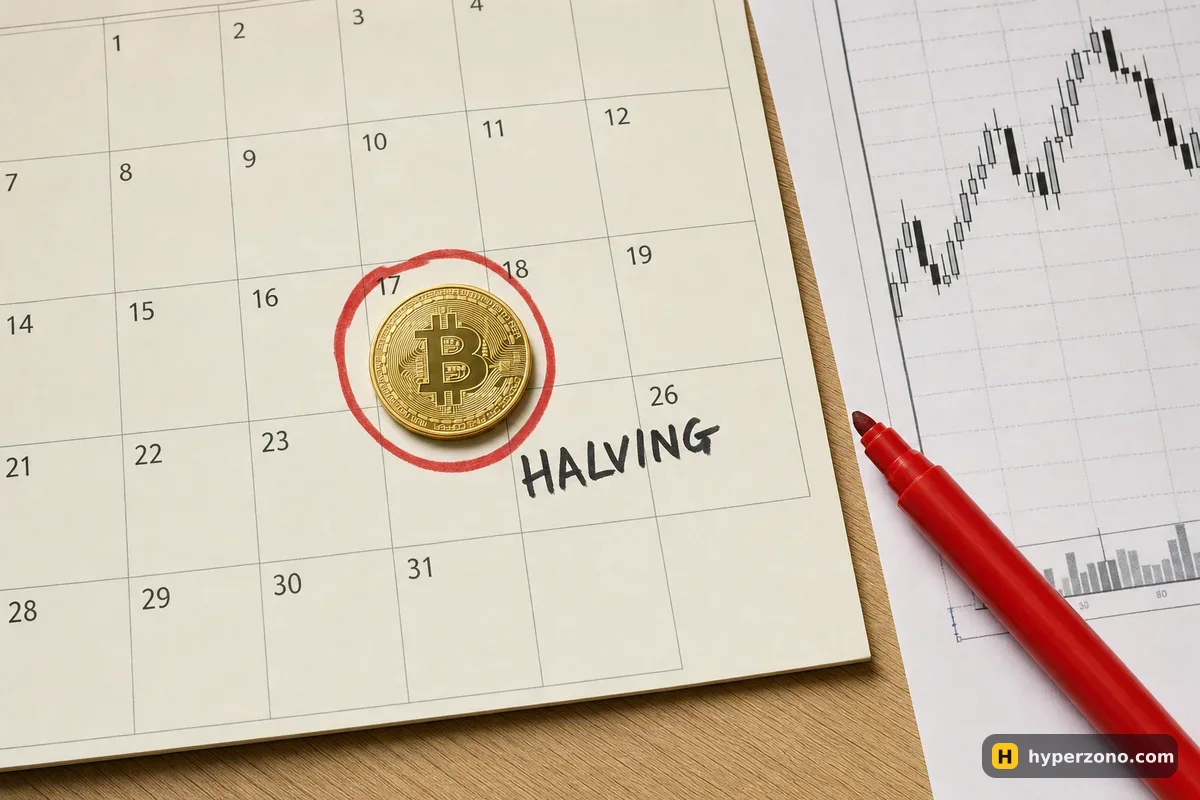
What the halving actually cuts
Every 210,000 blocks — roughly every four years — the reward a miner receives for adding a block to the bitcoin chain is cut in half. The most recent halving was in April 2024 at block 840,000, and it took the reward from 6.25 BTC to 3.125 BTC. Since fewer new coins are created with each block, the number of new bitcoins appearing each day drops by half as well.
Miners create roughly 450 new bitcoins a day now; after the next halving, expected around April 2028, that becomes about 225. In bitcoin's first years it was 7,200 a day, and over 94% of the 21 million coins that will ever exist have already been mined.
| Halving | Block reward after it |
|---|---|
| 2012 | 25 BTC |
| 2016 | 12.5 BTC |
| 2020 | 6.25 BTC |
| April 2024 (block 840,000) | 3.125 BTC |
| Projected around April 2028 (block 1,050,000) | 1.5625 BTC |
Whether miners end up earning more or less in dollars depends on the bitcoin price and on the fees people pay for transactions, so the schedule alone tells you nothing about their income. What the halving gives you is one certainty — half as many new coins per day — and no certainty at all about money.
It is a block number, not a date you can trade
The halving fires when the chain reaches a certain block height — 1,050,000 for the next one. Blocks arrive when miners find them, not on a timetable, so "around April 2028" can move by days in either direction. If your plan starts with "I will open a long the day before", you are building it on a date that is not fixed.
There is a second problem with treating it as a known opportunity. The schedule has been public since bitcoin started, so every trader, fund and market maker can see the same block numbers you can. Knowing when something happens is not the same as knowing what price will do when it happens, and nobody publishes a size or a timing for the effect, because there isn't one.
The halving happens on the bitcoin network, not inside your contract. A perpetual contract does not settle, convert or change its rules on halving day. Your order size steps, leverage and funding schedule come from the exchange, not from the chain — if you are unsure, open the contract specification in the app and read it before you plan anything.
Your trade lasts days; the supply change lasts years
Here is the mismatch that matters most. Issuance falls from about 450 to about 225 new coins a day, once, and then stays there for four more years — while a beginner's futures position usually lives for hours or days. Over that window, the coins that did not get mined today are a tiny trickle next to the coins already in circulation and changing hands on exchanges.
Put your own money on it and the scale becomes obvious. Say you have 100 USDT sitting in your futures wallet and you put 50 of it in as margin on a 250 USDT long at 5x, with a stop that closes you out if BTC drops 2%. The other 50 USDT stays untouched in the wallet, and the position is the one you chose rather than everything you own. On Binance the taker fee is 0.05%, so entry costs about 0.125 USDT on a 250 USDT position and the exit costs about the same.
There is one more cost while the trade is open. On a perpetual contract, every eight hours one side pays the other a small amount for keeping the position open — this is called funding. At the usual 0.01% rate that is about 0.025 USDT per payment on a 250 USDT position, so holding for three days means nine payments, around 0.23 USDT. Entry, exit and funding together come to roughly 0.48 USDT — under half a USDT, and the page on funding payments works through longer holds.
Now the two outcomes over those three days. If BTC rises 2%, your 250 USDT position gains 5 USDT and you keep about 4.5 after costs. If it falls 2%, your stop takes you out about 5.5 USDT down with fees and funding included — around 5.5% of your 100 USDT, from a move bitcoin can make in an afternoon for reasons that have nothing to do with block rewards. That is the real decision in front of you, and the halving schedule says nothing about which of the two you will get.
What else is pulling the price in the same week
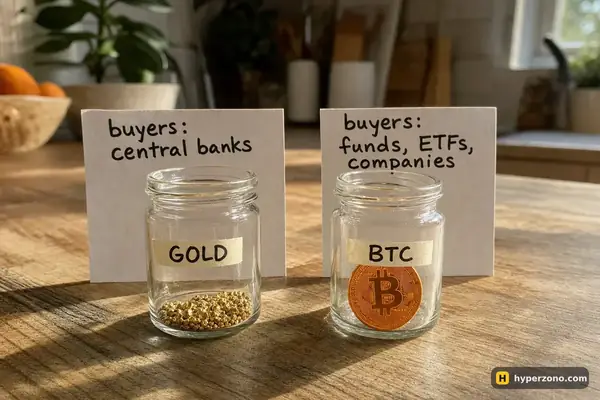
Binance Research argues that the market now reacts far more to demand than to supply: money moving in and out of spot ETFs, companies buying bitcoin for their balance sheets, and what long-term holders decide to do. Most coins also sit still — about 60% have not moved in over a year, about 25% in over five. So the bitcoin actually being bought and sold every day is a much smaller pile than the headline supply number, and a change in daily issuance lands in a market where demand swings are much bigger.
There is also the outside world. Over three-month stretches, bitcoin has often drifted in the same direction as US stocks — not every day, but often enough that a bad session on Wall Street regularly shows up in your BTC position too. If you want to follow one of these demand signals properly, start with how to read ETF inflow numbers rather than the halving calendar, and see the separate page on the four-year cycle before you build anything on repeating patterns.
Bitcoin has had quiet stretches and loud ones. Price swung about half as much in late 2025 as it did in the two cycles before, and the fall from top to bottom this cycle has been about 52% against roughly 80% in the past. A position that feels comfortable in a calm month can hurt in a loud one, so size from your stop, not from the story.
How to turn this into something you can actually test
Write the idea as one sentence with limits
Something like: "I think BTC goes up over the next five days; I'm out at this price if I'm wrong, out at this price if I'm right, and out anyway on Friday." A sentence without a price and a deadline is a hope, not a plan.
Check the contract you would actually use
Open BTCUSDT in the app and look at the minimum order size, the leverage you are allowed and how often funding settles. On Binance the minimum bitcoin position is 0.001 BTC, and leverage above 20x is not available during the first 30 days of a futures account.
Run it without money first
Test the same entry, stop and deadline in demo mode, where a mistake costs you nothing. The guide to demo trading on exchanges shows where to find it; demo is not available everywhere, so check during sign-up.
Then try it small and keep the record
One trade in a size you can lose, with the fees and funding written down next to the result. Which coins are sensible to practise on is covered in the guide to first trading pairs.
When you are ready to look at live numbers rather than an example, the easiest way is to open a Binance Futures account and read the BTCUSDT contract page yourself — minimum size, your available leverage, the funding countdown. If you want to compare venues first, which exchange suits a beginner goes through it, and check during sign-up that futures are actually available where you live.
When is the next bitcoin halving?
It happens at block 1,050,000, which works out at around April 2028, and it will cut the reward from 3.125 BTC to 1.5625 BTC. That date is a projection, because blocks arrive when miners find them rather than on a clock. Plan a trade around a price level, not around a day that can shift.
Does the halving make the bitcoin price go up?
Nobody can promise that. A halving can affect price indirectly, but no one can attach a size or a timeframe to it, and the schedule has been public for years. Most of the current analysis puts far more weight on demand — ETF flows, company buying, what long-term holders do — than on the change in new supply.
Should I open a long before the halving and hold it through?
You can, but then it is a normal directional trade and needs the normal protections: a stop, a size you can lose, and a deadline. The supply change plays out over four years, while fees and funding are charged on your position every few hours, so the calendar is not doing the work you might hope.
Does the halving change anything in my futures contract?
Nothing happens to the contract itself — a perpetual keeps running as before. Everything about your trade, including minimum size, leverage tiers and the funding interval, comes from the exchange, so check the contract specification in the app if you want certainty.
Do I need to own bitcoin to trade the halving idea?
No. A USDT-settled futures contract pays or takes the price difference in USDT, so your balance stays in USDT the whole time. The page on trading bitcoin without owning it explains how that works.
Sources and fact-check
Exchange terms were checked against official documents on November 8, 2026. Terms change — before you trade, check what matters to you in the exchange app and in your contract’s specs.
Binance Academy: HalvingBinance Research: Bitcoin — From Pizza to Portfolio