Contents
What the halving date really decidesFour observations are not a ruleThe buyers changed, and so did the productsWhat it costs when price ignores the calendarHow to use the cycle without trading from it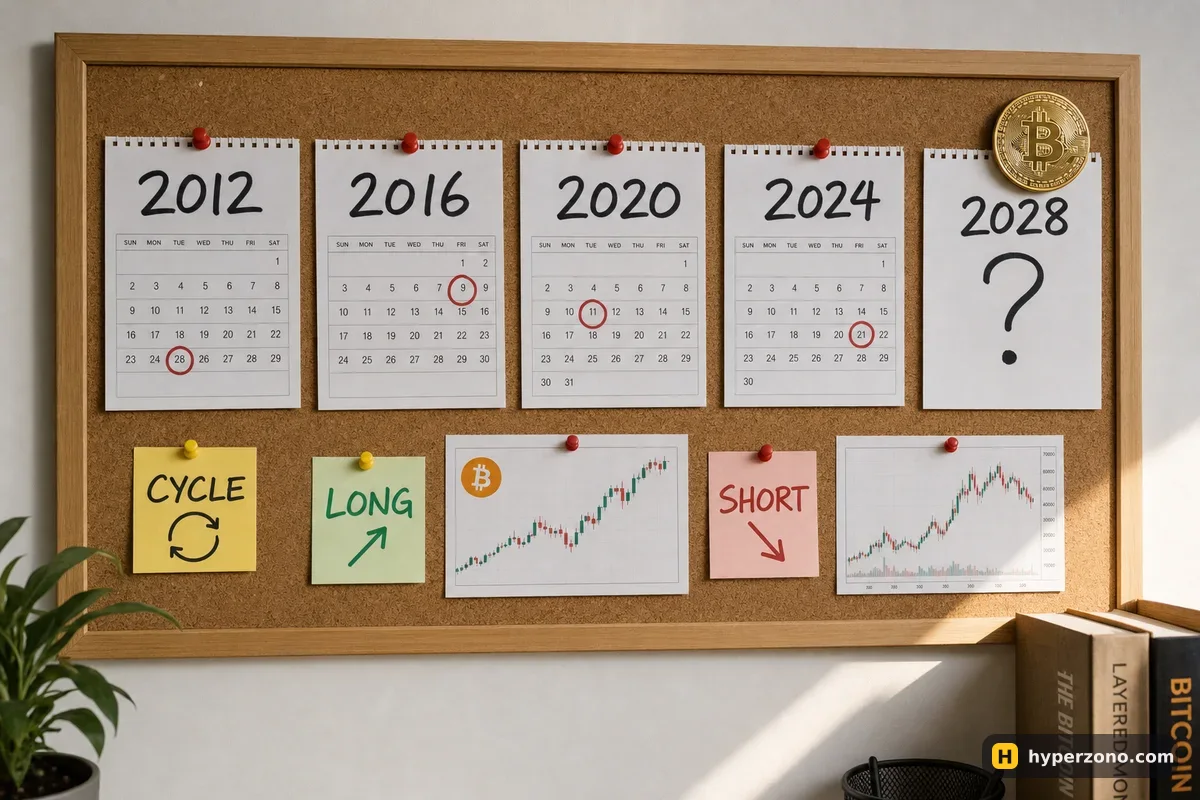
What the halving date really decides
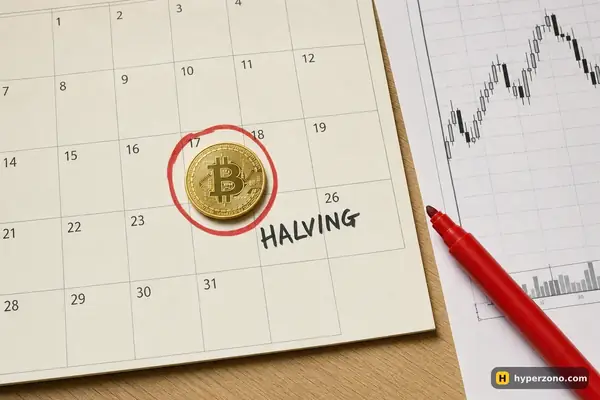
The part that really is scheduled is the halving. Every 210,000 blocks the reward miners get for adding a block is cut in half, which works out at roughly four years. In April 2024, at block 840,000, the reward went from 6.25 BTC to 3.125 BTC, and the next one is projected for around April 2028 at block 1,050,000, taking it to 1.5625 BTC.
That is the whole of the guaranteed part. The date decides one thing only: how many new coins miners get. It decides nothing about who buys, how much they buy, or what the rest of the market is doing that month. A halving does not change how many coins sit in your account. Nobody can tell you that the price has to rise after it, and nothing in the code says when.
| Halving | New coins per block after it | New coins per day after it |
|---|---|---|
| 2012 | 25 BTC | ≈3,600 BTC |
| 2016 | 12.5 BTC | ≈1,800 BTC |
| 2020 | 6.25 BTC | ≈900 BTC |
| April 2024 (block 840,000) | 3.125 BTC | ≈450 BTC |
| Around April 2028 (block 1,050,000) | 1.5625 BTC | ≈225 BTC |
Four observations are not a rule
When someone says "the cycle says buy now", ask how many times that pattern has been measured. Bitcoin has had four halvings in its whole history. Even if you slice each cycle into phases, you are looking at a handful of long, overlapping stretches of time, each one shaped by completely different news — exchange failures, a pandemic, interest rate decisions, new products. A pattern that fits four stories will fit almost any four stories.
There is also a quieter problem: nobody agrees on where each cycle started and ended, so the "rule" gets redrawn after the fact to match what happened. If you cannot write the rule down in advance — enter on this date, exit on that date, stop here — it is not a rule you can test, and it is not a rule you can risk 100 USDT on. The halving itself is worth understanding properly, and that is covered in what the halving really changes for a futures trader.
The buyers changed, and so did the products
What the halving controls is how many new coins appear each day, and that number is now tiny next to how much bitcoin is bought and sold. In 2010 miners got about 7,200 new BTC a day; now it is around 450, and after the 2028 halving about 225. When the flow of new coins is that small, the price moves mostly on who is buying, not on how many coins appear.
Funds, companies and governments now hold roughly 3.88M BTC, close to 18.5% of all the bitcoin there will ever be — including about 1.32M in ETFs, 1.24M with public companies and 650K with governments. For the first time the money setting the price comes mostly from funds and companies, not from people buying a few hundred dollars at a time. And the dates that actually moved this market have nothing to do with the halving schedule: the first corporate treasury allocation in August 2020, US spot bitcoin ETFs launching in January 2024, an executive order for a US Strategic Bitcoin Reserve in March 2025. If you want a feel for how that demand is tracked day to day, how to read ETF inflow numbers is a more practical starting point than a calendar.
Two more things matter if you use leverage. Bitcoin has moved less violently in the 2023–2026 cycle than in the two before it, and its worst fall from a high was about 52%, against around 80% historically. Still — a 52% fall would wipe out a 5x position many times over, so "calmer" does not mean safe.
The second one is the link with the stock market. Bitcoin now moves in the same direction as US stocks more often than it used to: on the usual scale, where 0 means no link and 1 means they move together, the number is often 0.25 to 0.5. For you that means a bad day on the US stock market can show up on your bitcoin position, even when nothing happened in crypto.
What it costs when price ignores the calendar
Say the cycle talk convinces you, and you hold a long for a month while the market goes the other way. These numbers are illustrative: you have 200 USDT in your futures account and open a long worth 500 USDT with 100 USDT set aside as margin, which is 5x. Bitcoin is at 100,000 in the example, so your position is 0.005 BTC.
Long 500.00 USDT, entry 100,000 → exit 90,000, fees 0.05% + 0.05% (example rates).
A 10% fall costs you 50 USDT on a 500 USDT position — half your margin, from a move most people would call ordinary. The taker fee on Binance is 0.05% of the position, so about a quarter of a dollar going in and roughly the same coming out. Then there is funding: a payment passed between traders every few hours, and on bitcoin the most common rate is 0.01% per 8 hours, around 0.03% a day. On 500 USDT that is about 0.15 USDT a day, near 4.5 USDT over a month — small per payment, visible when your reason for holding is "the cycle needs more time".
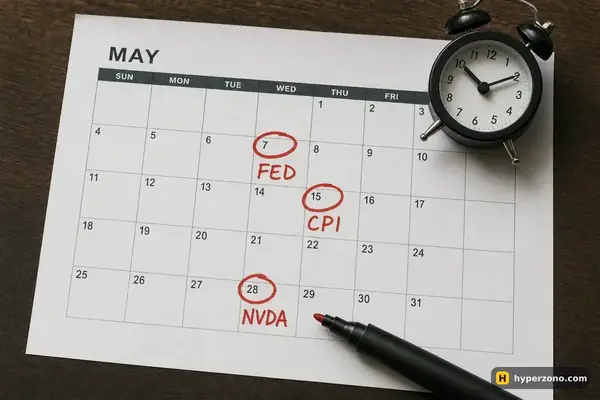
The calendar has no stop-loss in it. A cycle view gives you a direction and no exit. Before you open anything, decide the price at which you were wrong and set a stop there, and keep the position small enough that being wrong costs a planned amount rather than your account.
How to use the cycle without trading from it
Treat cycle history the way you would treat a friend's opinion: interesting background, not instructions. Then check the current situation yourself — what is actually moving this week, whether buyers are arriving, and what the contract in front of you costs to hold. Which pair you choose matters too, and picking your first trading pairs covers that side separately.
Write the claim down before you test it
Turn "the cycle says up" into something checkable: the price where you would enter, the price that would show you were wrong (that is where your stop goes), and how long you give the trade before you close it anyway. If you cannot write it, you cannot judge it later.
Check today's facts, not 2016's
Look at the current funding rate on the contract, the recent range, and whatever demand data you follow — the fastest way to see this is to open the BTCUSDT page on Binance and look at the current funding rate next to the order window. One month of real observation beats a chart of four halvings.
Run the scenario where you are wrong
Work out the loss if price moves 10% against you, and add fees and a month of funding. If that number makes you uncomfortable, the position is too big.
Practise it with no money at risk
Several venues let you test the same idea in a simulator first — see which exchanges offer demo futures trading. Demo shows mechanics, not future returns.
Check the contract and your country
Leverage limits, minimum order size and availability differ by venue and by where you live; check which exchanges are available in your country and confirm in the app during sign-up.
Does the bitcoin halving always make the price go up?
No one can promise that. The halving only changes how many new coins miners receive; any effect on price is indirect, with no direction and no timing attached. Four halvings since 2012 is a very small set of examples, and each one happened in a different market.
Is the four-year cycle over?
Nobody can tell you that honestly. What we do know is that the market around bitcoin changed: the flow of new coins is now tiny next to demand, funds and companies hold a large share of the supply, bitcoin has moved less violently this cycle, and it often moves together with US stocks.
When is the next bitcoin halving?
It is projected for around April 2028, at block 1,050,000, cutting the reward to 1.5625 BTC. It depends on how fast blocks are produced, so the date is an estimate, not a fixed day on the calendar.
Can I just hold a long for a whole cycle on futures?
You can hold a perpetual as long as your margin supports it, but you keep paying funding while it is open, and a deep fall can liquidate you long before your view plays out. On a 500 USDT position, funding at the common 0.01% per 8 hours is roughly 4.5 USDT a month, and that rate changes.
What should I look at instead of the cycle chart?
Things you can check today: the current funding rate on the contract, the recent price range, where your stop would sit, and demand signals such as ETF flows. One tested idea you wrote down in advance is worth more than a pattern drawn after the fact.
Sources and fact-check
Exchange terms were checked against official documents on November 8, 2026. Terms change — before you trade, check what matters to you in the exchange app and in your contract’s specs.
Binance Academy: HalvingBinance Research: Bitcoin: From Pizza to Portfolio