Contents
What people actually mean when they say altseasonYour money is on one coin, not on "altcoins"This coin hasn't moved yet — is it my turn?What one altcoin trade actually costs youTurning a headline into something you can actually trade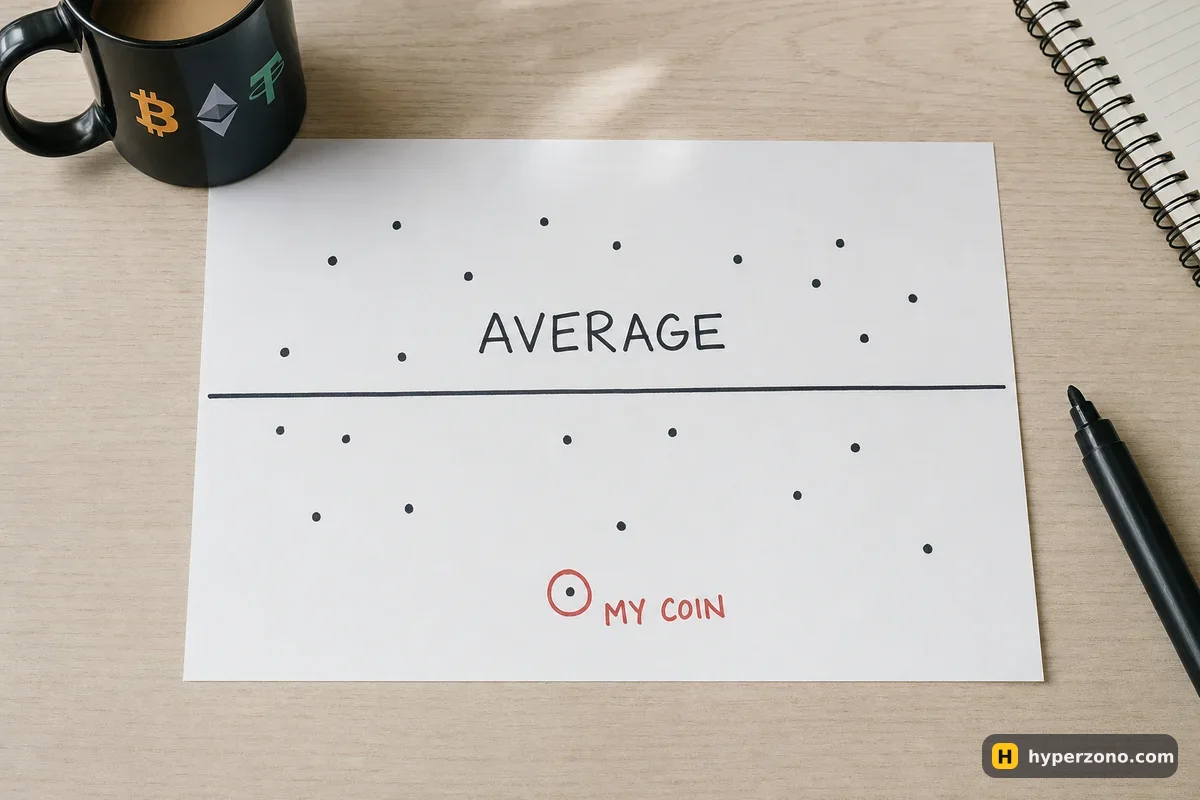
What people actually mean when they say altseason
Ask three traders and you get three answers. Many of them watch bitcoin dominance — bitcoin's market value divided by the market value of all crypto put together. Say bitcoin is worth 1.4 trillion dollars while all crypto together is worth 2.4 trillion: bitcoin is about 58% of the market. When that share falls, money has moved somewhere else in crypto — but it does not tell you which coin it went to, and that is the whole problem.
Others point at a score out of 100. One popular one is the Altcoin Season Index. In April 2025 that score read 32 out of 100 — bitcoin was ahead, and fewer than three quarters of the big altcoins had beaten it over the previous 90 days. There is no official cut-off that switches the label on. Notice what the score counts: how many coins beat bitcoin over a window, not how much any one of them made. It is a headcount of a crowd, and you are not buying the crowd.
There is also no "correct" dominance number to aim at. Years ago it sat above 90%, before altcoins existed in any size; in recent years it has moved roughly between 40% and 70%, and you can watch it live on CoinMarketCap or CoinGecko. High dominance does not mean altcoins are falling, and the share can shift simply because stablecoin money came into crypto without passing through bitcoin, or because new coins were added to the total. The page on rising bitcoin dominance goes through those readings one by one.
Your money is on one coin, not on "altcoins"
When a story runs — gaming tokens, DeFi, AI — that is a sector: attention and money flowing towards a group of projects. A score or an index sits one level above that, summarising many coins into a single number. A futures contract sits one level below: it is the price of one token against USDT, and nothing else.
| What you hear | What it actually measures | What you can trade on it |
|---|---|---|
| "It's altseason" | Many altcoins beating bitcoin over a past window | Nothing — it is a summary of history |
| "DeFi is hot" | Attention and flows into a group of projects | Several separate tokens, each with its own supply and release schedule |
| "SOMEUSDT perpetual" | The price of one token right now | This is where your margin, fees and funding actually live |
So the word can be true while your coin is down 15%. Falling less than bitcoin still counts as "beating" it, and a headcount says nothing about the size of anyone's gain. If you want the fuller picture of why coins tend to move together anyway, why altcoins follow bitcoin covers the mechanics.
This coin hasn't moved yet — is it my turn?
That is the natural next thought: find something still sitting quiet, because it must be next in line. Sometimes a coin is quiet simply because few people have noticed it. Often there is a plain reason — a big batch of tokens about to be released to early investors, a project that went silent months ago, or so few buyers that your own order moves the price. Coins that get popular fast can also lose their push once the first wave of interest fades.
Treat "it hasn't moved yet" as a question, not a reason to buy. Two checks cost nothing. First, write down the basics about the token — how many coins exist, who holds them, what is due to be released — the way a one-page fact sheet does it. Second, look at how much that contract trades in a day: a coin can be worth billions on paper and still be hard to get out of when everyone leaves at once.
What one altcoin trade actually costs you
Say you put 100 USDT of your own money into one altcoin contract at 5x, so your position is 500 USDT. On Binance, fees are charged on the position value each time you enter and each time you exit: at the base level a taker pays 0.05%, which is about 0.25 USDT in and 0.25 USDT out on that 500 USDT. Position sizes make small coins easy to try — the smallest bitcoin position is 0.001 BTC, ether starts from 20 USDT of position value, and most altcoin contracts start from about 5 USDT.
Funding is where excited markets get expensive. It is a payment between traders, made every 8 hours by default on Binance and every 4 hours on some contracts. If the rate on your coin sits at, say, 0.1% per payment — a made-up but realistic level for a crowded coin — that is 0.50 USDT every eight hours on your 500 USDT position, around 1.50 USDT a day just to hold it. Single payments are capped, and the caps differ: BTCUSDT and ETHUSDT are capped at ±0.30% per settlement, while 715 of Binance's 810 USDⓈ-M contracts are capped at ±2%, so a small coin can charge far more per payment and stay there for days. The page on funding shows how to read the number before you hold overnight.
One more line to check: small contracts can be removed. In the twelve months to 25 October 2026, Binance settled 86 USDⓈ-M perpetuals, and before a delisting it may cut maximum leverage and raise margin requirements without much warning. The easiest way to see all of this for a specific coin is to open the contract page on Binance Futures and read the specification and the latest announcements for that ticker before you size anything.
Turning a headline into something you can actually trade
Write down the claim
"Altseason" — by whose measure? Dominance, a score out of 100, or a chat group. Note the window it covers; a 90-day average tells you nothing about tomorrow.
Pick one coin, not a basket
Choose a single contract you can follow. Our guide to first trading pairs covers how to pick one by liquidity and risk rather than by story.
Open the specification
Minimum order size, maximum leverage, funding interval and cap, and any delisting notice. These are set per contract, not per exchange.
Run it in demo first
Hold a small position through at least one funding payment and watch the cost appear on your balance. Demo futures accounts let you do this without money.
Check it is available where you live
Futures are limited or closed in several countries, and some exchanges serve them through a separate local company. Confirm during sign-up, and check which exchanges are available in your country.
An average is not an entry. If you cannot say which coin, which contract and what it costs to hold for three days, you do not have a trade yet — you have a headline. Write those three answers down before you touch the order window.
Is it altseason right now?
Nobody can answer that for you, because nobody owns the definition. You can watch bitcoin dominance on CoinMarketCap or CoinGecko and look at the index scores, but both describe a past window across hundreds of coins and promise nothing about the one you want to trade.
Does falling bitcoin dominance mean altcoins are going up?
Not on its own. Dominance is bitcoin's share of total crypto market value, so it can fall because stablecoin money entered without passing through bitcoin, or because new coins were added to the total. Share and price are two different things.
Which altcoin rises the most during altseason?
There is no list known in advance, and the biggest 24-hour gainers are often already past their move. If a coin is quiet, find out why before you treat it as the next one.
Can I short an altcoin during altseason?
Futures let you open either direction, so yes. Check the funding rate first: when longs are crowded the rate is usually positive, meaning longs pay shorts — but the rate can flip, and small contracts can swing much harder than BTC.
Should I open several altcoin contracts to catch the move?
Every extra position adds its own fees, its own funding and one more thing to watch while you are learning. One contract you understand teaches you more than five you are guessing at.
Sources and fact-check
Exchange terms were checked against official documents on November 7, 2026. Terms change — before you trade, check what matters to you in the exchange app and in your contract’s specs.
Binance Academy: What Is BTC Dominance?