Contents
What you actually hold while the trade is openWhere does the bitcoin go, then?How much USDT do you need for one small bitcoin trade?Your USDT has to be in the futures walletThere is one kind of contract where you do need the coinWhat you actually hold while the trade is open
These contracts are called USDT-margined (on the exchange you'll see them grouped as USDⓈ-M or USDT perpetual). Everything about them happens in USDT: the deposit the exchange sets aside while your trade is open, the profit or loss when you close, and the small fee you pay. If you can buy USDT, you can trade bitcoin futures — buying bitcoin is not a step at all.
That surprises people who came from the idea of "buy crypto, wait, sell crypto". On spot you own the coin and your money is locked in it. On futures you keep a USDT balance and open an agreement whose value follows the bitcoin price. If you want the full comparison, it's laid out in futures versus buying on spot.
Where does the bitcoin go, then?
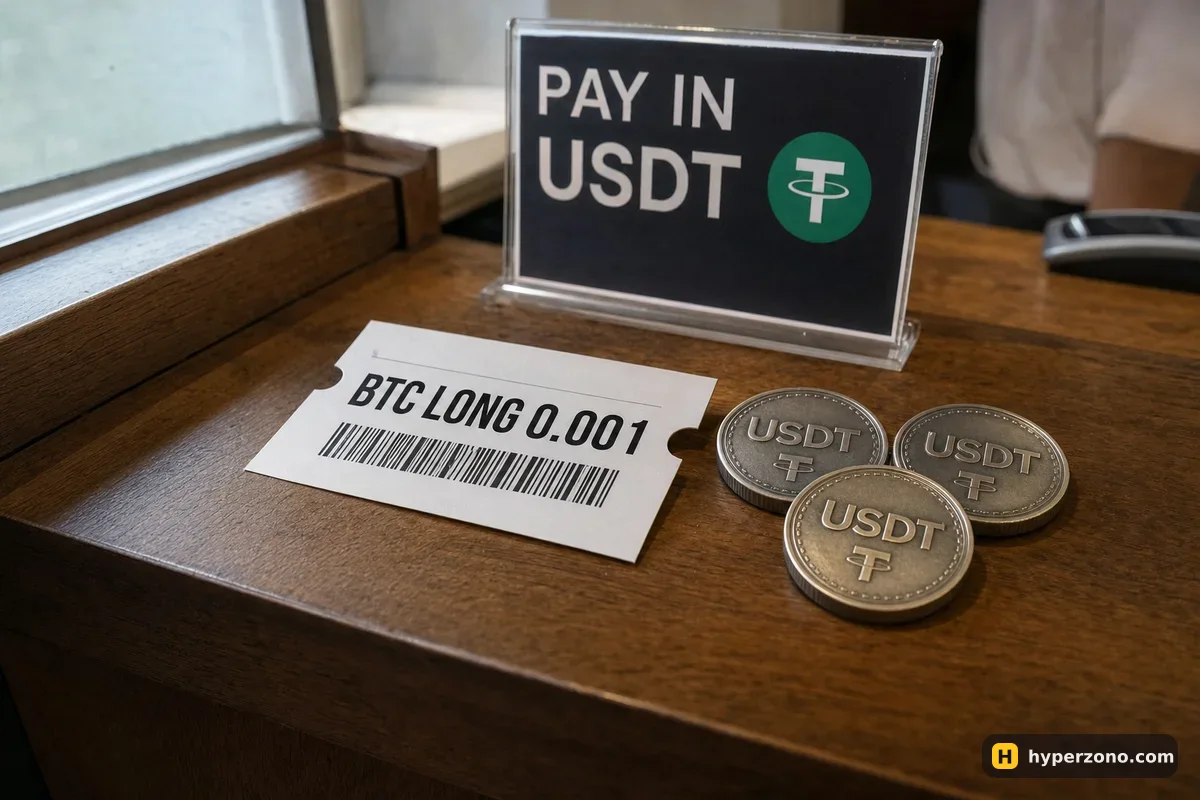
Nowhere. Nobody sends you bitcoin when you open the trade, and you don't have to deliver any when you close it. The exchange simply records the price you entered at and the price you left at, and moves the difference in USDT between your account and the account of the trader on the other side.
Here's what that looks like with illustrative numbers. Say bitcoin is around 83,500 USDT and you open a long on 0.001 BTC — a bet that the price goes up. The price moves up about 1%, to roughly 84,335, and you close. Your gain is 0.001 × (84,335 − 83,500) ≈ 0.84 USDT, credited in USDT. If the price had gone the other way, the same amount would have been taken out of your USDT. The coin was never involved, and the same logic works in reverse when you make money on a falling price.
How much USDT do you need for one small bitcoin trade?
Less than most people expect, because the exchange only holds part of the trade's value as your deposit. On Binance the smallest bitcoin position you can open is 0.001 BTC — at a price around 83,500 USDT that is about 83.5 USDT of trade size. At 5x leverage the exchange would hold roughly 17 USDT of your money as the deposit, so around 25 USDT sitting in the futures wallet is enough to open that position with a little room left over.
The fee is taken in USDT too, and on a trade that small it's tiny: at the base taker fee of 0.05%, about 0.04 USDT to enter and the same to exit. Other coins have smaller minimums — most altcoin contracts start from 5 USDT of trade size, ether from 20 USDT. How much deposit is held depends on the leverage you choose, which has its own page: what leverage actually means.
Your USDT has to be in the futures wallet
This trips up a lot of first-timers. You buy USDT, it lands in your spot wallet, you open the futures screen and the available balance says zero. Nothing is lost — the money just sits in a different pocket of the same account, and you move it across with an internal transfer that takes a second. The steps are in moving money to your futures wallet, and getting the USDT in the first place is covered in how to buy USDT.
Once the balance shows up on the futures screen, you pick the BTCUSDT contract, choose your amount and press long or short. The easiest way to see all of this for yourself is to open a Binance Futures account and look at the order window with a small balance — nothing happens until you confirm an order.
There is one kind of contract where you do need the coin
Alongside the USDT contracts, exchanges list coin-margined ones (COIN-M, also called inverse). There you post bitcoin as your deposit and your profit or loss comes back in bitcoin, not USDT. They exist mainly for people who already hold a lot of coin and want to keep it that way.
| USDT-margined (USDT-M) | Coin-margined (COIN-M) | |
|---|---|---|
| What you put up | USDT | Bitcoin you already own |
| Profit and loss arrive in | USDT | Bitcoin |
| Do you need to buy BTC first? | No | Yes |
| Good for a beginner? | Yes — simple to read | Skip it for now |
For a beginner the coin-margined version adds a second moving part: your profit is paid in an asset whose own price keeps changing, so a winning trade can still shrink in dollar terms. The math behind it is different too. Stay on USDT contracts until the basics feel boring.
One thing worth checking before you plan anything. Futures are not offered everywhere. In some countries an exchange serves you through a local entity with different products or lower leverage caps, and in others derivatives are not available at all. Check availability inside the app while you sign up, and never try to get around a block.
Can I trade BTC futures with USDT only?
Yes. On USDT-margined contracts, USDT is the only asset you need — it covers the deposit, the fees and the settlement of your profit or loss. The bitcoin price is just the number your contract follows.
Do you need to buy crypto to trade futures?
You need stablecoin, not the coin you're trading. USDT is crypto in the technical sense, but it stays close to one US dollar, so holding it isn't a bet on the market. Most exchanges let you buy it with a card, a bank transfer or from another person through P2P — check which methods appear for your country in the app.
Will bitcoin ever show up in my wallet after a futures trade?
No. These contracts are settled in cash — in USDT — so nothing is delivered either way. If you actually want to own bitcoin, that's a spot purchase, a different product on the same exchange.
Is it cheaper to trade futures than to buy bitcoin?
You tie up less money for the same size of position, because only part of the trade's value is held as your deposit. That's not the same as cheaper: the loss grows at the same speed as the profit, and the exchange can close your position if the deposit runs out. See what liquidation means before you raise the leverage.
Can I lose more than the USDT I put in?
Your position is normally closed by the exchange before that point, and using isolated margin keeps the risk tied to the deposit on that one trade. Treat the USDT you move into the futures wallet as the amount at stake, and keep it to money you can afford to lose while you learn. A stop loss makes that limit much tighter than liquidation does.