Contents
Who is actually buying each oneHow differently the two markets moveThree moments when the comparison breaks downTurn your idea into something you can checkThe same idea, two very different position sizesBefore you open either contractWho is actually buying each one
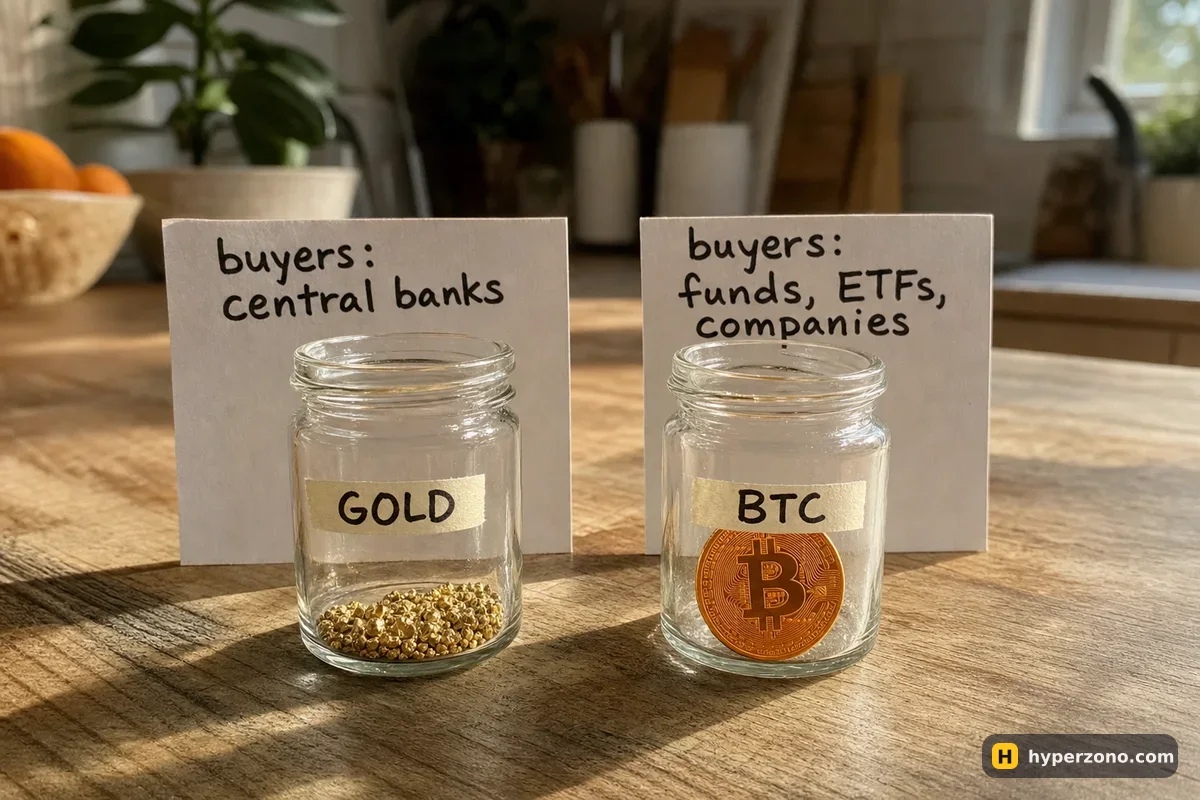
On the gold side, the big buyers are central banks — the state institutions that hold a country's reserves. In 2025 they bought about 860 tonnes between them: less than the year before, but still far more than they used to buy through the 2010s. Poland bought the most, for the second year running. These are buyers who move slowly and don't care what your chart did this week, and in the World Gold Council's 2025 survey a record share of them said they planned to add more gold, with none planning to cut.
Bitcoin's buyer list looks nothing like that. Binance Research counted about 3.88 million BTC — nearly a fifth of all the bitcoin that will ever exist — held by funds, listed companies and governments. In this cycle the new money came mostly from them, not from people like you and me.
Supply doesn't speed up when the price rises either: about 450 new coins a day, falling to about 225 after the April 2028 halving. Around 60% of all bitcoin hasn't moved in over a year, so even less is really available to trade.
How differently the two markets move
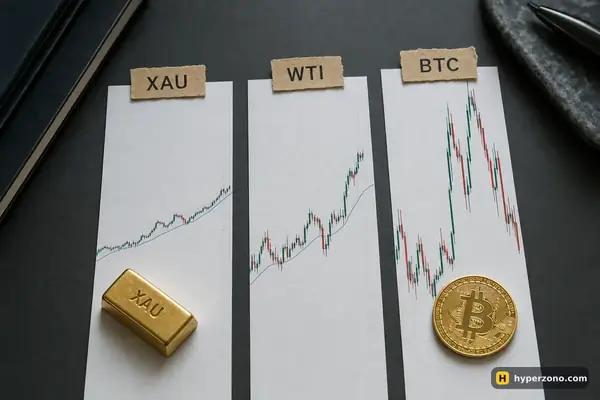
Speed is the part beginners feel first. Traders measure how much a price swings over a year, in percent, and that number is called volatility. Gold runs around 15% a year, bitcoin around 48% in this cycle — roughly three times more. In practice that is the difference between a 500 USDT gold position moving a few dollars on a normal day and the same 500 USDT bitcoin position moving three times that. Bitcoin was unusually calm in late 2025, around 29%, its quietest stretch in roughly a decade, and even that is twice gold.
Across 2025 bitcoin moved about as much as Nvidia shares did — not like a metal at all. In practice a bitcoin position behaves more like one fast-moving tech stock than like gold.
The second difference is what each one moves with. Through 2022–2026 bitcoin mostly moved with US stocks, not with gold. In plain terms: on a bad day for the stock market, bitcoin usually falls too, while gold often does its own thing. Binance Research measured the link with stocks as steady over those years and the link with gold as on-and-off — the opposite of what the nickname promises.
| What to compare | Gold | Bitcoin |
|---|---|---|
| Big buyers you can see | Central banks, about 860 tonnes net in 2025 | Funds, listed companies and governments, about 3.88 million BTC in total |
| Supply reaction to a higher price | Mining and recycling can respond over time | No reaction; about 450 BTC a day, halving to about 225 in April 2028 |
| Yearly price swing (volatility) | About 15% | About 48% this cycle; about 29% in its calm late-2025 stretch |
| Moves with | Its own buyers — reserves and jewellery demand | US stocks most of the time; gold only on and off |
| Market size | About US$31.5 trillion | About US$1.5 trillion, roughly 5% of gold |
Three moments when the comparison breaks down
The first is a bad week for stocks. If you buy bitcoin thinking it will hold up while stocks fall — the way gold is supposed to — you may get the opposite: bitcoin falling with the stock market, on the same day, for the same reason. The hedge you imagined and the asset you bought are not the same thing.
The second is a record high. The World Gold Council notes that central banks bought more carefully as gold set records, so a high price can slow those buyers down. Bitcoin's new buyers often work the other way round: money arrives into the funds because the price is already rising, and with so many coins sitting still, the report says the price reacts strongly to those flows. One market can be cooled by a high price, the other can be fed by it.
The third is simply size. Gold is about twenty times bigger. The same billion dollars of buying barely registers in one market and makes a visible move in the other — which is also why a bitcoin fund announcement makes the chart jump and a similar gold headline often does not. If you want to read central bank buying properly before trading it, that is its own skill: see how to read central bank gold buying.
Turn your idea into something you can check
The useful question is not "which one is the real digital gold" but "what exactly do I think is going to happen, and which contract pays me if I'm right". Write it as one sentence with something checkable in it. "Central banks keep adding to their reserves, and a record share of them say they plan to" points at gold. "Funds and listed companies keep buying bitcoin while the daily supply of new coins falls" points at bitcoin. If your sentence works equally well for both, it is too vague to trade yet.
Watch out for ideas that sound like gold but are really about something else. "Prices are rising, so I'll buy gold" has its own trap, covered in why gold futures can still lose money as an inflation hedge. And treat the big round comparisons carefully: the Binance report notes that bitcoin at 10% of gold's size would be around US$160,000 a coin, and matching gold entirely would be around US$1.6 million. That is arithmetic about size, not a forecast, and the report says so itself.
The same idea, two very different position sizes
Here is the practical part. Say you have 200 USDT in your futures wallet and you open a 500 USDT position at 5x, so 100 USDT of your money is held as margin. On an illustrative day where gold moves 1% against you, that costs 5 USDT. On an illustrative day where bitcoin moves 3% against you — perfectly ordinary for bitcoin — the same 500 USDT position costs 15 USDT. Fees are small next to that: on Binance's base level about 0.25 USDT to open a 500 USDT trade and the same again to close it, with the details in what futures fees cover.
So if you want the two trades to risk the same money, the bitcoin position has to be roughly a third the size, not the same size. That is the real content of the 15% against 48% difference. Work it out before you click rather than after: put your account size, your stop distance and the amount you are willing to lose into the calculator below, and do it separately for each market.
Small accounts hit one more wall here: minimum order sizes differ by contract. On Binance the smallest bitcoin position is 0.001 BTC, and commodity contracts have their own minimums — how small a commodity trade can be covers that side. The markets overview lists what else trades alongside these two.
Check what the gold contract actually tracks. Not every "gold" perpetual is built the same way. On OKX, gold and silver follow the spot metal price, while oil and copper contracts follow designated deliverable futures with a rollover. On other venues, open the contract specification in the app and read what the price is based on before you size a trade.
Before you open either contract
Both bitcoin and gold trade as perpetual contracts on the big exchanges, which means there is no expiry date and there is funding: a payment between longs and shorts every few hours that you pay or receive depending on which side you are on and what the rate is. On a trade you plan to hold for days, that cost belongs in your plan — see how funding works. Availability also varies: crypto futures, and commodity contracts in particular, are not offered everywhere, so check during sign-up whether the product is available where you live rather than assuming it is.
The quickest way to see all of this side by side is to open a Binance Futures account, find BTCUSDT and the gold perpetual in the contract list, and compare the specification, the maximum leverage and the current funding rate on each. Then start small, with one market and one sentence you can check.
Is bitcoin a safe haven like gold?
Not reliably. Through 2022–2026 bitcoin mostly moved with US stocks: when the stock market has a bad day, bitcoin usually falls too. Binance Research (May 2026) found that link steady over those years, while the link with gold came and went. If you need a trade that holds up while stocks drop, don't assume bitcoin will do that job.
Which moves more, bitcoin or gold?
Bitcoin, by a wide margin, even after calming down. The number traders use is volatility — how much a price swings over a year, in percent. Gold runs around 15% a year, bitcoin around 48% this cycle, about three times more. Even in its quietest stretch in late 2025, around 29%, bitcoin still moved twice as much as gold, so your bitcoin position should be smaller for the same money at risk.
If bitcoin reached gold's market cap, what would one coin be worth?
Using the report's own arithmetic, gold is about US$31.5 trillion and bitcoin about US$1.5 trillion, so matching gold would mean roughly US$1.6 million a coin, and reaching 10% of gold about US$160,000. It is a size comparison, published with a note that it is not a forecast, and nothing in it says when or whether that happens.
Can I trade gold on a crypto exchange at all?
Yes — several venues list gold as a perpetual contract settled in stablecoins, alongside silver, oil and other commodities. What differs is the price source and the maximum leverage per contract, and whether the product is offered in your country, so read the specification and check availability in the app during sign-up.
Should I just trade both at the same time to cover myself?
You can, but don't assume one offsets the other — the two only move together on and off, so you may simply be running two separate risks. If you do hold both, size each one on its own speed, 15% a year against 48% a year, and decide the loss you accept on each before you open it.
Sources and fact-check
Exchange terms were checked against official documents on October 31, 2026. Terms change — before you trade, check what matters to you in the exchange app and in your contract’s specs.
Binance Research: Bitcoin: From Pizza to PortfolioWorld Gold Council: Gold Demand Trends, Full Year 2025 — Central Banks