Contents
Where the big-lot number comes fromRead the unit before you read the priceTurn the smallest order into USDT, then look at margin separatelyDoes your budget fit without stretching the leverage?How to check your real minimum in a couple of minutesWhere the big-lot number comes from
On an old-school futures exchange like CME, one contract is a fixed parcel of the real thing — that is where the scary numbers come from. CME does list smaller versions of its metals contracts, but you still buy a whole contract, not the quantity you choose.
A commodity perpetual on a crypto exchange works differently. OKX describes its Commodity Perpetuals as contracts that track the price of commodities such as crude oil, gold, silver and copper, with no expiry date and nothing physical to hold; they are margined and settled only in USDT, and you type in the quantity yourself. The markets overview lists the asset classes you will find there, and what you are really buying in an oil contract is covered on its own page.
Read the unit before you read the price
The first thing to check is what one unit of the contract means, because it differs from one commodity to the next. In the app, the help section tells you what one unit of oil or copper is, but the numbers you actually need — the smallest quantity you can buy and the price step — sit on the contract page for that exact ticker. That is the page to open.
| Contract | What one unit is |
|---|---|
| XCUUSDT (copper) | 1 lb of copper |
| CLUSDT (WTI crude) | 1 barrel |
| BZUSDT (Brent crude) | 1 barrel |
| NGUSDT (natural gas) | 1 MMBtu of Henry Hub gas |
| XAUUSDT (gold), XAGUSDT (silver) | Unit not stated on the help page — read the contract specification |
If the specification confirms that one unit is one barrel, then a price of 60 next to the oil ticker means 60 USDT for a single barrel, not for a thousand of them — that is the number to check. For gold, don't assume either: the help page simply doesn't say what the unit is, so open the specification for that exact ticker and see whether the price is per ounce or something else.
Turn the smallest order into USDT, then look at margin separately
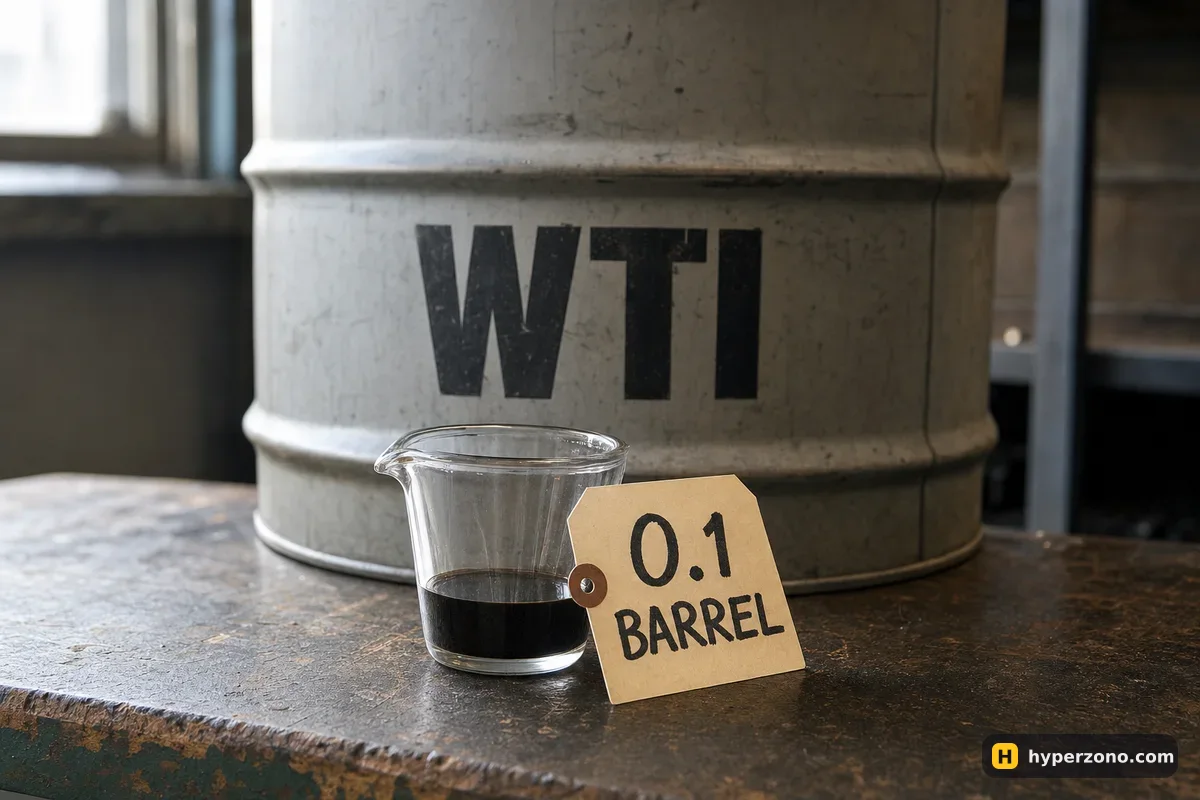
Two numbers decide whether a commodity fits your budget, and beginners often mix them up. The first is the size of the trade: quantity × price, and the smallest version of it is the minimum quantity × price. The second is the money the exchange locks while the trade is open — that is your margin, and it depends on the leverage you pick.
Here's what that looks like with illustrative numbers. Say the specification shows a minimum of 1 barrel and oil is around 60 USDT. The smallest trade you can open is then about 60 USDT, and 5 barrels would be 300 USDT. At 10x leverage that 300 USDT trade holds about 30 USDT of your account, so a 100 USDT balance carries it comfortably.
Those are two different numbers. The 300 USDT is the trade; the 30 USDT is what the exchange holds while it is open. Your loss is still measured on the 300.
Now the unfavourable side of the same example. Oil drops 2% against you: 300 USDT × 2% = 6 USDT gone, a fifth of your margin. On top of that, OKX's base rate for perpetual swaps is 0.05% taker, charged on the trade size when you enter and again when you exit — about 0.30 USDT in total here. Hold the position through a funding settlement and there is a funding payment too; it is charged only if you are holding at settlement time, and the interval is listed on each contract's specification.
Does your budget fit without stretching the leverage?
With oil at around 60 USDT a barrel, the smallest trade is small enough that a 50 USDT balance is not shut out. The problem comes on a contract whose smallest trade is bigger than your account can carry at low leverage. Say the smallest trade on some contract is 800 USDT and you have 100. To fit it you would have to go to 8x or more, and then a 2% move against you costs 16 USDT — a sixth of everything you have. That is the signal to pick a different commodity, not a bigger leverage number.
The better habit is to decide your quantity from the loss you accept rather than from the maximum the slider allows — that is what working out position size is for. Set the trade to isolated margin and put a stop-loss on it, so a bad move costs you the margin on that one trade and not the rest of your balance. Just remember a stop fills at the next available price, so in a fast move it can land a little worse than your level. Gold and oil also trade around the clock on OKX, weekends included, though the exchange warns that liquidity can be thinner and spreads wider on weekends and traditional market holidays.
How to check your real minimum in a couple of minutes
Check that you can trade there
Check during sign-up that commodity contracts are available to you — OKX does not serve every country.
Open the commodity contract list
Find the ticker you care about — gold, silver, copper, WTI, Brent or natural gas — on the futures side of the app.
Open the contract specification for that exact ticker
This is where contract size, minimum quantity, tick size and leverage limits live. The general help page does not have them.
Multiply the minimum quantity by the current price
That is the smallest trade in USDT. Write it down.
Divide by the leverage you are willing to use
That is the margin the trade will hold. Compare it with your balance and with the loss you are ready to take.
It takes longer to read about than to do — you can sign up on OKX, open the commodity list and read the minimum quantity straight off the ticker's specification.
Small size first, then leverage. If a contract's minimum trade is too big for your account, lowering the quantity is the right fix. Raising leverage so the margin fits does not make the trade smaller — it only means a smaller price move empties the margin.
Do I need thousands of dollars to trade oil futures?
Not on a cash-settled perpetual. The quantity is yours to choose down to the contract's minimum, and with oil quoted per barrel a handful of barrels is a small trade in USDT. The exact minimum is on the contract specification page for that ticker.
Will a barrel of oil or a gold bar ever be delivered to me?
No. These contracts are settled in cash and margined in USDT — nothing physical changes hands. You make or lose money on the price difference only.
Is the minimum trade size the same as the money I need?
No, and that is the main mix-up. The trade size is quantity × price; the money held is that size divided by your leverage. A 300 USDT trade at 10x locks about 30 USDT, but your loss is still measured on the full 300.
Why can't I find the contract size for gold on the help page?
The OKX help page describes units for copper, crude and natural gas but not for gold and silver — it sends you to the contract specification instead. Open that page for XAUUSDT and read the size, minimum quantity and tick there.
Can I trade commodity perpetuals from my country?
Not everywhere. OKX lists India, Japan, Malaysia, Hong Kong and Canada among its restricted countries, and offers no derivatives to residents of the UK, Brazil and South Korea. Check the current list and see what your account can actually trade once you are signed in.
Can I practise before putting money in?
Many exchanges offer a demo mode, but the presence of a specific commodity contract in demo is not guaranteed. Check your chosen ticker there first; if it's missing, practise the mechanics on a contract that is available.
Sources and fact-check
Exchange terms were checked against official documents on October 27, 2026. Terms change — before you trade, check what matters to you in the exchange app and in your contract’s specs.
OKX: Commodity PerpetualsCME Group: Metals Futures and Options