Contents
An announcement is permission to spend, not money spentThe arithmetic a buyback actually changesCheck the deadline, the money and the new sharesYou hold a contract, not a shareWhat to check before you open the trade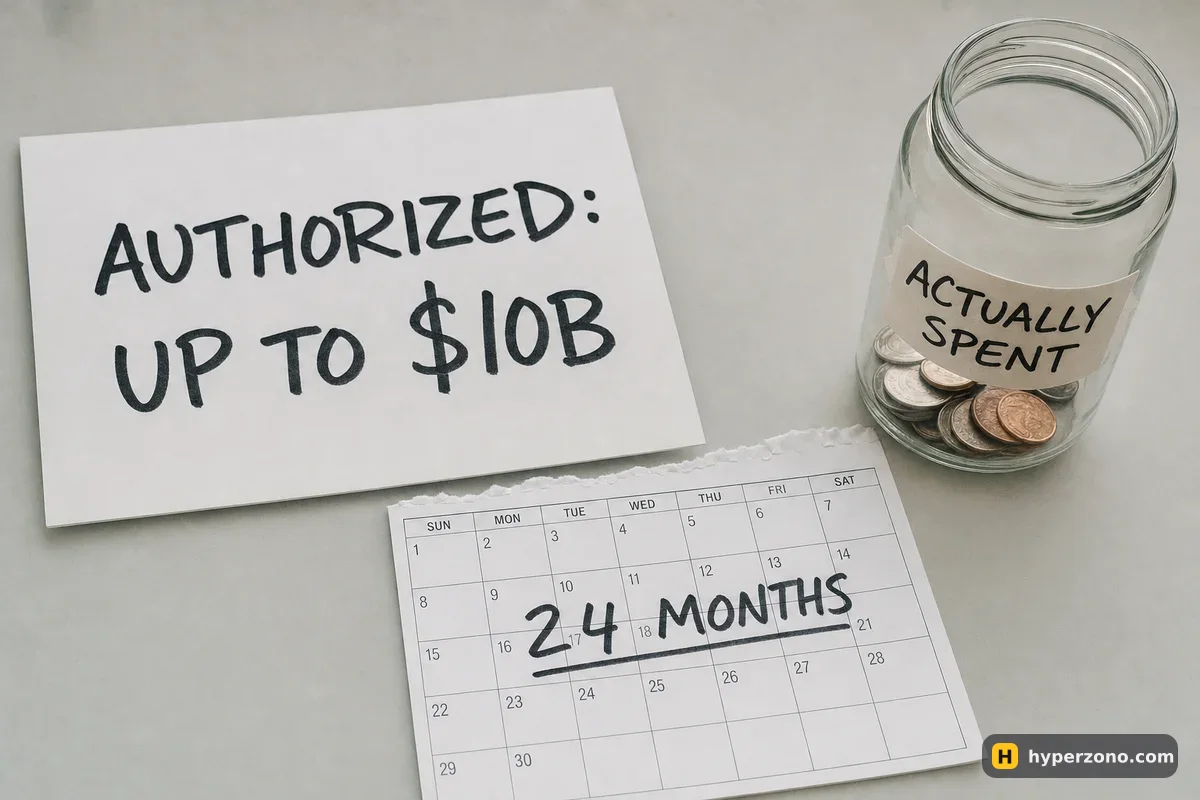
An announcement is permission to spend, not money spent
Read the wording of the press release and you will almost always see two limits: an amount ("up to") and a period. That is a ceiling the board has approved, not a schedule. The company decides later how much it buys, when, and at what price, and it can slow down or stop if cash gets tight, or if the share price climbs to a level where management no longer thinks buying is good value.
The money actually spent shows up later, in the company's own quarterly report — in the part that lists cash coming in and going out. Buying back shares is cash leaving the company, and it sits in that part alongside things like paying off a loan. That is the line to compare with the headline.
So the number worth having is not the announced maximum but last quarter's real spending, measured against the pace the program would need to finish on time. A two-year program is eight quarters long, so around an eighth of the money each quarter means the company is actually doing it. Far below that, and you have a headline and little else.
The arithmetic a buyback actually changes
Shares the company buys back stop counting, and that is the whole mechanism. Fewer shares and the same profit mean each remaining share now represents a bigger slice of the company's earnings, and if buyers keep paying the same price for a slice of profit, the price per share has to be higher. Traders call that profit per share EPS: a $20 share with $2 of profit behind it means buyers are paying ten years of profit for one share.
Here is what that looks like with made-up but tidy numbers. Say a company earns 2,000 million a year, has 1,000 million shares, so profit per share is $2 and the share trades at $20. Now compare three ways the same announced 5% buyback can end up.
| What actually happens | Shares left | Profit per share | Price if buyers still pay ten years of profit |
|---|---|---|---|
| Full 5% bought back | 950 million | $2.11 | $21.05 (+5.3%) |
| Only a third of the program executed | 983 million | $2.03 | $20.34 (+1.7%) |
| 5% bought back, half offset by new shares from staff option plans | 975 million | $2.05 | $20.51 (+2.6%) |
Even the best row here is a single-digit percentage move spread over months, and the market usually prices part of it on the day of the announcement. A buyback is a slow, partial push upwards, not an event with a date on it. That is very different from an earnings surprise, where the whole reaction lands in one session — which is its own topic, covered in why a stock can fall on good earnings.
Check the deadline, the money and the new shares
The deadline tells you how patient you would have to be. A program that runs 24 months will not be visible in the share count for a while, and you pay funding on the position while it's open — on most contracts every eight hours, on some every four or even every hour. The interval is shown on the contract's own page, so check it for the ticker you want, then match the length of the program against how long you can realistically hold a leveraged position. If those two don't match, the buyback is background, not a reason to enter.
Where the money comes from matters just as much. A company can pay for a buyback out of the cash its business earns, or it can borrow to do it, and those are not the same thing — borrowing swaps shares for debt and interest payments. In that same cash section of the report you can see both sides: how much cash the business brought in, and how much new borrowing came in next to it.
Then check whether the company is handing out new shares at the same time. The notes at the back of the report list staff share option plans, and that is where you see whether new shares are being created while old ones are retired. If the option plans issue nearly as many shares as the company buys back, the share count barely moves and the effect on profit per share quietly disappears. The mirror image of this is covered in new share issuance and dilution.
The same report also has a part where management writes about what it expects next — new debt, weaker demand, a slower year. It is worth a minute of your time, because it often explains why the buying slowed down.
You hold a contract, not a share
On a crypto exchange you are trading a perpetual contract on the share price. You are not a shareholder: you don't vote, you can't sell your shares into the company's buying, and dividends reach equity perpetuals through a contract adjustment rather than as a payment to you. The only channel through which a buyback can reach your account is the price of the contract.
A shareholder and a contract holder also face completely different clocks. The shareholder can hold for 18 months and simply wait for the share count to fall. You have a liquidation price, probably a stop, and regular funding payments, so a slow push upwards can expire before it earns anything. Writing out both sides before you enter is the fastest way to see whether the idea fits your position at all.
Here is the unfavourable version with numbers. Say you put 100 USDT of margin into a 500 USDT position at 5x on a stock perpetual and hold for three weeks. You pay the exchange when you open and again when you close — on Binance that is 0.05% each time if you buy at the price already on screen, so about 0.50 USDT in total on a 500 USDT trade. Funding at a common baseline rate of 0.01% per 8 hours would add roughly 3 USDT over 21 days. If the share drifts sideways, you are down about 3.50 USDT for nothing; if the whole market drops 8% on news that has nothing to do with the company, that's 40 USDT off a 100 USDT margin, plus the costs.
Ask what would have to go wrong. If your answer to "why might this not work?" is only "the market could fall", you haven't checked the buyback yet. Three concrete answers worth having: the company spends far less than it authorized, it borrows to buy, or option grants replace the shares it retires.
What to check before you open the trade
Read the announcement, not the headline
Write down the maximum amount, the deadline, and whether the wording says "up to". That is the ceiling, and it is the number the news summary usually turns into a certainty.
Find last quarter's actual spending
Compare the money really spent with the pace needed to finish the program on time — for a two-year program that is about an eighth of the total each quarter. A company at or above that pace is doing something; one far below it has made a statement.
Check the source of the cash and the share count
Cash earned by the business versus new borrowing, and whether the share count is lower than a year ago. If it isn't lower, the buying is being cancelled out somewhere.
Look at the contract itself
Find the ticker in the exchange's stock perpetuals list and check its maximum leverage, fee, funding interval and 24-hour volume. These contracts trade around the clock including weekends, which means the price can move while the underlying stock market is shut.
Write the plan before you click
Entry, stop-loss, target, and a time limit. If the program runs two years and your plan runs five days, be honest that you are trading the reaction, not the buyback.
If you have never opened one of these contracts, the mechanics — finding the ticker, choosing size, setting a stop — are laid out in how to trade Tesla, Apple or Nvidia on a crypto exchange, and the wider menu of stock, index and commodity contracts sits in the markets section. A useful practice run: pick a company that announced a buyback a few quarters ago, look at what it actually spent, and see whether the chart did what the headline suggested.
When you want to check real parameters rather than examples, the quickest way is to open a Binance Futures account and look up a stock perpetual in the TradFi list — the screen shows maximum leverage, the funding interval and the fee for that specific contract. Binance added stock perpetuals to futures on 6 October 2026, with new listings starting at up to 20x; at the base level the fee is 0.05% if you buy at the price on screen and 0.02% if your order waits in the book until someone trades with it. Availability of these contracts depends on where you live, so check during sign-up that futures and that specific contract are open to you.
Does a share buyback always push the stock price up?
No. It can only help if the company actually buys, if profit holds up, and if buyers still pay the same price for a slice of that profit. Plenty of programs are announced, partly executed, and then overtaken by weaker results or a falling market.
How do I find out how much a company really bought back?
In its own quarterly and annual reports. Look at the part that lists cash coming in and going out: money spent on the company's own shares sits there, next to things like repaying a loan. Compare that figure with the headline amount and how much time is left on the program.
Do I get anything from a buyback if I only hold a perpetual contract?
Only through the price. You are not a shareholder, you can't sell shares back to the company, and on equity perpetuals dividends are handled by a contract adjustment rather than paid to you. Everything you earn or lose comes from the price difference, minus fees and funding.
Is it better to trade the reaction on announcement day or hold for the program?
They are two different trades with different risks. The announcement move is fast and often faded within days; holding for the share-count effect means weeks or months of funding payments on a leveraged position. Pick one and write the stop and the time limit that goes with it.
Why would a company announce a buyback and then not do it?
Because the announcement costs nothing and the spending is optional. Cash may be needed elsewhere, borrowing may get expensive, or the share price may rise to a level management no longer finds attractive. That is exactly why the authorized amount and the amount actually spent deserve two separate lines in your notes.
Sources and fact-check
Exchange terms were checked against official documents on November 9, 2026. Terms change — before you trade, check what matters to you in the exchange app and in your contract’s specs.
SEC: Beginners' Guide to Financial Statements