Contents
The price already knows the good newsCompare the result with expectations, not only with last yearRevenue, profit and the outlook are three separate storiesWhy the price can move several times while you are still readingA practice review you can do without guessing in hindsightWhat the trade itself would look like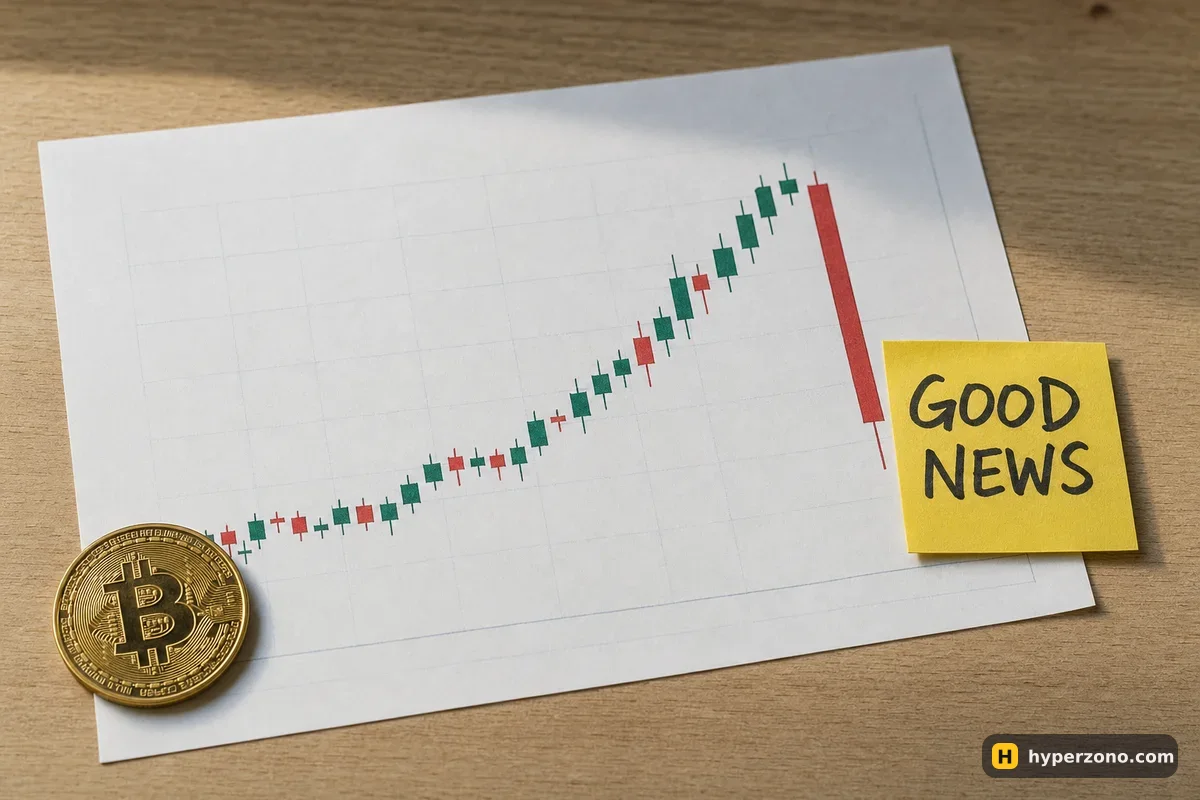
The price already knows the good news
A share price on the day before earnings is not a photo of the past quarter. It is what buyers and sellers are willing to pay today, knowing roughly what the company is likely to report. If everyone in the market expects strong growth, strong growth is already paid for. The report then only confirms the price that exists — and anyone who bought hoping for something even better has a reason to sell.
That is why the reaction often looks upside down. A result can be excellent compared with last year and still be a miss compared with what people had already decided to believe. The same logic works the other way: a weak quarter with a better-than-feared outlook can send the price up.
Compare the result with expectations, not only with last year
Two comparisons live in every earnings headline, and news articles mix them freely. "Revenue up 26% year on year" compares the company with itself. "Revenue slightly below forecasts" compares the company with the market. The second one usually drives the first hour of trading.
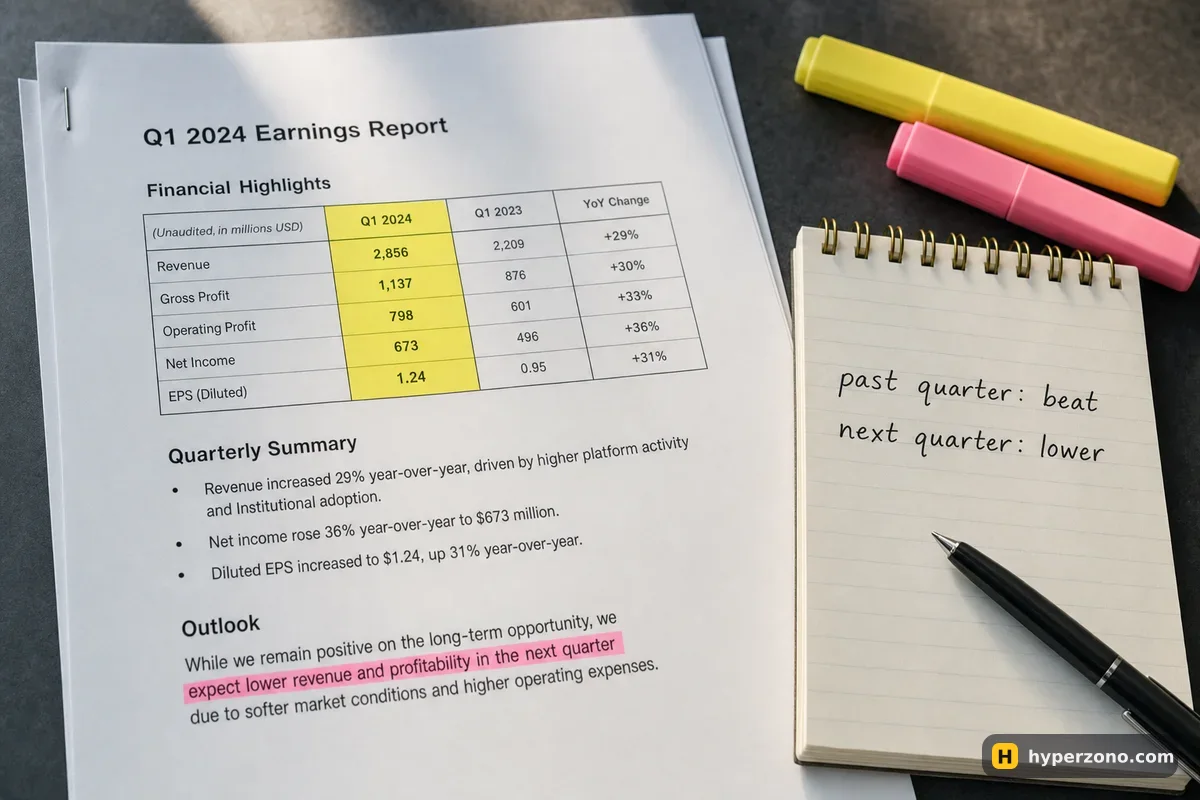
There is a third number you need before reading any report. Along with the quarter that just ended, the company tells you what it expects to sell and earn in the months ahead. That forecast from management is called guidance, and it is often the line the price reacts to.
Here is a made-up company so all three sit side by side. The numbers are invented for the example, not a real report.
| What is measured | A year ago | What the market expected | What the company reported |
|---|---|---|---|
| Revenue | 10.0 bn | 12.5 bn | 12.6 bn |
| Profit per share | 1.00 | 1.30 | 1.32 |
| What the company expects next quarter (guidance) | — | about 13.5 bn | 12.8 bn |
Where do you find the expectation half? The company's own site gives you the result and its outlook — on Nvidia's investor page, for instance, under Quarterly Results. The forecast you need to compare it with is the one published before the release; big financial news sites print it as the "expected" revenue and profit next to the headline. Note both numbers down the day before, while they are still easy to find.
Revenue, profit and the outlook are three separate stories
A quarterly report is several different numbers wearing one label. For the price reaction you mostly care about three of them: how much the company sold, how much it kept as profit, and what management says about the months ahead. Sales can grow while profit shrinks, because costs grew faster — that is a different signal from a weak outlook, even though both can turn the chart red on a day of good headlines.
So when you see a green headline and a red chart, split the report into those three parts and ask which one came in below what people expected. Usually one of them stands out, and it is rarely the revenue line in the headline. How a market digests a release in general — earnings, rate decisions, inflation data — is the subject of trading the news with futures.
Why the price can move several times while you are still reading
US companies usually release results outside the main Nasdaq and NYSE session, which runs from 9:30 to 16:00 New York time. The headline numbers come out first, then management speaks on a call, and the two can pull in opposite directions. A contract on that company at a crypto exchange keeps trading through all of it, including nights and weekends, so you may watch a jump up, a slide back down and another move an hour later — which hours these contracts trade is worth knowing before you plan an entry.
The first minutes are the most expensive place to be wrong. When the price jumps in one second, a stop order sends your exit to the market at whatever price is available then, which can be well past the level you set. If you want to be in the market around a release, use the smallest position you can open — or wait an hour and trade the move you can actually see.
A practice review you can do without guessing in hindsight
The point of reviewing an earnings reaction is not to collect a story, it is to find out whether your reading of expectations was any good. That only works if the reading is recorded before the event. Here is a simple cycle you can repeat on one company every quarter.
Pick one company and find its report date
Use the investor relations site of the company itself — the events and quarterly results sections carry the date. One company is enough; you learn more from four quarters of one name than from one quarter of four.
Note the expectation the day before
Write down the forecast revenue and profit you can find, the company's own previous forecast, and the current price of the contract you would trade.
Write both reactions in advance
Two or three sentences each: what makes you expect the price up, what makes you expect it down. Give each a rough size, for example "a 3–5% move". After the release both explanations will feel obvious, and only this note shows whether you read it right.
Record the actual numbers and the first hours
Fill in revenue, profit and the new outlook next to your expectations, and note where the price was one hour, one day and one week later.
Mark what you missed, not what you predicted
If the price fell on a beat, find the line that caused it. That line is the thing you did not weigh correctly, and it is the only part of the exercise worth keeping.
You can run this whole cycle without any money in a trade. Demo trading simulates the mechanics but not the feeling, and a specific stock contract may or may not be available in demo, so check the ticker you chose before you rely on it.
What the trade itself would look like
If you then want to act on one of your scenarios, the contract side is simple. On Binance you can trade contracts on company shares in the same place as bitcoin, with everything counted in USDT. These contracts have no end date — they are called perpetuals, and perpetual futures versus ones with an expiry date explains how that works.
Binance lists 217 of these non-crypto contracts in total — stocks and ETFs, gold, silver, oil, gas, copper and some Hong Kong and Korean shares. Stock contracts go up to 20x–75x depending on the company, Tesla is 25x, and the newest stock listings top out at 20x. On an earnings day you do not need anything near that. Holding one of these contracts does not make you a shareholder; instead of a dividend payment, equity perpetuals use a dividend adjustment.
Say you take a 500 USDT position with 100 USDT of margin at 5x after a report, and the price goes against you by 4%. Your loss is 20 USDT on the price move, plus the fee on each side — the exchange takes 0.05% of the position size each way, that is 0.25 USDT to open and 0.25 USDT to close. A 4% move against a 5x position has taken a fifth of your margin, and around earnings a 4% move can arrive in a minute. Put the stop in together with the order and keep the trade on isolated margin, so the most you can lose is the margin you set aside for it.
Before anything else, check that the exchange and its futures are available where you live — stock contracts are not offered everywhere, and the country list is not published. The quickest way to see the real contract details, maximum leverage and your own fee level is to open a Binance Futures account and look at the contract page for the ticker you have been following; finding that ticker and placing the order step by step is covered in how to trade Tesla, Apple or Nvidia contracts. Our buttons and links to exchanges carry a referral identifier and we may receive a reward from the exchange; it does not change what we write here.
Why do stocks fall on good earnings?
Because the price before the report already included good earnings. The move afterwards measures the gap between what was expected and what arrived — including the company's own forecast for the next quarter. Results can beat last year and still land below the bar the market had set.
Where can I see what the market expected before the release?
The company's own investor relations site carries the result and its outlook, usually under quarterly results. The forecast to compare it with is printed by big financial news sites as the "expected" revenue and profit next to the headline. Write both numbers down before the release, because afterwards everyone remembers having expected the right thing.
Is it a good idea to open a trade right before earnings?
It is the hardest moment to trade, because the move can be large and fast in either direction, and a stop order can fill well away from your trigger price when the price jumps. If you still want to try it, use the smallest position you can open, set a stop before the release and accept that it may fill below your price. The simplest alternative is to wait an hour after the numbers and trade what you actually see.
Does the contract keep moving when the stock exchange is closed?
Yes. The stock contracts on Binance trade around the clock, weekends included, so a result released after the New York close shows up in the contract price right away. The stock exchange being shut does not pause the contract.
If I hold a stock perpetual, do I own the share?
No. You hold a contract whose price follows the share; you are not a shareholder and you get no voting rights. For dividends, equity perpetuals use a dividend adjustment rather than a payment to a shareholder.
How many reports should I review before I trust my reading?
One company over several quarters teaches more than one quarter across several companies, because you start recognising which part of that company's report the market reacts to. Keep the notes in the same place so you can compare your pre-release expectation with what actually mattered.
Sources and fact-check
Exchange terms were checked against official documents on November 9, 2026. Terms change — before you trade, check what matters to you in the exchange app and in your contract’s specs.
SEC.gov: Beginners' Guide to Financial StatementsNVIDIA Corporation — Financial Reports (investor relations)