
Contents
The three ways to practice with no moneyWhy one tool alone is not enoughA four-week plan that uses all threeKeep a journal from the very first tradeWhen practice without money stops helping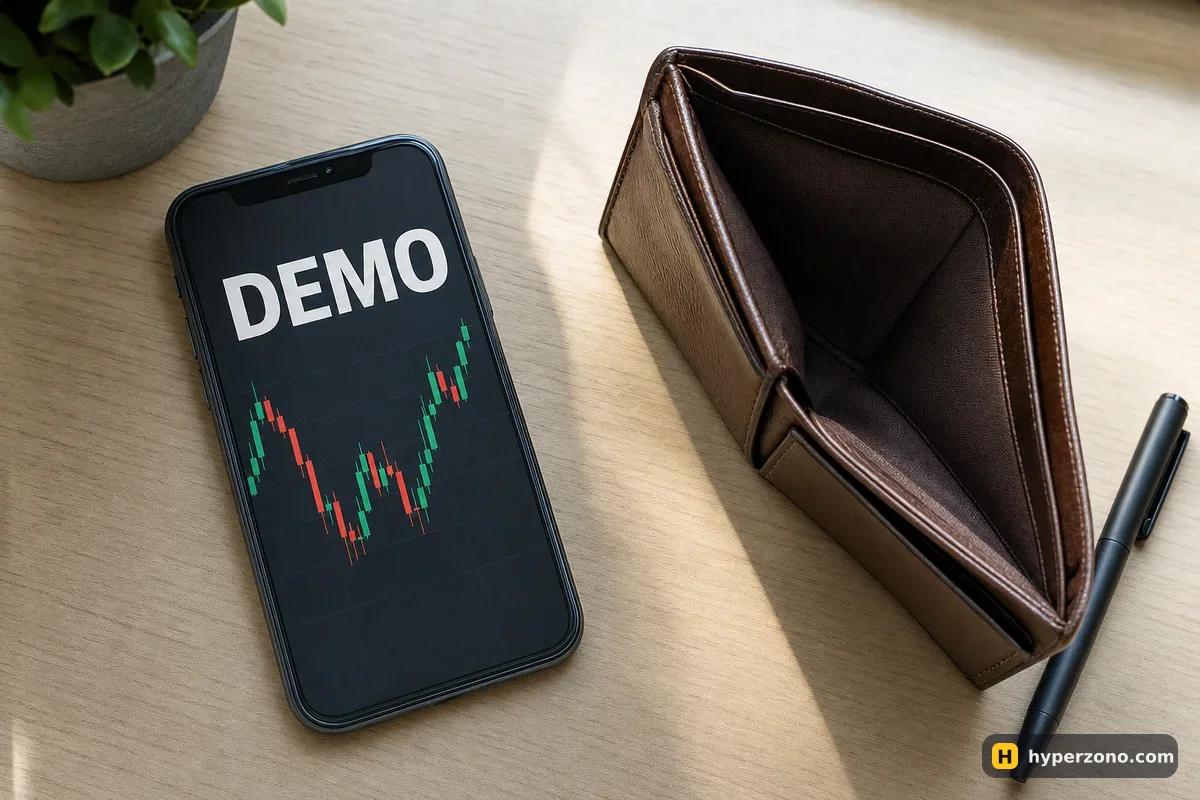
The three ways to practice with no money
The first one is a demo account on the exchange — the app gives you virtual USDT and real live prices. You trade in the same order window you would use for real: orders go through, the position shows a profit or a loss, and if the loss eats the deposit you put behind the trade, the exchange closes the position on its own. That is called liquidation (what liquidation is). On demo it costs you nothing but a lesson. Several big exchanges offer demo trading; we list them on the page about exchanges with demo futures trading.
The second is paper trading, which sounds fancy but is just a spreadsheet. You watch the live chart, decide you would go long bitcoin at 83,500 with a stop at 82,700, and you write that down with the time, the size and the reason. Later you come back and record where it actually ended. No app, no account, no buttons — only your decisions, written honestly.
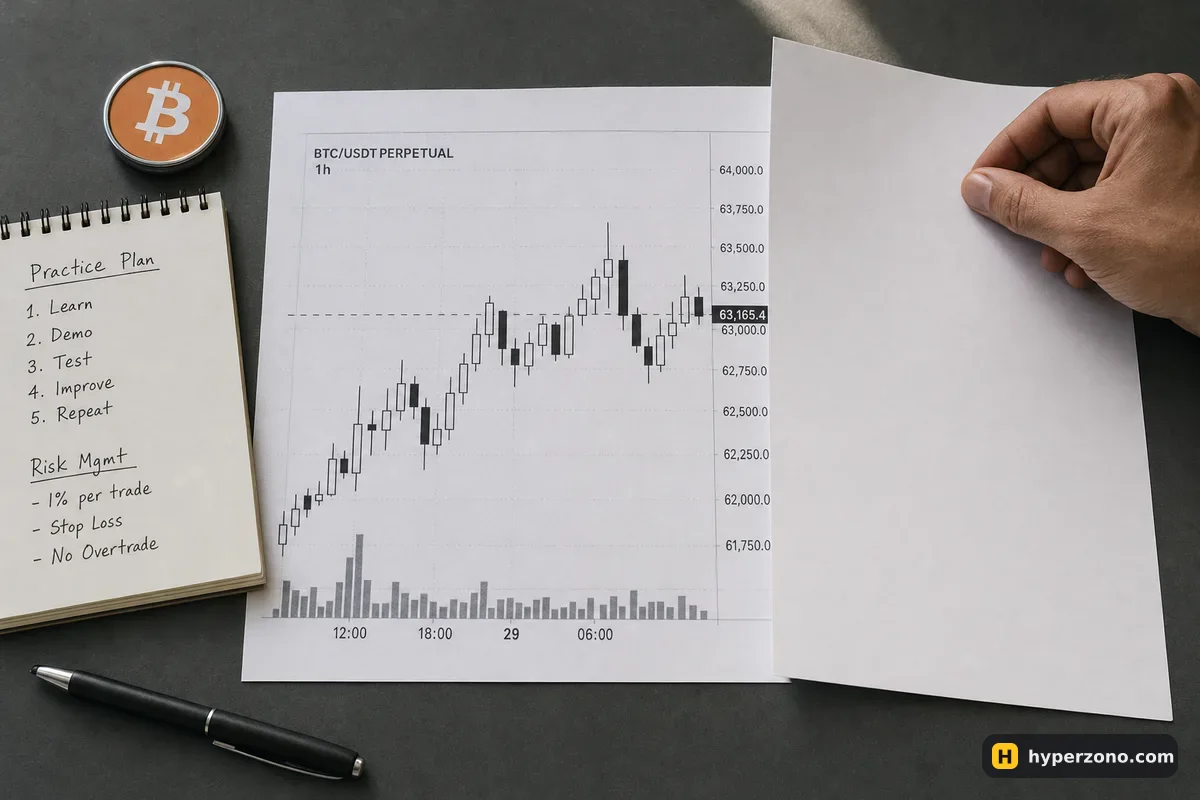
The third is replay on historical charts. Most charting tools have a replay button that hides everything to the right of a chosen date and then reveals the candles one at a time, so you see the past as if it were happening now. It is simply the fastest way to see hundreds of situations without waiting hundreds of days. If your charting tool has no replay button, a sheet of paper over the right half of the screen does the same job.
Why one tool alone is not enough
Demo is where you learn the machine: where every button sits, how a stop-loss and a take-profit behave once the price reaches them, how much of your balance the exchange locks up when you change leverage, and how isolated margin keeps one bad trade from touching the rest of your money. What it cannot teach you is how it feels to risk funds that are actually yours, and that gap makes people sloppy. When the balance says 10,000 virtual USDT, opening a 50x trade on a coin you have never heard of costs nothing, so you do it and you build a habit that will be expensive later. The fix is simple: decide that only 100 USDT of that balance exists, and trade as if that were the whole account.
The spreadsheet does something the demo never will: it forces you to decide before the candle moves, and it keeps the record even when the trade goes against you. Planning the entry, the stop and the size in advance, the same way every time, is the habit that separates trading from clicking. The catch is execution — on paper you always get the exact price you wanted, while in the app you get the price the market gives you, usually a little worse. You also never pay a fee on paper, so write it into the sheet yourself: on Binance's USDⓈ-M futures at the base level that is 0.02% if your order sits in the book and 0.05% if it fills straight away, charged once when you open and again when you close — more in what fees you pay on futures.
Replay has the opposite problem. You can always peek at the next candle, and you already know how the story ended, so it proves nothing about whether a strategy will keep working. What it does well is train your eye and your patience — an hour of it shows you more market situations than a week of watching the live chart. Use it for one narrow question at a time, like what a breakout looks like just before it fails, rather than as evidence that you have found something that always works.
A four-week plan that uses all three
Week 1 — read the chart in replay
Pick one pair, bitcoin or ethereum, on a one-hour chart. Replay old price action for 30–40 minutes a day. Before each new candle appears, say out loud whether you would buy, sell or stay out, and where your stop would sit. Write ten of these decisions down with the result. You are not making money here, you are training your eye.
Week 2 — learn the buttons on demo
Open a demo account and place around 20 trades with the sole aim of using the tools correctly: market and limit orders, a stop-loss on every single position, take-profit, isolated margin, and changing leverage while watching how much of your balance the exchange locks up as a result. Deliberately let one trade get liquidated so you see exactly what that looks like in safety. If you choose Bybit, look for the demo or practice option in the account section of the app — see how to open a Bybit demo account, and check during sign-up whether demo trading is offered where you live.
Week 3 — paper trade live prices
Now slow down. One or two trades a day, written in the spreadsheet before you look at the result: entry, stop, target, size, reason, fee. Risk the same small amount on each one — say 2 USDT out of an imaginary 100. The goal is not profit, it is doing the same thing twenty times in a row.
Week 4 — repeat week 3 on demo, then review
Run the same plan on the demo account, so your written decisions meet live prices and the fill you actually get, not the perfect one in your head. Check in the demo whether it also charges the fee; if it doesn't, subtract it yourself in the sheet. At the end of the week read your whole journal in one sitting and find the pattern: most beginners discover their losses come from trades they never planned. Fix that one thing before you add any money.
Give your demo account a realistic size. If the exchange hands you a large virtual balance, decide that only 100 of it exists and never open a position bigger than that account could carry. A habit built on fake millions does not survive contact with your real 100 USDT.
Keep a journal from the very first trade
Practice without a journal is just screen time. The journal is what turns twenty random clicks into something you can learn from, and it takes about a minute per trade. A notebook, a notes app or a spreadsheet all work equally well — what matters is that you fill it in before you know the outcome.
- Date, pair and direction — long or short
- Entry price, stop price, target price, and the size in USDT
- Why you took it, in one plain sentence
- How you felt: calm, bored, in a hurry to make the money back
- Result after fees, and one line on what you would do differently
After thirty entries the honest answers start to show up on their own. You will see that your planned trades behave very differently from the ones you opened because the price was moving fast. That single discovery is worth more than any video course, and it costs you nothing but the minute a day you spend writing things down.
When practice without money stops helping
There is a ceiling, and most people hit it after four to eight weeks. The signs are easy to spot: your demo results stop changing, you follow your own rules without effort, and you start placing random trades out of boredom because nothing is at stake. At that point more simulation adds very little, because the part you still have not trained is your reaction to real losses — we go through those differences in demo versus the real thing.
Demo and live feel different, and the bridge is small money rather than a bigger demo balance — the smallest position your exchange allows, isolated margin, a stop-loss on every trade. When your journal says you are ready, you can sign up on Bybit and run the same plan with real USDT behind it; check during sign-up that futures are available where you live.
Can I really practice crypto futures for free?
Yes. Demo accounts on exchanges cost nothing, a spreadsheet costs nothing, and replaying old charts costs nothing. The only thing you spend is time, and a month of it is enough to learn the mechanics properly.
Is paper trading crypto futures actually useful, or is it a waste of time?
It is useful for one specific thing: forcing you to decide before the price moves and to write the decision down. It is a waste of time if you give yourself the perfect price and skip the fees, because then you are only recording a fantasy.
Do I need to register and verify my identity to use demo mode?
That depends on the exchange — some give you a demo account right after sign-up, and demo trading itself is not offered everywhere. Check inside the app when you create the account and look for a demo or practice option in the account section.
How long should I practice before using real money?
Four to eight weeks of regular practice with a journal is enough for most people. Stop when your results stop changing and you follow your own rules without arguing with yourself, then start with an amount you could lose without it affecting your week.
Does replaying old charts prove that a strategy works?
No. Replaying history is great for training your eye and your patience, and terrible as proof that something will keep working in the future. Treat it as practice, not as a promise, and never raise your position size because old candles looked kind to you.
Can I lose money on a demo account?
No — the balance is virtual, so even a liquidation on demo costs you nothing but a lesson. That is exactly why you should deliberately blow up one demo position early: you see the whole process once, in safety, instead of discovering it with your own funds.