Contents
Why gold shows up twice in your appHours, settlement currency and what holding costsA gold trade counted out, up and downHow to confirm which one you are about to openWhich route makes more sense for you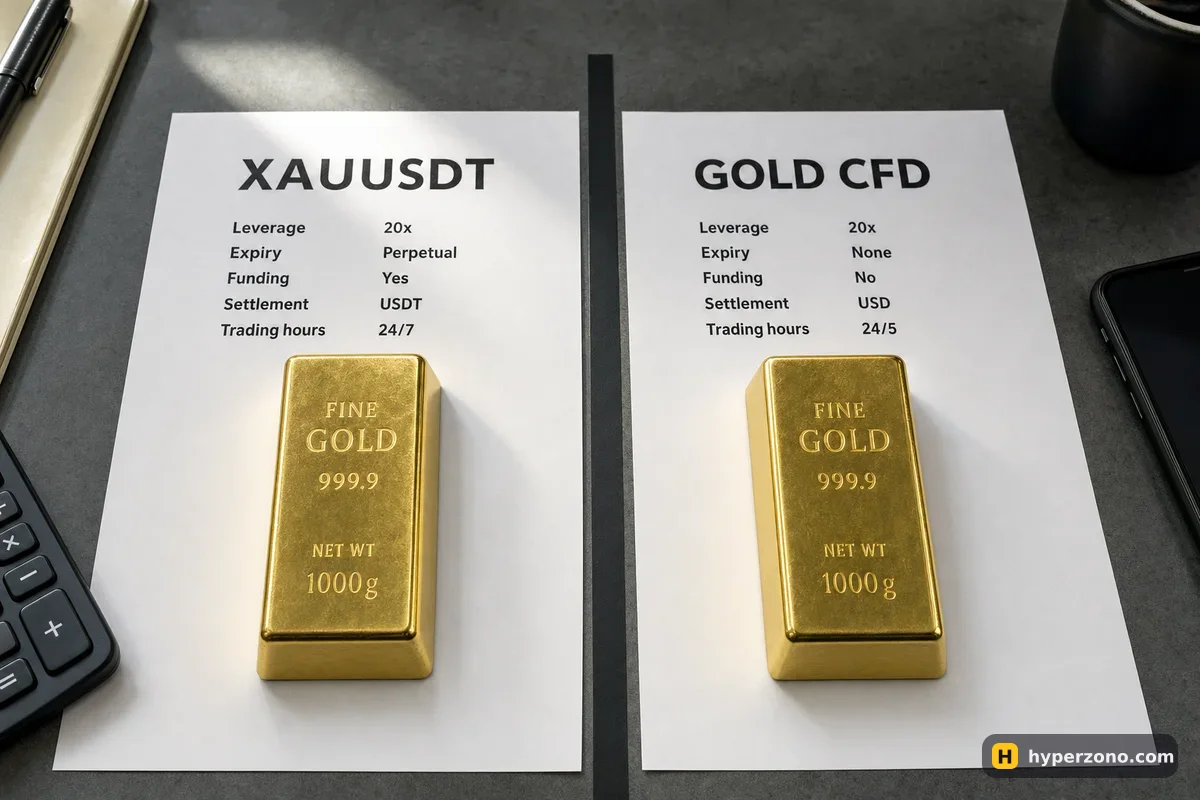
Why gold shows up twice in your app
Both products exist for the same reason: most people who want to trade the gold price have no interest in storing a bar. So companies sell you the price difference instead. A CFD provider does it privately — you open the trade with that firm, and that firm quotes the price, holds your money and pays or collects the difference when you close.
A crypto exchange does it through a market. When you open a long on a gold perpetual, your order meets somebody else's sell order in the same order book, and the exchange sits in the middle enforcing margin rules for everyone. That is the core difference: a CFD is a contract with one company, a perpetual is a contract matched against other traders on a venue. You don't need a separate brokerage account for the second route — we cover that in do I need a broker for crypto futures.
Everything else people argue about — hours, currency, overnight costs — follows from that first difference. The provider sets its own schedule and its own charges. The exchange publishes one specification per contract, and everyone trading that ticker gets the same terms.
Hours, settlement currency and what holding costs
Here is what to compare side by side before you decide which account to open. The perpetual column uses what Binance publishes; the CFD column stays deliberately open, because those numbers come from whichever provider you are looking at and you have to read them there.
| What to check | Crypto-exchange perpetual | CFD with a provider |
|---|---|---|
| Who is on the other side | Other traders in the same order book; the exchange matches orders and sets the margin rules | The provider quotes your price and is your counterparty |
| Where the rules live | The contract specification page for that ticker on the exchange | The provider's instrument details and terms |
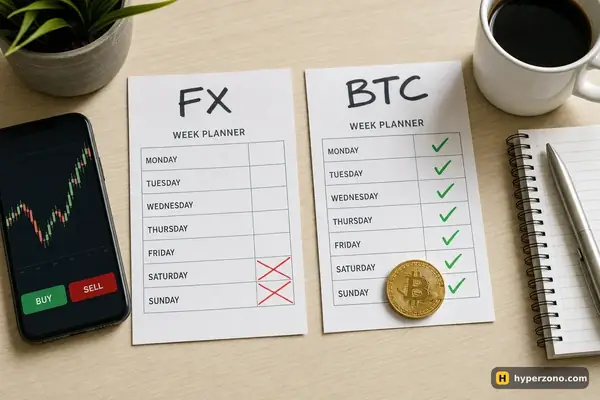
| Trading hours | Crypto runs around the clock; Binance's stock and commodity perpetuals also trade on weekends | The schedule that provider sets for the instrument — check it before planning a weekend trade |
| Money it is counted in | USDT or USDC on most contracts | Whichever account currency the provider offers you |
| Cost of holding | A fee on entry and a fee on exit, plus funding every 8, 4 or 1 hour depending on the contract | The spread — the gap between the buy price and the sell price the provider shows you — plus a charge for every night you keep the trade open. Ask for both in money, not just a percentage. |
On a Binance USDⓈ-M contract at the base level, you pay about 0.05% of the trade size when you buy at the price already on screen, and a little less — 0.02% — if you place a limit order and wait for someone to come to you. You pay that twice: once to open and once to close. On top of it sits funding, a payment passed between longs and shorts, which the exchange does not keep. On a CFD the equivalent costs are usually folded into the spread and a daily financing charge, which is why two providers can show the same gold price and still cost you different amounts over a week.
A gold trade counted out, up and down
Say you have 100 USDT in your futures wallet. You decide to risk only part of it: you put 50 USDT in as margin at 5x, which opens a 250 USDT position in gold. The other 50 USDT stays free, so a bad move has room to breathe before the exchange steps in.
Gold rises 2% and you close a couple of hours later, without holding through a funding settlement. The position earns 5 USDT and the only cost is the fee: roughly 0.13 USDT to open and 0.13 to close. You keep about 4.75 USDT, so your 100 becomes about 104.75.
Hold the same trade overnight and you pass one or two funding settlements. At the usual baseline of 0.01% per 8 hours, each settlement takes about 0.025 USDT from a 250 USDT position, so roughly 0.05 USDT if you pass two of them overnight. Small next to the price move, but it is there, and only whoever holds the position at the settlement moment pays it.
Now the other direction, which matters more. Gold falls 2% instead: the position loses 5 USDT, the same 0.25 USDT of fees still comes off, and your account is down to about 94.75, with roughly 44.75 USDT left supporting the trade. These are illustrative numbers, but the shape is real — the costs are small next to the price move, and the price move is what decides your result.
And if gold keeps sliding, the loss keeps coming out of the margin you committed. At 5x, a fall of around 20% would use up those 50 USDT, and the exchange closes the position on its own before the margin runs out — that is called liquidation. Two habits keep this boring rather than frightening: set a stop loss at the moment you open the trade, so you choose the exit price instead of the exchange, and keep the position in isolated margin, so the money at risk is the 50 USDT you assigned and not the whole balance. You can put your own amounts into the fee calculator below.
How to confirm which one you are about to open
The names on screen are not always helpful — platforms call things "derivatives", "TradFi", "margin" or just "gold". These checks take about a minute each and settle it.
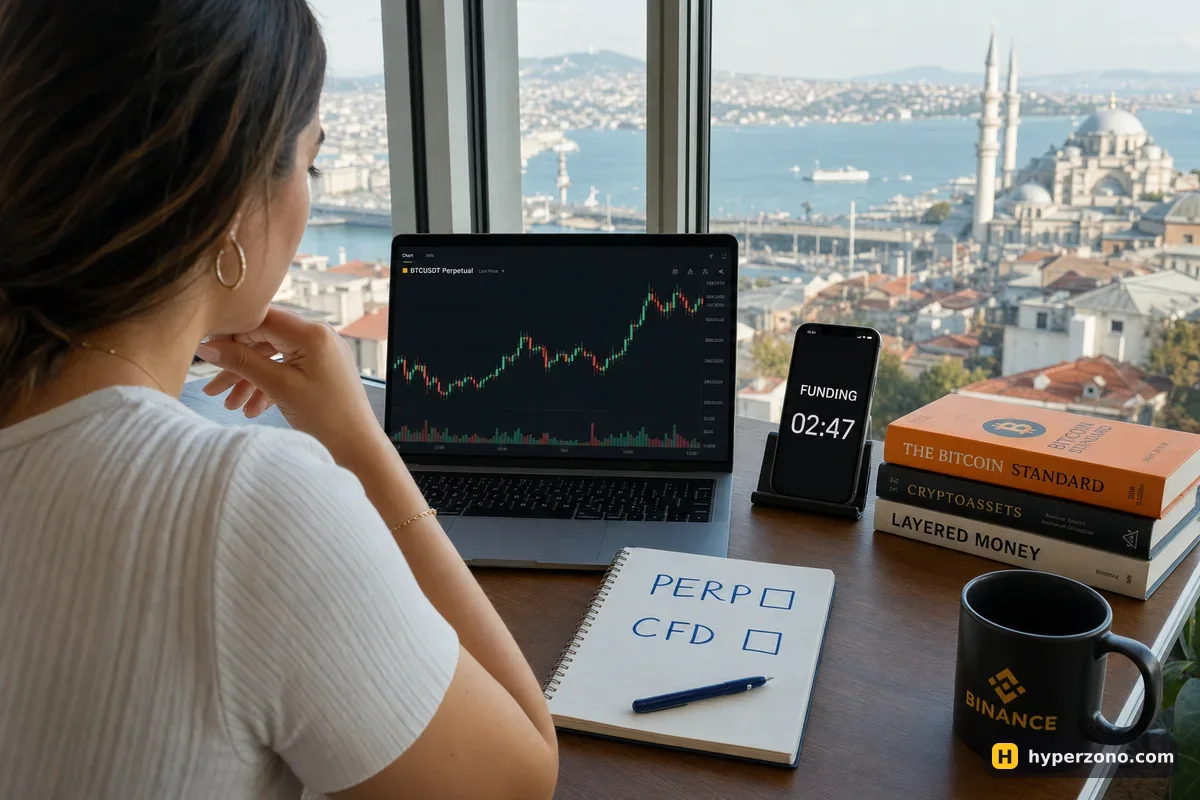
Look for a funding countdown
A perpetual futures screen shows a funding rate and a timer to the next payment, because longs and shorts settle with each other every few hours. A CFD screen has no such thing — it has an overnight charge instead.
Read the ticker carefully
Crypto-exchange contracts carry their settlement currency in the name, like XAUUSDT or XAUUSD1. A plain "Gold" or "XAUUSD" with no contract page behind it is usually a provider's own instrument.
Open the contract specification
On an exchange every ticker has one: minimum order size, maximum leverage, funding interval, settlement. If you cannot find such a page, you are not on an exchange contract.
Check where the margin comes from
A perpetual draws margin from your futures wallet in USDT or USDC. A CFD account is a separate account, usually in a national currency, funded separately.
Open it in demo first
Before any money moves, find the same instrument in demo mode and open one small trade. Not every contract exists in demo, so check your chosen ticker; if it is missing, practise the mechanics on one that is there.
If you want to try the exchange route, the quickest way to see all five checks at once is to open a Binance Futures account, find the gold contract and read its specification page before you deposit anything.
Your country can reshape both products. In February 2026 ESMA said that perpetual futures for retail clients are likely to fall under the same national rules as CFDs — leverage caps, risk warnings, margin close-out and negative-balance protection. OKX's X-Perps for the EEA show what that looks like in practice: contracts with a five-year expiry and perpetual-style funding, capped at 10x, after identity checks and a suitability test. Check availability and limits inside the app during sign-up rather than assuming the global product reaches you. Details for European readers are in trading futures in the EU.
Which route makes more sense for you
If you already hold USDT, want crypto and gold or stocks in the same place, and like the idea of reading one public specification per contract, the crypto-exchange perpetual is the simpler starting point. Trading does not stop at the weekend, the fee is a published percentage of your trade size, and the holding cost is funding you can see in advance instead of a number hidden in the gap between the buy and sell prices.
A CFD account can suit you better if you want to pay in your local currency, if your country's rules make a licensed local provider the straightforward option, or if the instruments you care about simply are not listed on any exchange you can use. In both cases nobody delivers you gold — you simply get paid, or pay, the difference in price, and you can use leverage on both. So the better route is whichever is properly available to you with costs you can read. If you are leaning toward the exchange, which exchange suits a beginner narrows it down, and how gold trades on a crypto exchange shows what the contract looks like in practice.
One more thing worth knowing before you commit: on a crypto exchange you also choose between a perpetual and a contract with an expiry date, and they cost different things to hold. That choice is explained in perpetual versus dated futures.
Is a perpetual just a CFD with another name?
Economically they are close: in neither case does anyone deliver you the metal or the shares, you simply settle the price difference in money, and both let you use leverage. The difference is structural — a perpetual is matched against other traders on an exchange with one published specification, while a contract for difference is a private agreement with a provider. Regulators have noticed the overlap, which is why ESMA said in 2026 that retail perpetuals in the EU are likely to fall under the existing CFD rules.
Can I trade the same gold on both at once?
Nothing stops you if both are available where you live, but treat them as two separate risks with two separate sets of costs. Running the same idea in two places usually just doubles your fees, and you end up with twice as much money riding on the same gold price without noticing it.
Which one is cheaper to hold for a week?
You can only answer that with the actual numbers. On an exchange contract you can add it up in advance: the entry and exit fees plus funding for each interval you hold through. With a CFD you need the provider's overnight charge in money, not a percentage, to compare properly.
Do I need a broker account to trade crypto futures?
No. A crypto exchange account is enough — sign up, verify your identity, deposit USDT and switch on the futures section. There is no broker, no separate trading platform and no paperwork beyond the exchange's own checks.
What if my country restricts one of them?
That happens often, and in both directions — some places limit leverage on CFDs, others restrict crypto derivatives entirely or push them through a licensed local entity with different products. Check the exchange's own country pages and confirm during sign-up; never try to get around a block.