Contents
Who is on the other side of your tradeHours, minimum entry and leverageWhat each one costs on the same tradeRules, protection and the catches on each sideSo which one should you start with?Who is on the other side of your trade
On a crypto exchange, when you tap Long your order goes into one shared list of everyone's buy and sell orders. The person on the other side is another trader somewhere in the world, and the exchange's job is to match you and take a small fee from each side. Everyone looking at that contract sees the same list and the same last traded price, which is why two people in different countries can argue about where bitcoin is going but never about what it just traded at.
Retail forex works differently. There is no single central exchange you connect to: your price comes from your broker's own feed. With many brokers, the firm itself takes the other side of your trade, or hands it to a few big banks it works with. Two brokers can show slightly different prices for the same currency pair at the same second, and the spread you pay is set by the company you signed up with.
This is not about one side being dishonest — plenty of brokers are properly licensed and plenty of people trade with them for years. It just means that on forex your entry price, your exit price and your cost all come from one company, while on an exchange you can watch them in a public list. If you want to see what that looks like, open a Binance Futures account and put the order list next to the chart.
Hours, minimum entry and leverage
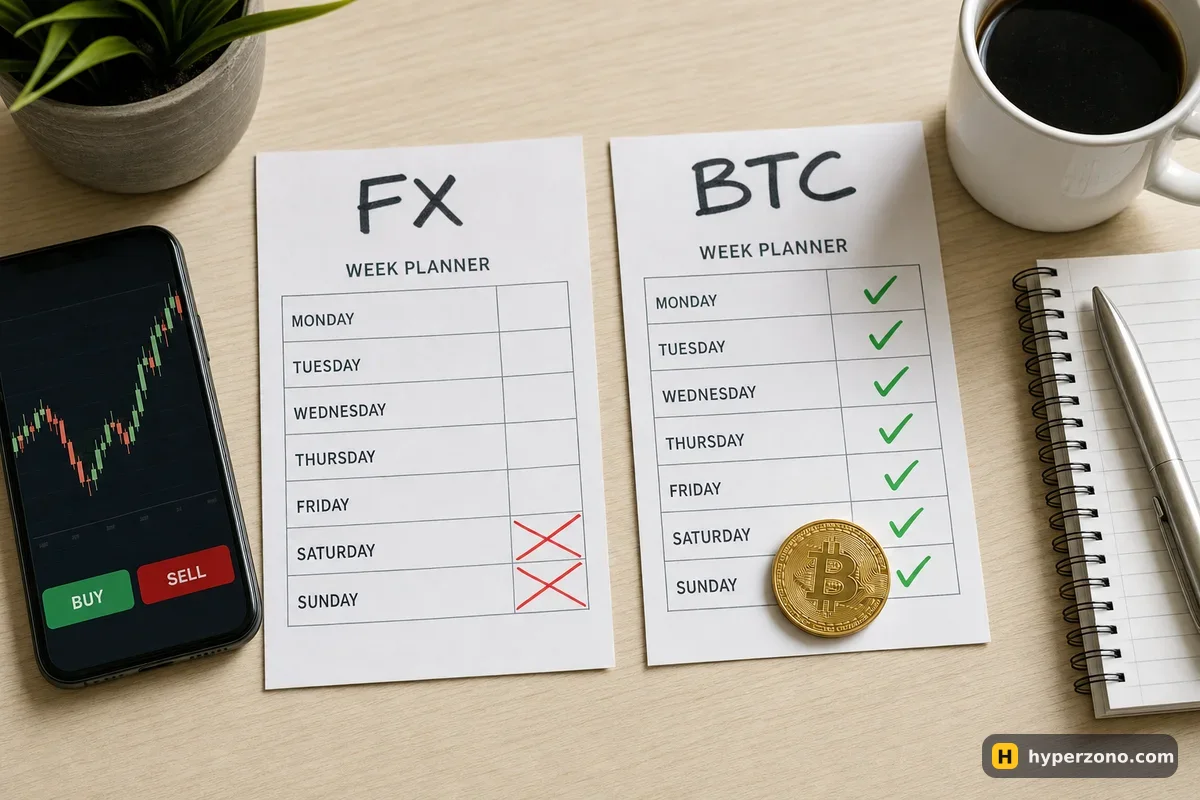
Crypto futures trade every day of the week, weekends and public holidays included. Forex runs around the clock on weekdays and then stops for the weekend, so a position you hold on Friday evening sits through two days of news you cannot react to. If you work weekdays, this matters: crypto gives you Saturday morning to practise, and forex gives you two days when you genuinely cannot look at the screen.
The size you can start with is where the gap is widest. On Binance, most altcoin contracts can be opened from about 5 USDT of position size, ETHUSDT from 20 USDT, and bitcoin from 0.001 BTC — with 25 USDT of margin that bitcoin position opens from 5x leverage. Retail forex is usually built around lots: a standard lot is 100,000 units of the base currency and a micro lot is 1,000, so the smallest normal trade is still worth about a thousand dollars of currency, even if the deposit your broker holds for it is much smaller.
Leverage limits differ on both sides and depend on where you live. On Binance, a new futures account cannot use more than 20x during its first 30 days, and the starting leverage comes from the experience level you pick when you open the account — 2x for Beginner, 5x for Experienced, 20x for Advanced. Forex brokers are capped by whichever regulator licenses them, which can mean a low limit in one country and a high one in another. The arithmetic is the same either way, and what leverage actually does to your money is worth reading once before you choose a number.
What each one costs on the same trade
Say you open a 1,000 USDT position on bitcoin and close it later the same day. At Binance's base fee level you pay 0.05% as a taker going in — 0.50 USDT — and 0.05% coming out, another 0.50 USDT, so one USDT in total. If you hold through a funding payment, you also settle funding: most contracts pay every 8 hours, some every 4, and at an illustrative rate of 0.01% a 1,000 USDT position means 0.10 USDT. That payment goes between traders, not to the exchange, and it can land on your side instead — how funding works explains when you pay and when you get paid.
On forex the same trade is usually priced through the spread. Prices there move in tiny steps called pips — on a 0.01 lot of EUR/USD, which is 1,000 euros, one pip is about 0.10 dollars. The spread is what you pay to get in and out, so a one-pip spread on that trade costs you about 0.10 dollars in total, and there is no separate fee on the way out. Hold overnight and the broker applies a swap, which can be charged to you or credited to you depending on the pair and your direction. Both of those numbers live in your broker's own tables, so look them up before the first trade rather than after.
On paper a spread on a major currency pair often looks smaller in percentage terms than an exchange fee. Count it in your own money instead. A 1-pip spread on a 10,000-euro trade costs you about a dollar, roughly the same as the fees in and out on a 1,000 USDT bitcoin trade — and currency pairs move far less in a day than bitcoin does, which is why forex trades tend to be bigger and more frequent. Compare what you actually pay, not the percentage.
| Crypto futures (Binance USDⓈ-M) | Forex through a broker | |
|---|---|---|
| Who takes the other side | Another trader in a shared order list; the exchange matches you and charges a fee | Often the broker itself, or the big banks it works with; the price is the broker's |
| When it trades | Every day, weekends included | Around the clock on weekdays, closed for the weekend |
| Smallest trade | From about 5 USDT on most altcoin contracts; ETHUSDT from 20 USDT; bitcoin from 0.001 BTC | Usually a micro lot — 1,000 units of the base currency |
| What you pay | Maker 0.02% / taker 0.05% at the base level, on entry and on exit | The spread, sometimes a separate commission |
| Cost of holding | Funding every 8 hours on most contracts (4 or 1 hour on some), paid between traders | A swap for each night the position stays open, settled with the broker |
| Where you can use it | Not everywhere: Binance derivatives are unavailable in the UK, Brazil, Australia, South Korea, New Zealand and Hong Kong | Depends on which company of the broker group your agreement is with |
Rules, protection and the catches on each side
A broker licensed in the country where you live answers to a local regulator. In practice that usually means rules about how much leverage you can be offered, how client money is held, and a formal route to complain if something goes wrong. The thing worth checking is which company name is actually on your agreement, because many groups sign clients outside their licensed region to a different company with different rules and different protection.
Crypto exchanges are organised the same way: different companies for different regions, and futures are simply not offered in some places. Check in the app during sign-up whether futures are available where you live — our page on which exchanges serve which countries is a starting point, not a substitute for what the app tells you. In an extreme crash an exchange can also close part of a winning position to settle a bankrupt one on the other side — rare, but it exists.
The weekend pause on forex carries a cost of its own. Nothing trades from Friday evening until Sunday night, but the world keeps producing news, and the first price on Monday can open well away from where Friday closed. A stop-loss cannot protect you across that jump — it triggers at the new price, so the loss can be bigger than the one you planned. Crypto futures have no weekend hole, though a sharp move at three in the morning does much the same thing to a position nobody is watching.
So which one should you start with?
Pick crypto futures if you want to start with a small amount, trade at the hours that suit you including weekends, and see a public price instead of one firm's quote. Pick a forex broker if currency pairs are genuinely what interests you, you are comfortable with a smallest trade worth around a thousand dollars of currency, and having a locally licensed firm matters more to you than seeing the price everyone else sees. Both can lose you money quickly with too much leverage, and in both cases the real costs sit in tables that nobody will read out to you.
Read the cost tables yourself before you pay anything. On an exchange that means the fee page and the funding rate on the contract you want; with a broker it means the spread and the swap for your pair, in both directions. Five minutes there tells you more than any promotional page, and a venue that makes those numbers hard to find has told you something too.
If you are leaning toward crypto futures, start small: open an account, put in money you can afford to lose, take one trade on one contract at low leverage with a stop-loss, and see how it feels. The step-by-step version is in how to start trading futures from scratch, and you can try the buttons first on a demo futures account without any money at all.
Is crypto futures trading the same thing as forex trading?
The idea is similar — you take a position on a price going up or down with leverage, without owning the asset. The setup behind it is different: crypto futures sit in a public order list on an exchange and run every day of the week, while retail forex goes through a broker that quotes you a price and closes for the weekend.
Which one is cheaper for a beginner?
It depends on the size you trade, not on the percentage. A one-pip spread on a 10,000-euro currency trade costs you about a dollar; fees on a 1,000 USDT bitcoin trade in and out cost about the same. Compare the cost against the move you are actually trying to catch.
What happens to a forex trade over the weekend?
It stays open while the market is closed, and the broker charges or credits a swap for each night. The risk is Monday morning: if big news lands on Saturday, the first price can be some distance from Friday's close, and your stop-loss will fill at that new price rather than at your level.
Can I trade currency pairs on a crypto exchange and skip the broker?
Binance's TradFi perpetuals cover US stocks and ETFs, gold, silver, WTI and Brent oil, natural gas, copper and some Hong Kong and Korean stocks. For currency pairs, check the contract list in the app before assuming anything — if they are not there, a broker is still the route.
Is forex safer because brokers are regulated?
A local licence gives you rules about client money, leverage limits and somewhere to complain, which is real value. It does not stop you losing money on a leveraged trade, and it does not apply if your agreement is with an offshore company of the same brand. Check the company name on the contract, not the logo on the website.
Can I really start crypto futures with less than $50?
Yes, in the sense that the minimums allow it: most altcoin contracts on Binance open from about 5 USDT of position size and ETHUSDT from 20 USDT. Whether it is worth it depends on the fees relative to your size, and on treating the first weeks as learning rather than earning.