Contents
Same bitcoin, different settlement coinWhat that looks like with 200 USDTLiquidity, funding and the fine print of each pairAlready holding USDT is not the only reason to pick itA simple way to decide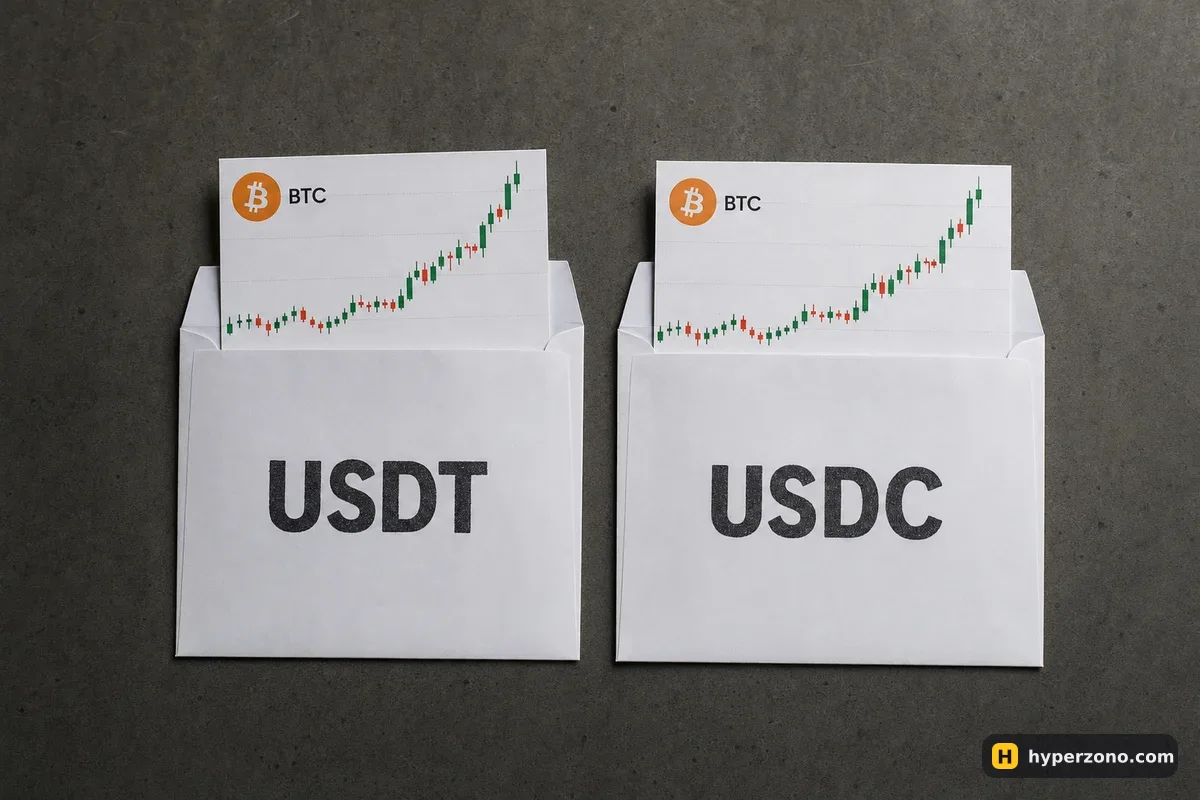
Same bitcoin, different settlement coin
Whatever you make or lose on BTCUSDT comes to you in USDT. On BTCUSDC it comes in USDC. Both are dollar coins — one dollar in, one dollar out — just issued by different companies. USDT is the one most beginners meet first; USDC is the other big one.
Your margin goes in as that coin, the fees come out of it, funding is charged in it, and your result lands in it when you close. If you are not sure what these coins are in the first place, the short version is on our page about what USDT is and why futures use it.
The two pairs are separate markets, not two views of one market. Each has its own buyers and sellers, its own last traded price, its own index and its own funding rate. Most of the time the prices sit very close together, because both follow the same bitcoin — but the cost of holding a position in one can be noticeably different from the other on the same day.
What that looks like with 200 USDT
Say you put 200 USDT into futures and open a trade worth 1,000 USDT using 5x leverage — your 200 USDT is the deposit, the trade itself is five times bigger. These numbers are illustrative, just to show the arithmetic.
Bitcoin rises 2% and you close. The price difference is about 20 USDT. The exchange takes a fee twice — on Binance the base taker fee is 0.05%, so about 0.50 USDT to open and 0.50 to close — and you keep roughly 19 USDT.
If bitcoin goes 2% the other way, the same trade loses about 20 USDT, the same 1 USDT of fees is still charged, and your 200 USDT comes back as about 179. The USDC version works exactly the same way with 200 USDC of margin, and the result arrives as USDC.
Here is the part people miss. If your money is in USDT and the contract needs USDC, you convert first — and you usually convert back later. When you swap USDT for USDC you get slightly less than one for one, and the same happens on the way back. Each swap costs you a little.
On a 19 USDT profit that is small change. If you move a few hundred back and forth every week, though, those little costs start to add up. Check the rate the exchange gives you in both directions before you convert, and see what swapping USDT to USDC costs for the details.
Liquidity, funding and the fine print of each pair
Because the two contracts are separate markets, the only honest way to compare them is to look them up one by one in the app. The quickest way to see the difference is to open a Binance Futures account and put the pairs next to each other in the market list — volume, funding, minimum size, all visible before you risk anything.
| What to check | Where you see it | Why it changes your trade |
|---|---|---|
| Settlement coin | The ticker and the margin field in the order window | Profit, loss, fees and funding are all counted and paid in that coin |
| 24h volume of that exact pair | The market list, next to the pair name | A quieter pair can fill a market order at a worse price than you expected |
| Funding rate and its interval | The contract information panel on the trading screen | You pay or receive this for as long as the position stays open |
| Minimum order size and quantity step | The contract specification | Decides whether 50 or 100 USDT of margin is enough to open the trade at all |
| Fee schedule for that contract | The exchange's fee page | Fees are charged on the size of the trade at entry and at exit, not on your margin |
Funding deserves one extra line. Two contracts on the same coin can have different rates at the same moment, simply because longs and shorts are balanced differently in each market. If you plan to hold for days rather than minutes, that gap matters more than the fee. You can see current and past rates per venue on our BTC funding page, and the mechanics are explained in what funding is.
Contract specifications differ too. On Binance the minimum position on BTCUSDT is 0.001 BTC — at a bitcoin price near 83,500 that is about 83.5 USDT of trade size. The minimum on a USDC pair sits in its own specification, so read that one rather than assuming it matches. And on some exchanges USDC contracts behave differently in ways that surprise newcomers, such as an entry price that changes without you placing a new trade.
One letter apart in the list. BTCUSDT and BTCUSDC sit next to each other and look nearly identical on a phone screen. Before you confirm an order, read the full ticker at the top of the order window and check which coin the margin field is showing. Opening the wrong one is not a disaster, but you will suddenly need a coin you do not have.
Already holding USDT is not the only reason to pick it
It is a good reason, and for a first trade it is often the deciding one: no conversion, no extra step, no second balance to watch. But it is one input, not the whole decision. A pair with far more volume, a funding rate that is working in your favour, or a minimum size that actually fits your account can be worth a small conversion cost.
The reverse is also true. If you already keep most of your money in USDC because that is what your bank route or your wallet gives you, there is no rule saying you must convert to USDT to trade futures. Start by checking that the contract you want exists in that version at all: type the coin into the market search in the app and see which versions come up, then look at how much is trading on each.
One more thing to keep separate in your head: the coin that settles your contract is not the same question as the coin sitting in your account as collateral. Some accounts let you post other assets as margin, with their own rules and their own risks. That is a different topic, covered in using crypto you already own as futures collateral.
A simple way to decide
Open the market list, search the coin you want and see which versions your exchange actually offers. If only one exists, the decision is made for you. If both are there, compare the five rows from the table above: if one pair has clearly more volume and a funding rate you can live with, take that one and accept the conversion cost if there is any. If they look close, take the one that matches the coin already in your account and keep your money in one place.
If you have not picked an exchange yet, start with which futures exchange suits a beginner, then check that futures are offered where you live during sign-up. Availability varies by country and by exchange, and it is worth confirming before you move any money.
Is USDC safer than USDT for futures trading?
That is a question about the coins themselves, not about the contracts. Both are used by millions of traders every day, and in both cases you are trusting the company that issues the coin to keep it worth a dollar. For a short futures trade, the bigger practical differences are liquidity, funding and conversion cost on the specific pair you open.
Will I make more money on a USDC contract than a USDT one?
Not from the settlement coin alone. The same price move on the same trade size gives the same result; what can differ is the funding you pay while holding, the fee schedule for that contract and how cleanly your order fills.
Can I open a USDC contract if my balance is in USDT?
You convert first, inside the exchange. The conversion itself is usually quick, but check the rate you are given in both directions — you get slightly less than one for one each way, and that is the real cost of switching.
Do both contracts have the same funding rate?
No. Each market sets its own rate from its own balance of longs and shorts, so the two can differ at the same moment. If you plan to hold overnight or longer, compare both rates before you choose.
Does every coin have both a USDT and a USDC version?
No. Not every coin has a USDC version, and the list is different on every exchange — type the coin into the market search in the app and see which versions come up. If only the USDT one appears, that is your answer for that coin on that exchange.