Contents
Three questions that decide it for youWhen spot is clearly the better startWhen futures actually make sense for a beginnerThe safest path: spot with real money, futures in demoSigns you are not ready for leverage yet
Three questions that decide it for you
The first one is your goal. If you want to own some bitcoin and look at it again in a year, spot is simply the right tool and leverage adds nothing. If you want to react to a move this week — up or down — and you are fine closing the trade in a day or two, that is what futures are built for.
The second is the money. Ask yourself how much you could lose completely without it changing your month. On spot a bad entry usually means your coin is down 20% and you wait. On futures with leverage, a move against you of a few percent can take the whole amount you put into that trade. Your answer to "how much can I afford to lose" is the real decision, not your opinion about the market.
The third is time. Spot needs almost none — you buy and you live your life. A futures trade asks more of you. You set a stop-loss before you enter, you watch the fees, and you close the trade when your plan says so. There is also a small payment that longs and shorts make to each other while a trade is open — on most contracts every eight hours. It is called funding, and sometimes you pay it, sometimes you receive it. If you work twelve-hour shifts and check your phone twice a day, start with spot and a demo account rather than a live leveraged position.
When spot is clearly the better start
If you still cannot say, before you buy, at what price you would get out, spot forgives that. The coin drops, you still own it, and nobody closes the position for you. There is no deadline and no running cost — you are not paying anything to hold it.
Spot also wins if your plan is measured in months. Holding a leveraged position for half a year is hard work: funding is settled every few hours and can go against you, and one sharp move can end the trade. Spot has neither of those problems. And if the whole reason you are looking at futures is that someone promised fast money, read what you can realistically expect to earn first and then decide calmly.
When futures actually make sense for a beginner
Futures earn their place in two situations. One is when the price is falling: on futures you can make money when the price goes down, which spot simply cannot do. If half the moves you watch are down moves, spot leaves you with nothing to do on those days.
The other is when you already own coins and want to protect them for a week or two. You open a small trade that makes money if the price falls — a short — so part of the drop in your coins is paid back by that trade, and you don't have to sell everything and buy it back later.
Size is the part that draws most people in, and it is worth seeing honestly. Say you have 100 USDT (an illustrative amount). On spot, a 3% rise gives you 3 USDT. On futures with 5x, the same 100 USDT backs a 500 USDT position, so that same 3% move is about 15 USDT, minus a small fee each way — and when the price goes the other way instead, you are down about 15 USDT just as fast. If you just want to see what all this looks like on a screen before deciding, you can open a Binance account and look at the futures order window without funding anything.
Use futures when you actually need what they do — trade a fall, or protect coins you already own. If you just want to own bitcoin, spot does the same job with fewer things to watch, and the full comparison of futures and spot goes through the rest of the differences.
The safest path: spot with real money, futures in demo
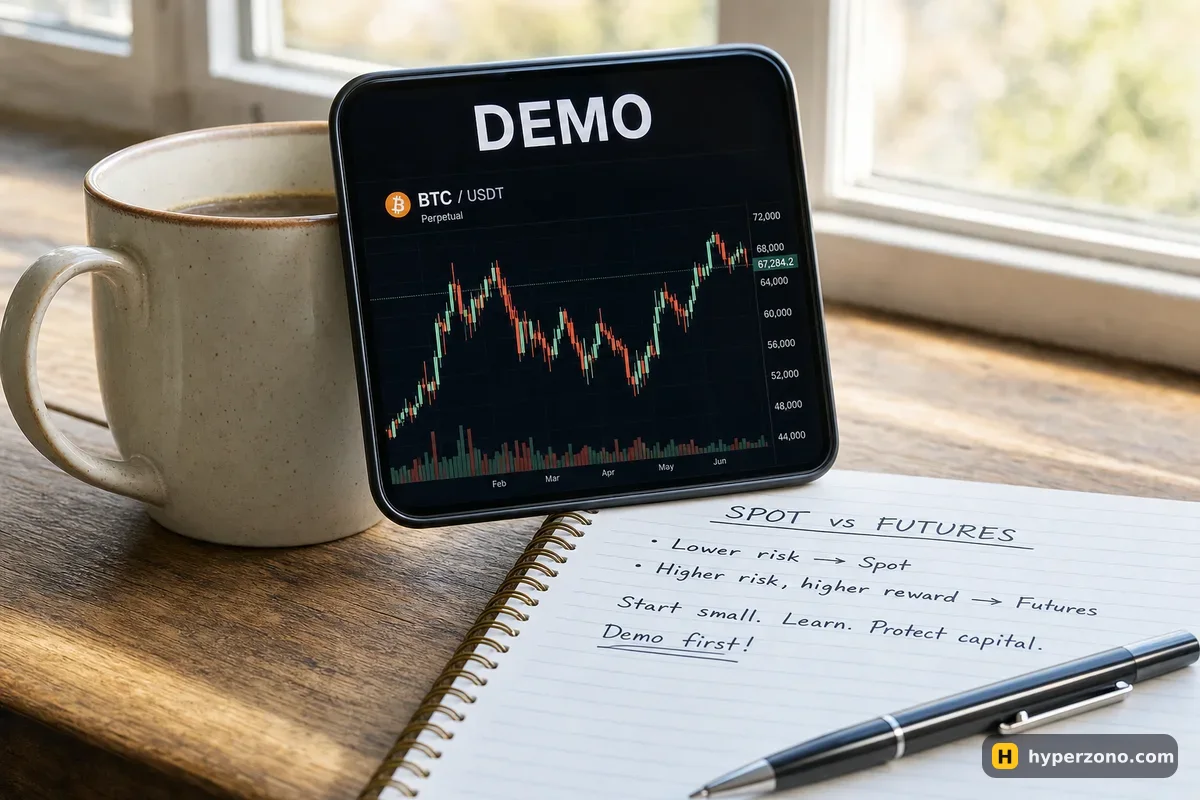
You do not have to choose one and abandon the other. Put a small amount into spot so you have real money in the market and real feelings about it, and at the same time open a demo futures account and practise the mechanics there: picking a direction, setting leverage, placing a stop-loss, closing early.
Buy a small amount on spot
Something you would not panic about — 20 to 50 USDT of bitcoin or ethereum. Watch how it moves over a week.
Switch on demo futures
On Bybit the demo account sits next to the real one and uses play money; the steps are in our guide to the Bybit demo account. Check during sign-up that futures are available where you live — availability differs by country.
Do ten demo trades with a stop-loss on every one
Same coin, small size, low leverage. The habit you are building is setting the stop before you enter, not predicting the market.
Go live with an amount you can lose
When the buttons feel boring, move to real money with a few dollars of margin per trade and keep the same rules.
Setting this up takes an evening, and only the spot part puts real money at risk — sign up on Bybit, fund a small spot balance, and keep the demo futures account open beside it.
Demo teaches your hands, not your nerves. Losing play money feels like nothing, so you will take trades in demo you would never take with your own cash. Treat demo as practice for the buttons and the order window, then expect real trading to feel completely different for the first few weeks — and start real money as small as the exchange allows.
Signs you are not ready for leverage yet
None of these make you a bad trader. They just mean spot and demo are where your next month belongs.
- The money you want to trade with is rent, tuition or borrowed.
- You cannot say, before opening a trade, at what price you will close it if you are wrong.
- You are copying a Telegram signal without understanding why that direction.
- You would not be able to look at your phone for the next eight hours.
- You find yourself thinking that higher leverage will let you make the loss back faster.
That last one is the most common way beginners lose everything, and it has nothing to do with the market. If any of these are true today, trade spot, practise in demo, and come back to leverage when you can read how much to risk per trade and actually apply it.
Is futures trading good for beginners at all?
It can be, if you treat it as a skill with rules rather than a shortcut. The beginners who do fine start small, use a stop-loss on every trade and keep leverage low. The ones who lose everything in a week skip all three.
Can I start with futures and never touch spot?
You can, and plenty of people do, especially if they want to trade both directions from day one. But you give up the gentlest way to learn how the market behaves, so at least spend your first weeks in demo instead.
How much money do I need to start either one?
Spot works from a few dollars, and futures can start from very little too — on bitcoin the minimum position on Binance is 0.001 BTC, and most altcoin contracts start from around 5 USDT of position size. Minimums differ by exchange and contract, so check in the app.
Will I lose more than I put in on futures?
The exchange normally closes your position before your margin runs out — that is called liquidation — so your loss is usually limited to the money backing that trade. Use isolated margin and you keep the rest of your balance out of it. See can you lose your whole deposit for the details.
How long should I practise before using real money?
There is no fixed number, but a useful signal is boredom: when you can place an order, set a stop and close a position without rereading anything, you are ready for a small live trade.