Contents
What a broker actually does on other marketsOn a crypto exchange, one account does all of itWhy there are no forms, calls or minimum amountsWhat about CFD brokers and futures brokers?What you give up when there is no brokerWhat to do instead of looking for a broker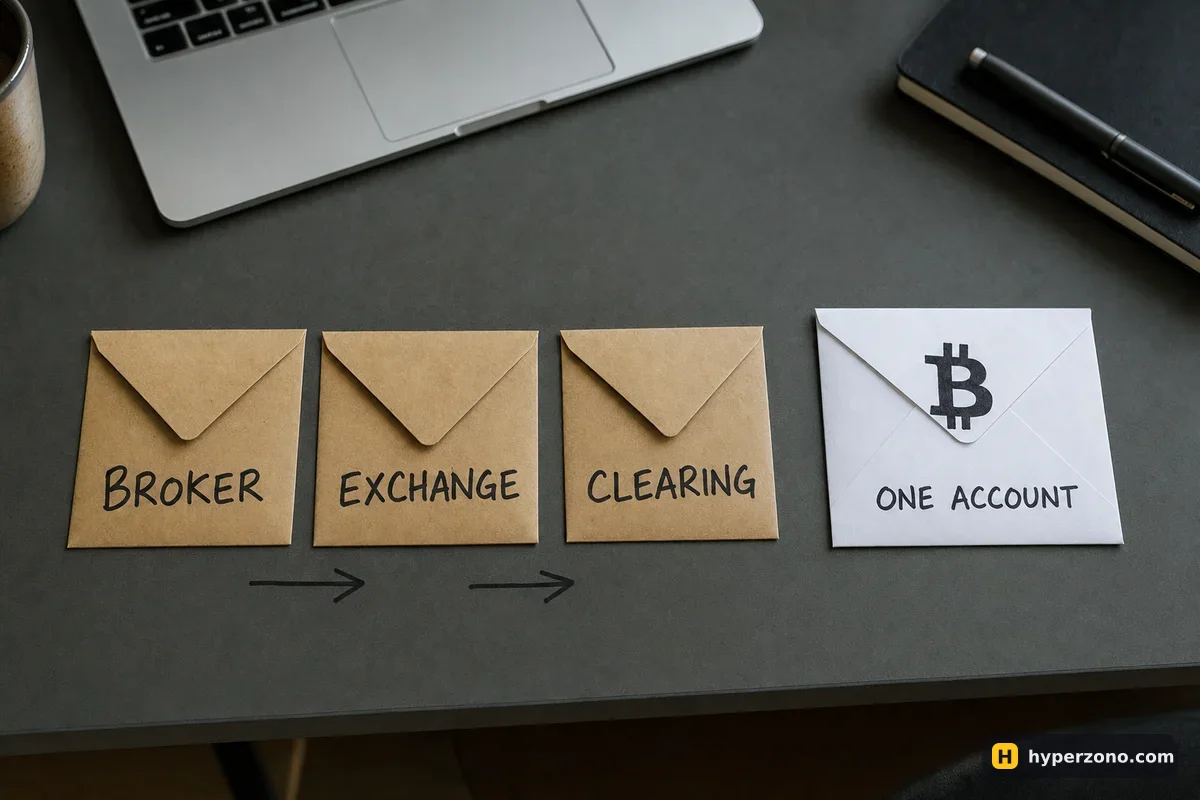
What a broker actually does on other markets
If you want to trade oil or index futures on a traditional market, you cannot walk up to the market yourself. A broker opens an account for you, takes your order and sends it to the exchange, where it is matched against someone else's order. Then a third company steps in between the two sides and makes sure the trade is really settled and that each side keeps enough money on deposit — that company is called a clearing house.
That is three separate companies doing three separate jobs, and the broker is the one you talk to. It is also the reason traditional futures accounts come with paperwork: application forms, approvals, sometimes a minimum amount to open the account, sometimes a phone call before you are allowed to use leverage.
On a crypto exchange, one account does all of it
A crypto exchange is not a broker that sends your order somewhere else — it is the broker, the market and the settlement system in one company. Your USDT sits in a wallet inside your exchange account. When you tap Long or Short, your order goes straight onto the exchange's own list of buy and sell orders — the order book — where it meets an order from another trader. The same exchange then tracks your margin, charges the fee and credits your profit or loss to the same wallet.
So the person on the other side of your trade is another user, not the exchange. The exchange's job is to put your order together with someone else's, hold the money and work out who is up and who is down. The quickest way to see that there is no broker anywhere in the chain is to open a Binance Futures account and look at the order window: there is a coin, a direction, an amount, leverage and a button. No broker field, no routing choice, nobody to call.
Why there are no forms, calls or minimum amounts
Opening a futures account on a crypto exchange is an email, a password, an identity check and a transfer of money into the futures wallet. The identity check is real and it is required on the big exchanges — that part is covered in do I need to verify my identity — but nobody asks you to sign papers, prove how much money you have in total, or talk to a manager before you are allowed to trade.
The only minimums you meet are technical ones set by each contract. On Binance, for example, the smallest bitcoin position is 0.001 BTC. If bitcoin is around 83,500 USDT, that's about 83 USDT of position size — the exchange shows you the current minimum in the order window. Most altcoin contracts start from about 5 USDT of position size. That is a rule of the contract, not a rule about how rich you have to be.
What about CFD brokers and futures brokers?
You may have seen two other ways to trade with leverage. One is a company that lets you bet on price moves against the company itself — those are usually called CFD brokers. The other is a broker that passes your order to a big traditional futures exchange. In both cases a company sits between you and the market: it opens the account, holds your money and decides what you are allowed to trade.
A crypto exchange takes that layer out. Starting is simpler and usually cheaper, and the flip side is that there is nobody above the exchange to appeal to if you disagree with how your position was handled. There is also a step further: exchanges that run on the blockchain itself, where you connect your own crypto wallet and no company holds your money at all — that route is described in trading futures from a wallet.
| What changes | Broker | Crypto exchange |
|---|---|---|
| Who is on the other side of your trade | Often the broker itself, or another trader at the exchange it sends your order to | Another trader on the same exchange |
| Who closes you out when your margin runs out | The broker, sometimes after warning you first and asking you to add money | The exchange, automatically, by formula |
What you give up when there is no broker
Without a broker, the exchange's own terms are the rules of your trading, and you agreed to them when you signed up. The exchange decides the fees, the leverage limits, how much margin a position must keep, and when your position is closed automatically because the margin ran out. That automatic close is called liquidation, and it happens by formula, without a phone call and without a warning conversation.
The same goes for who may trade at all. Futures are not offered everywhere, and in some countries an exchange serves you through a separate local company with different products and lower leverage. Check availability during sign-up and on the exchange's own country pages — more on that in which exchanges are available in my country. And since nobody is vetting the venue for you, spend ten minutes making sure the exchange is a real one before you deposit: how to check an exchange is not a scam.
The exchange is also the referee. It holds your money, runs the market and enforces the margin rules. That is not a reason to avoid futures, but it is a reason to use a large, well-known exchange, to keep only your trading money there, and to always set a stop-loss instead of hoping someone will call you first.
What to do instead of looking for a broker
Pick one exchange
Choose a big venue with a clear app in a language you read. Which exchange suits a beginner compares the usual options; you only need one account, not several.
Sign up and verify
Email, password, two-factor login, then the identity check with a document and a selfie. Confirm during sign-up that futures are available for your country.
Fund the futures wallet
Buy or deposit USDT, then move it from your spot wallet to the futures wallet inside the account. Start with money you can afford to lose — 50 or 100 USDT is plenty to learn on.
Open one small trade with a stop-loss
Pick bitcoin or ethereum, choose low leverage, set the stop before you confirm the order, and watch how the position behaves for a day or two.
If you would rather not deposit yet, most large exchanges have a demo mode where the same order window runs on fake money, though it is not offered in every country. Either way, the structure is the same: one account, no broker, your own finger on the button.
Is a crypto exchange a broker?
Not in the traditional sense. A broker passes your order to a market somewhere else; a crypto exchange is the market, and it holds your money and settles the trade too. You deal with one company from deposit to withdrawal.
Can I trade bitcoin futures through my stock broker instead?
In some countries brokers do offer bitcoin-related futures or similar products, usually with their own account rules, trading hours and contract sizes. That is a different product from the perpetual contracts on crypto exchanges, which trade around the clock and in small sizes. If your broker offers something like this, compare the contract size and the fees before deciding.
Can I trade futures without a broker and without an exchange account?
Yes. There are exchanges that run on the blockchain itself, where you connect your own crypto wallet and no company ever holds your money. Starting is faster, but you carry the whole weight of keeping that wallet safe.
Is it safer to go through a broker?
A regulated broker in your own country may give you complaint procedures and account protections that a global crypto exchange does not. The trade-off is paperwork, higher minimums and fewer crypto contracts. Decide honestly which matters more to you, and never trade with money you need for rent.
Do I need a licence or special permission to use leverage?
Not a licence, but the exchange may set its own gates: an experience level you choose when opening the futures account, limits on brand-new accounts, or a knowledge test in certain regions. You will see those rules during sign-up, in the app.