
Contents
Start with the address, not the reviewsWho actually runs it, and can you find that name anywhere else?Is the trading real, or are the numbers painted on?Proof of reserves, and the check that beats itRed flags that mean walk awayYour twenty-minute check before the first deposit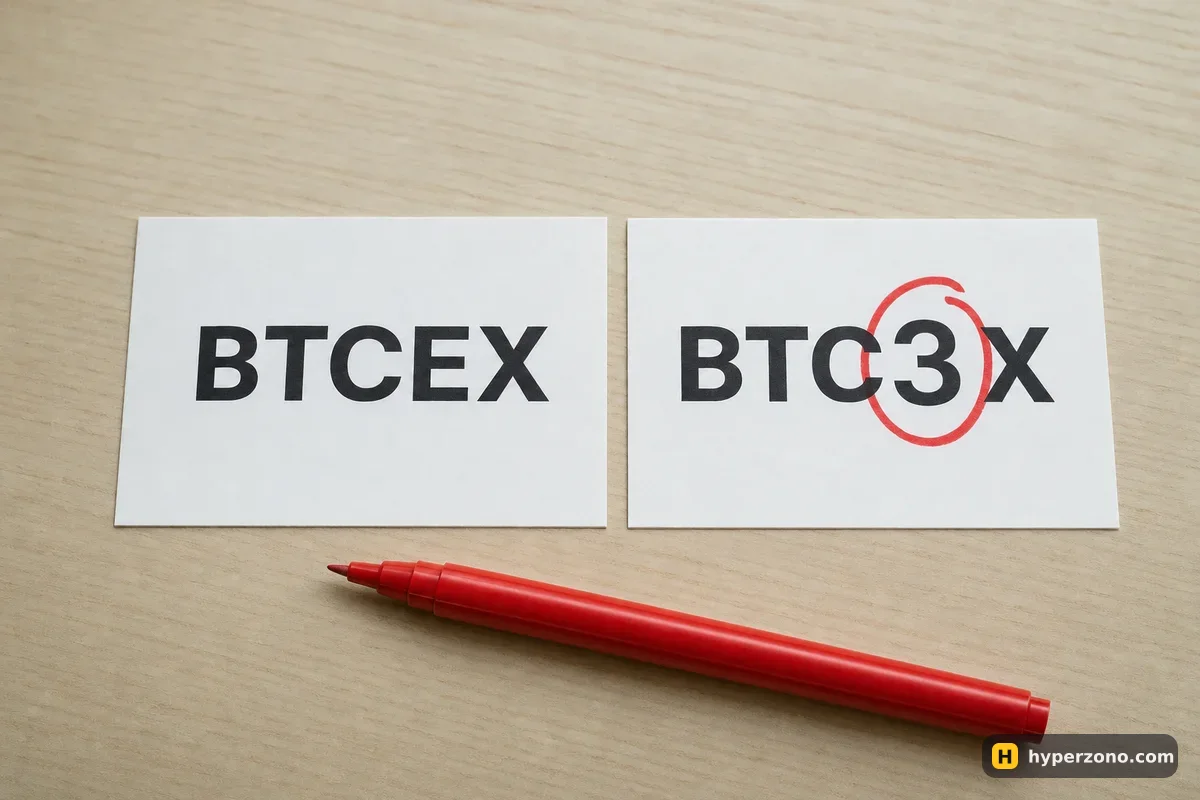
Start with the address, not the reviews
Most people who lose money to a fake exchange never went looking for one. They searched for a well-known name, tapped a paid ad sitting above the real result, and landed on a page that looked exactly right apart from one changed character in the address. The deposit went through fine. Nothing else ever did.
So the first check costs you ten seconds: type the address yourself or open it from your own bookmark, never from a chat message, a YouTube comment or an ad. For the app, use the download link on the exchange's own website, and in Google Play or the App Store look at the publisher name under the app title before you install it. Clone apps usually have a publisher nobody has heard of, a few thousand downloads, and a wall of five-star reviews all posted in the same week. If the app asks you to disable store protections or install from a file sent in Telegram, that is where you stop.
Who actually runs it, and can you find that name anywhere else?
Big exchanges are not one company — they are a group of companies, and the one you deal with depends on where you live. Scroll to the bottom of the site or open the terms of use and find the legal entity named there, with its country. Binance's global terms name Nest Services Limited in Seychelles; Bybit onboards users in the European Economic Area through Bybit EU GmbH, which holds an Austrian MiCAR licence, on a separate site; OKX has separate entities for Australia, the UAE and the EEA. A real exchange tells you plainly which company you are contracting with.
Then do the part most people skip, and it is easier than it sounds. Type that company name and its country into a search engine together with the word "register" — for example "Bybit EU GmbH Austria register". You want to land on a government or supervisory authority site, not a blog, a news story or the exchange's own page, and you want to see the company name spelled exactly as it appears in the terms. If the only place on the internet where that name exists is the exchange's footer, treat it as unverified and keep your money out.
Keep your expectations honest about what you find, too. A licence tells you the company is supervised for certain services in certain places. It is not a promise that your trades will make money, and it does not mean futures are offered where you live, which is a separate question covered in which futures exchanges are available in my country.
Is the trading real, or are the numbers painted on?
A fake venue can print any volume figure it likes on the home page, because nothing is being traded behind it. You don't need data skills to see through that. Open the bitcoin perpetual contract on the venue and compare its price with the price shown on a couple of large, well-known sites — on a liquid contract they should agree closely, moving together second by second. If the price sits still, drifts on its own, or is a few hundred dollars away from everyone else, the chart is a decoration.
Next, look at the list of buy and sell orders next to the chart — on the exchange it is labelled the order book. On a real BTC contract it is dense and refreshing constantly, and the gap between the best buy and the best sell price is tiny. Many venues also show open interest — the total value of positions currently open on that contract. A platform claiming billions in daily volume while its order book is nearly empty and open interest is a rounding error is telling you two different stories. The quickest way to learn what normal looks like is to sign up on Bybit and watch a BTC perpetual for a few minutes, then compare that picture with whatever the unknown venue shows you.
Proof of reserves, and the check that beats it
Several large exchanges publish a proof of reserves page: a snapshot showing the coins they hold against the balances they owe customers, usually with a way for you to confirm that your own balance was included in the count. If the big exchanges publish one and the venue you are looking at has never published anything, ask yourself why. It doesn't prove they are stealing, but it's one more reason to keep your test deposit small. And read the page for what it is — a photograph of one moment that shows assets, not debts the exchange may owe elsewhere, and not a promise about tomorrow.
The stronger check is simpler. Search the exchange's name together with the word "withdrawal" and look at the last few months of posts on forums and social media, ignoring both the paid praise and the one angry person who got liquidated. You are looking for a pattern: are withdrawals processing in minutes, or are dozens of people describing requests stuck for weeks? Then run your own test — put in a small amount such as 20 or 30 USDT, make one tiny trade, and withdraw what is left. A platform that takes deposits instantly but finds a new reason every day not to release your money has answered your question.
Red flags that mean walk away
Some signals need no investigation at all. If you see any of these, there is nothing to weigh up — close the tab.
- A promise of a fixed daily percentage, or trading where you supposedly cannot lose. Real futures can lose money on any day, and anyone who tells you otherwise is selling something else.
- A personal manager or "trading coach" who appears right after you register and wants to see your screen or place trades for you.
- Support that is fast and friendly about deposits and goes quiet about withdrawals.
- A fee, "tax" or "verification payment" you must send before your withdrawal is released. No real exchange ever asks you to deposit money in order to take money out.
- No website of substance — the whole operation lives in a Telegram group or a WhatsApp chat, with screenshots of profits instead of terms, a legal entity or a public contract specification.
- You are told to send USDT to a personal wallet address rather than to a deposit address generated inside your own account.
- A bonus that freezes your own deposit until you trade a huge volume. Sometimes it's simply a harsh promotion rather than fraud, but read the terms before you accept anything — see how futures welcome bonuses work.
The withdrawal tax is the classic trap. Fake platforms let you "profit" on paper for weeks, then ask for a payment of 10–20% of the balance before they will release it. People pay, and then there is a second fee, and a third. The money you send after the first refusal is the money you actually lose. Once a withdrawal is blocked behind a payment, stop sending anything and treat the balance as gone.
Your twenty-minute check before the first deposit
Open the site the safe way
Type the address yourself or use your saved bookmark, and install the app only from the store link on that site. Check the publisher name under the app title.
Find the company
In the footer or the terms of use, note the legal entity and its country. If no company is named anywhere, you already have your answer.
Search that name plus "register"
Put the company name, its country and the word register into a search engine — for example "Bybit EU GmbH Austria register". Aim for a government or supervisory authority page showing the name spelled exactly as in the terms. If the name lives only on the exchange's own pages, treat it as unverified.
Test the market, not the marketing
Open the BTC perpetual, compare the price with two large independent sources, and watch the order book refresh for a minute.
Check money comes back out
Read the proof of reserves page if there is one, scan recent withdrawal complaints, then deposit 20–30 USDT, make one small trade and withdraw the balance.
Secure the account, then fund it
Only then put real money in — with two-factor authentication turned on, plus the withdrawal address whitelist or the extra withdrawal code if your exchange offers one; check the security section in the app, and see how to secure your exchange account.
Here's one that surprises people: if an exchange is holding your money and never asks for your documents, be more careful, not less. A company with a real licence is obliged to ask, and what that check involves is usually a photo of your ID, a selfie and your address details. Venues where you trade straight from your own wallet are a different story — there the money never leaves you, so nobody needs to identify you.
None of this takes an afternoon, and it costs far less than one bad deposit. If you would rather skip the research for now, the shortlist of venues that already pass these checks is in which exchange is best for a beginner — and whichever name you pick from it, still run the small test withdrawal yourself before you fund the account properly. That one round trip tells you more than every review you will read.
How do I know if a crypto exchange is legit?
Four things together: a real address and app publisher, a named company you can find in a public register, trading data that matches the wider market, and withdrawals that actually arrive. Any one of them alone can be faked or explained away. All four together are hard to counterfeit.
How do I check a licence if I don't know who the regulator is?
You don't need to know. Take the company name and country from the terms and search for them with the word "register" — like "Bybit EU GmbH Austria register". If the result is a government or supervisory authority page with the same company name, that's your confirmation. If every result points back to the exchange's own site, treat it as unverified.
Does a licence mean my money is safe there?
It means a specific company is supervised for specific services in specific places, which is better than nothing. It does not protect you from a bad trade, and it does not mean futures are offered to people in your country. Check the name on the authority's site, not in the exchange's footer, and check availability again during sign-up.
What is proof of reserves and can I check it myself?
It's a published snapshot of the coins an exchange holds against the balances it owes users, and most versions let you confirm that your own balance was counted. It shows one moment in time and says nothing about debts elsewhere, so treat it as one item on the list. The test withdrawal is still the real proof.
They want a fee before releasing my withdrawal. Is that normal?
No. Exchanges take their fee out of the amount you withdraw; they never ask you to send money in before they let money out. A "tax", "release fee" or "verification payment" demanded before a withdrawal is one of the oldest frauds there is, and paying it only leads to the next demand.
How much should I risk on the test deposit?
An amount you would shrug at if it vanished — 20 or 30 USDT is plenty. Deposit it, open one small trade, close it, and withdraw what's left. If that round trip works cleanly, you can start thinking about a real deposit.