Contents
Why the futures tab stays locked until you verifyWhat you can do before you verifyCan I trade futures without verification at all?What you risk on a site that asks for nothingWhy using someone else's documents ends badlySo what should you actually do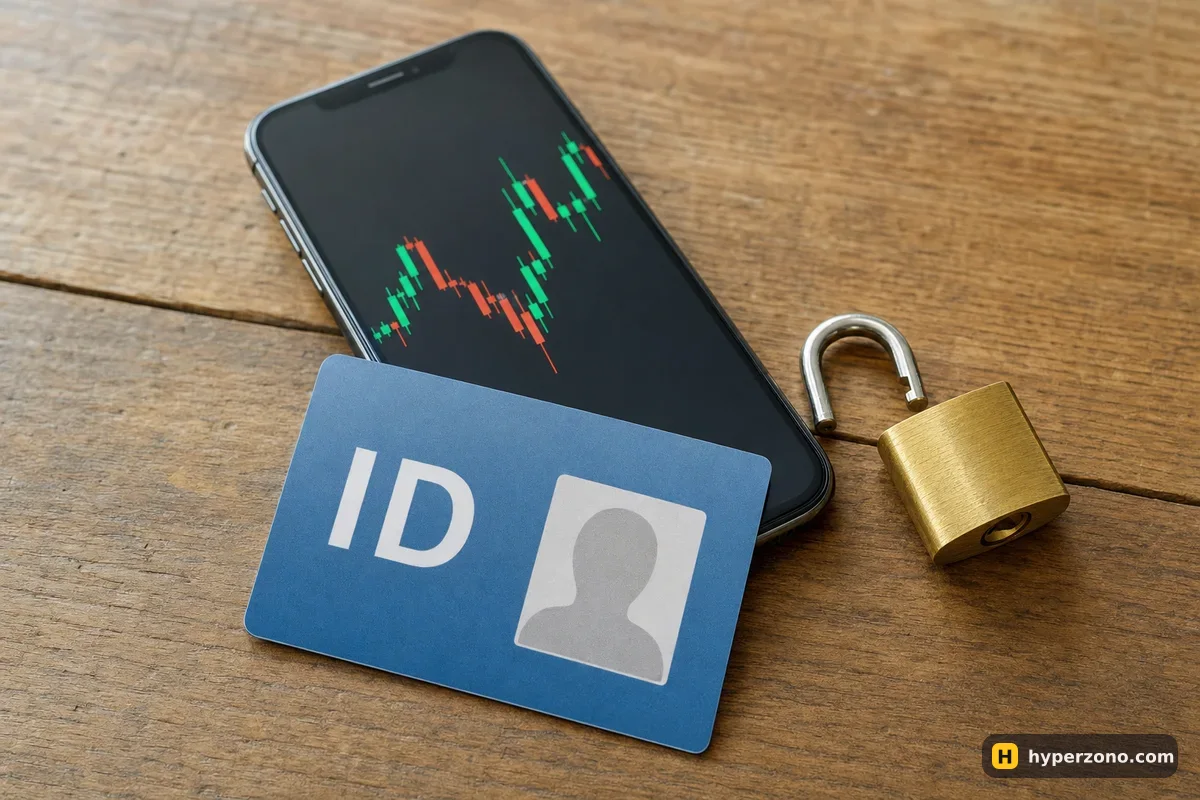
Why the futures tab stays locked until you verify
Exchanges have to know who their customers are, and they treat futures more strictly than simple buying and selling of coins. On Binance, for example, the steps before futures are: pick your experience level, accept the futures agreement and complete identity verification. Until that is done, the futures order window will not take your trade. What else is open to you before verification differs from exchange to exchange — the app shows it on your account page.
Other big exchanges ask for the same kind of check before futures work. The exact order of steps differs, so follow what the app shows you during sign-up. When you sign up on Bybit or any other large exchange, do the verification right away rather than after your first deposit — it is unpleasant to have money sitting there while you hunt for a document. What the check actually asks for, and why people get rejected, is covered on the page about documents for KYC.
What you can do before you verify
Quite a lot, actually, and it is all free. The public side of an exchange is open to anyone: live prices, the fee page, and the contract specification where you can see the minimum order size for a coin. That is enough to get comfortable with the screen before any money is involved.
- Browse markets, charts and contract details on the exchange's website.
- Read the fee page, and the page about funding — the small payment longs and shorts send each other while a trade is open (more on that in funding explained).
- Check whether a practice account is available to you — Binance and Bybit both offer demo futures trading, though it is not offered everywhere and may sit behind the same account steps. See the overview of demo futures accounts.
What you cannot do before verification is open a real futures trade. Everything else — deposits, withdrawals, limits — depends on the exchange and on where you live, and the app is the only honest source for that. Do the check on day one — it takes a few minutes and it is the only thing standing between you and the futures screen.
Can I trade futures without verification at all?
There is one honest answer here: venues that run on a blockchain instead of on a company's servers. Hyperliquid, for instance, works through your own crypto wallet — you connect the wallet, and there is no email, no password and no documents. That really is trading futures without KYC, and it is a genuine option for people who are already comfortable with wallets and networks. How this route works in practice is explained on the page about trading futures straight from a wallet.
Here is the catch, and it is a real one. You hold the keys, so there is no password reset and no support desk that can undo a mistake: send funds to the wrong network and they are gone. Access is still not universal — the app shows a message saying you are accessing the service from a restricted jurisdiction if you are somewhere it does not serve. And "no documents" does not mean "no rules": you are still responsible for whatever your own country requires of you.
What you risk on a site that asks for nothing
There is a second kind of no-KYC platform: a centralized site that advertises instant anonymous futures trading. Depositing there is always easy. The problem shows up at the exit — a withdrawal suddenly triggers a verification demand you were told would never come, or the request simply sits "in processing" for weeks. If the operator is unknown and unregulated, there is nobody to complain to, and in the worst case the site closes with the balances inside.
If you are tempted by one of these, at least run through the checks on the page about spotting a fake exchange first. A small fee saving is not worth the chance of never seeing your deposit again.
Money with the wrong name on it is money you cannot get back. Verification is how an exchange decides whose funds those are. If the name on the account does not match the person withdrawing, the balance stays where it is — and arguing is very hard when you are not the account holder on paper.
Why using someone else's documents ends badly
People sometimes borrow a relative's passport or buy a ready-made verified account. It works until the first check — a random review, a larger withdrawal, a photo request — and then the account is frozen with everything in it. You cannot appeal, because officially the account is not yours, and the real document owner is now mixed up in it too.
The same goes for pretending to be somewhere you are not. Futures are genuinely unavailable or limited in a number of places, and in several regions an exchange serves customers through a separate local company with different products. The right move is to check what is actually offered to you during sign-up and on the exchange's own country pages — the page on availability by country walks through how to do that. If one venue does not serve you, another may; starting with false details only moves the loss further down the road.
So what should you actually do
Pick an exchange that works where you live, verify straight away, and start small. The check usually asks for an ID document and a photo of you, and the app lists exactly what it needs for your country. You can open a Binance Futures account and have that part behind you in a few minutes, after which the futures section is simply there — same leverage slider, same long and short buttons, and your own name attached to the balance. That last part is what makes the profit withdrawable.
Is KYC mandatory on Binance futures?
Yes. Before the futures section works you choose an experience level, accept the futures agreement and complete identity verification. Without that, the order window will not take your trade.
Can I trade futures without verification on any normal exchange?
Not on the big centralized ones. The only realistic no-account route is trading from your own crypto wallet on a blockchain-based venue, where you connect a wallet instead of registering — with no support desk and no way to recover a mistake.
Do I need KYC just to try demo trading?
Demo usually lives inside an exchange account, so you will at least need to register, and demo is not offered in every country. Check in the app whether practice mode is open to you before you plan around it.
Can I withdraw profit without verifying?
On a regular exchange you will not get that far — futures do not open at all until you verify, so there is no profit to withdraw. Whatever an unverified account can and cannot do is shown on your account page in the app.
How long does the identity check take?
Often minutes, sometimes longer if the photo is blurry or the document is hard to read. Use good light, show all four corners of the document, and follow the on-screen instructions for the selfie step.
What if my country is restricted on the exchange I want?
Then look for a venue that does serve you, or accept that this product is not available to you. Do not try to get around a block with someone else's documents or by pretending to be somewhere you are not — it ends with a frozen account and funds you cannot reach.