Contents
Am I breaking the law if I trade futures from Italy?Why a crypto licence is not a futures licenceWhat the big exchanges actually say about ItalyWhat about trading from your own wallet?How to check a platform before you give it moneyYou already have an account: what to do nowTax, in one paragraphAm I breaking the law if I trade futures from Italy?
Buying and holding crypto is not the issue here. Leveraged futures and perpetuals sit in a separate legal category, and the rules are written for the companies rather than for you as a private person: a firm needs the right authorisation before it can offer those products to someone living in Italy, and most offshore exchanges simply do not have it. The practical consequence for you is rarely a knock on the door — it is losing access from one day to the next, and having no European consumer protection to fall back on if the platform freezes withdrawals or disappears.
That is the real risk to plan around: not a fine, but money sitting with a company that is not allowed to serve you and does not answer to any regulator you can reach. If your own situation is unusual — you are an Italian citizen living abroad, or a resident of Italy with an old account opened elsewhere — that is a question for a qualified professional, not for a guide.
Why a crypto licence is not a futures licence
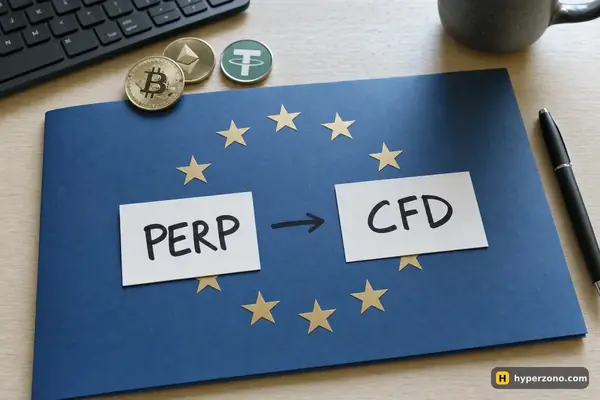
Europe's crypto rulebook, MiCAR, is about crypto-asset services — holding coins for you, exchanging them, executing orders. Perpetual futures are not in that box. On 24 February 2026 ESMA reminded firms that perpetual futures offered to retail clients are likely to fall under the existing national measures written for contracts for difference, the older leveraged products Europeans could already trade on shares and currencies. In plain terms, that means a European firm has to cap how much leverage it gives you, warn you in writing, close your position automatically when your deposit runs low, and make sure you can't end up owing more than you put in.
That is why you will never see 100x advertised to an Italian retail account by a properly licensed European firm, and why a shiny "MiCA licensed" badge on a website tells you nothing about whether that firm may sell you a perpetual. Two different permissions, two different questions. Our overview of which exchanges serve which regions and the wider EU picture sit next to this page, but for Italy the detail below is what matters.
What the big exchanges actually say about Italy
Binance published a notice on 30 July 2021 stating that futures and derivatives products are unavailable in Germany, Italy and the Netherlands. That notice still carries its 2021 date, so the only thing that tells you about your own account is what Binance shows you in the app and sends to your email. Binance also said in a June 2026 blog post that it had withdrawn its MiCA application in Greece and intended to apply in another EU country. If you see news about Binance and the EU, check your own inbox and the app before believing it.
Bybit onboards users in the EEA through a separate company, Bybit EU GmbH, with an Austrian MiCAR licence and its own site and account. European registers list what each company is allowed to do, and for Bybit EU the permissions on record cover holding your coins, swapping them and moving them — futures are not on that list, so don't assume perpetuals come with that account. Bybit also said in June 2026 that access to certain global services for EEA residents would be progressively limited.
OKX is the one confirmed route of a different kind. Its Maltese company, OKX Europe Markets, offers contracts it calls X-Perps in all 30 EEA countries. They behave much like the perpetuals you see elsewhere — you pay or receive a small funding payment while the trade is open — except they have an end date five years out, and leverage is capped at 10x. Before you get access you verify your identity and answer a short set of questions about your trading experience (OKX help page updated 4 September 2026). A locally licensed company, a cap on leverage, a few questions first: that is what a compliant European offer looks like.
Here is what that cap means for your money. With 100 USDT you can open a trade worth up to 1,000 USDT. If the price moves 2% your way, that is about 20 USDT before fees; if it moves 2% against you, you lose the same 20 USDT and the rest of your 100 stays where it is. At the 50x advertised offshore, the same 100 USDT would be holding a 5,000 USDT trade, and a 2% move the wrong way takes 100 USDT — essentially everything you put in. The low cap is the reason a European account is harder to blow up in an afternoon, and the reason the headline numbers look boring next to the adverts. Whether your own account qualifies is something only the app can tell you during sign-up.
What about trading from your own wallet?
There is a second route that works differently: you connect a wallet to an on-chain venue and trade without registering with an exchange at all. Hyperliquid's terms of use name only the United States and Ontario, plus territories under comprehensive sanctions — Italy is not written there. That absence is not a green light. European rules apply to the firm offering the product, not to a list of countries in a document, and a venue that does not name you also does not owe you the protections a licensed European firm must give: nobody caps your leverage at a European level, nothing stops your balance going below zero in a violent move, and there is no regulator to complain to. Your position still gets closed automatically when the margin runs out — that part works like everywhere else. You also hold your own keys, so a lost backup or a wrong address is your loss. If you want to understand what that route involves before judging it, start with futures from a wallet.
How to check a platform before you give it money
A country missing from an exchange's "restricted" list is not permission — those lists are written to protect the exchange, and most of them say outright that they are not exhaustive. The check that counts goes the other way round: look up the exact legal name of the company in the platform's terms, not the brand on the home page, and check that name against your national regulator's register of authorised firms. If it does not appear anywhere in an official register, that is your answer. Our checklist for spotting a dishonest exchange covers the rest of the warning signs.
You already have an account: what to do now
Read what the platform sent you
Emails and in-app notices give the actual dates: when new orders stop, when deposits stop, how long withdrawals stay open. Those dates beat anything you read in a forum.
Close or reduce positions on your own schedule
A forced close happens at whatever price the market gives at that moment. Closing while the market is calm, with your stop still in place, is the cheaper version.
Move the money out
Withdraw to a provider that is authorised to serve you, or to your own wallet — checking the network and the address first. The mechanics are in our guide to withdrawing from futures.
Export your history before access ends
Trade history, funding and fee statements, deposit and withdrawal records. Once the account closes, getting them back is somebody else's priority, not yours.
Every rule change brings a wave of fake emails. Messages that look like the tax office or "exchange support" asking you to confirm a wallet, pay a release fee or share a recovery password are phishing. Real notices never ask for a password or a recovery phrase, and you can always check by typing the platform's address yourself instead of tapping the link.
Tax, in one paragraph
We don't publish Italian tax rules here — they change, and getting them wrong costs you money. Check the Agenzia delle Entrate guidance or ask a commercialista before your first return, and keep the records from step four: you will need them either way.
Is Binance legal in Italy?
Binance's own notice from 30 July 2021 says futures and derivatives are not offered in Italy. That notice still carries its 2021 date, so the thing that decides your account today is what the app shows you and what Binance sends to your email — check there, not the news.
Can I make it look like I am in another country to reach an exchange that blocked Italy?
No, and we will not help with it. Exchange terms forbid getting around country restrictions by technical means, and the usual outcome is a frozen account at the moment you try to withdraw — with no regulator you can turn to. It also changes nothing about whether the firm is allowed to serve you.
Can I open an account if I am an Italian citizen living outside Italy?
Platforms normally decide by where you live and where your documents say you are resident, not by your passport alone. That means the answer depends on the country you actually live in, and the exchange will ask for proof during verification.
Will my money get stuck if an exchange stops serving Italy?
In the cases documented so far, platforms kept withdrawals open for a period after stopping new trading — but the window is set by them, not by you. The safe assumption is that the trading door closes before the withdrawal door, so act on the earliest date in the notice.
Is there any legal way to trade perpetuals from Italy?
OKX's Maltese company says it offers its X-Perps contracts in all 30 EEA countries at up to 10x, after you verify your identity and answer a few questions about your experience (page updated 4 September 2026). They work like a perpetual with funding payments, but with an expiry five years out. Whether you personally qualify is decided during sign-up, and 10x means 100 USDT of yours controls at most a 1,000 USDT trade — far less than the numbers advertised offshore.