Contents
One question, three different answersCheck the platform with the regulator firstWhat the exchanges' own documents say about NigeriaWhat happens to your account if an exchange changes courseWhat a futures trade actually does with your moneyA sensible order to do this inOne question, three different answers
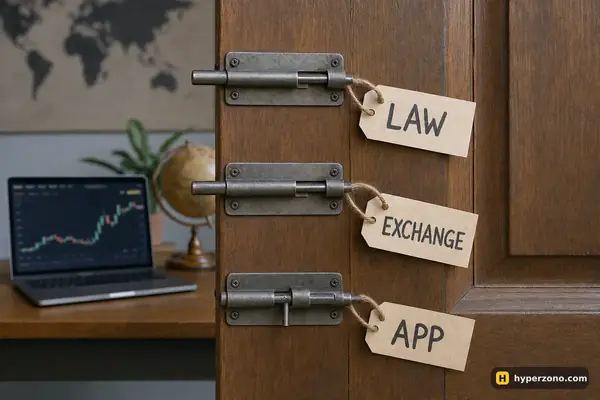
People ask one thing — "can I trade futures in Nigeria?" — but there are really three questions inside it, and the answers come from three different places. Here they are, and where to look for each.
- Will a global exchange accept a Nigerian user at all? The exchange's own restricted-country page answers that, and it carries a date.
- Is a particular platform approved to operate in Nigeria? That sits with the SEC's own site, not with an exchange's marketing page.
- Will your naira actually get in and out? That only becomes clear inside your own verified account, at the deposit and withdrawal step.
Only the first has a published, dated answer that anyone can read, and we go through it below. The other two change, so check them at the source and write down what you found and the date you checked. If you want the same picture for other countries, the global availability overview covers exchange by exchange.
Check the platform with the regulator first
Crypto platforms in Nigeria sit under the SEC, and that status is checked per platform, not per person. Take the exchange's full legal name from its terms page — not the brand you see in the app store — search it on the regulator's own website, and note the date you checked. If the name is not there, that is information rather than proof of anything bad: it usually means the company works from abroad and Nigerian approval simply does not cover it.
What this changes for you is expectations. On a platform approved at home there is a local body you can complain to; on a global futures exchange your relationship is with a company registered far away, under terms you accepted at sign-up. That is not automatically dangerous, but it means your own checks matter more: how long the exchange has existed, whether a small test withdrawal actually arrives, what its own country page says. The checklist for spotting a fake or unsafe exchange is a sensible second step.
What the exchanges' own documents say about Nigeria
Bybit's service-restricted page, last updated on 16 October 2026, lists countries such as the United States, mainland China, Canada, Hong Kong and Singapore. Nigeria is not on it. The page itself says the list is not exhaustive and can be extended "from time to time", so treat it as a snapshot rather than a promise.
OKX is the interesting case, because its documents differ depending on which version you open. The global risk and compliance page, last updated 8 July 2026, does not name Nigeria among its restricted places, while the version written for US users does list Nigeria alongside Bangladesh, El Salvador and France. Gate's user agreement names more than thirty restricted locations, and Nigeria is not among them.
Binance's terms name only a few high-risk places — Cuba, Iran, North Korea, Syria and the Crimea region — and Nigeria is not among them. Binance also keeps a separate, longer prohibited-countries page, and its terms add that residents of some countries can use only part of the services, so check that page yourself in the app at sign-up. The honest summary is: no exchange currently shuts Nigeria out, but none of them promises it will stay that way.
The sign-up flow is the real test. When you register on any of these venues and enter Nigeria as your country, the app shows you which products are actually open to you — that is also the moment identity verification decides whether futures appear at all, and which deposit routes you get.
What happens to your account if an exchange changes course
Binance's terms say residents of some countries may be able to use only part of the services. In practice that can mean the naira deposit and withdrawal routes disappear while the crypto side keeps running, and it can mean the whole country is closed with a deadline for moving funds out. Neither announcement gives you much time, so it is worth deciding in advance what you would do.
The best protection is boring: keep your own records. While the account is open, export your deposits, closed trades, fees, funding payments and withdrawals, and save the file outside the app. Turn on the exchange's official announcement notifications instead of relying on group chats, keep only the money you are actively trading on the platform, and make sure the bank account or wallet you would withdraw to is already verified and working.
If access closes, do not try to get around it. Hiding where you are, or trading on a friend's documents, is the fastest way to have withdrawals frozen during a review — and you would have broken the agreement you accepted yourself. If a venue stops serving Nigeria, withdraw inside the stated deadline and keep the records.
What a futures trade actually does with your money
Say you have 100 USDT in your futures account and you open a bitcoin trade worth 250 USDT at 5x. The exchange sets 50 USDT aside as a deposit while the trade is open — that is your margin — and the other 50 stays free. Your profit or loss comes from the price move on the full 250, so a 2% move in bitcoin is 5 USDT for you, in whichever direction it goes. These are illustrative numbers, picked to keep the arithmetic simple.
If price runs far enough against you, the exchange closes the trade on its own so the loss does not run past the money backing it; that is called liquidation. None of this changes because of where you live, which is why it is worth understanding what crypto futures are before you think about deposits. The country questions matter, but they will not protect you from a mistake in the order window.
A sensible order to do this in
Look the platform up with the regulator and note the date. Read the exchange's own restricted-country page and note that date too. Then practise where a mistake costs nothing: learning without real money first means that if you do decide to trade, you are deciding with your eyes open.
Demo mode is the cheapest place to see how a 100 USDT position behaves before any naira moves, and the walkthrough for a demo futures account on Bybit shows what to switch on. If you would rather start with the reading, where to learn futures for free collects the rest in order.
Is crypto trading legal in Nigeria?
Crypto platforms in Nigeria sit under the SEC, and that status is checked per platform, not per person. Take the exchange's full legal name from its terms page, search it on the SEC's own site, and note the date you checked. If it is not listed, it usually means the company works from abroad — you can still have an account, but there is no Nigerian body to complain to, so your own checks matter more.
Does Binance still work for Nigerians?
Binance's terms name only a few high-risk places and Nigeria is not among them, but the same terms say residents of some countries get access to only part of the services. The real answer appears during sign-up and at the deposit step inside your own account, because local payment routes can be switched off without the account itself being closed.
Can I fund a futures account in naira?
Local currency methods come and go, and they vary by exchange and by period. Do not plan around a method until you see it live inside your own verified account, and never move money through an unofficial middleman because a group chat said the official route is down.
Can I use an exchange that blocks my country if I hide my location?
Technically it might get you past a screen, and that is exactly the problem. You would be breaking the agreement you accepted, and the result usually shows up at withdrawal, when the account is reviewed and funds are held. If a venue does not serve you, that venue is simply not an option — pick one that does.
Do I pay tax on futures profit in Nigeria?
Tax rules on digital assets have been moving, so check the current law on an official government source or ask a Nigerian tax professional rather than trusting a forum answer. Whatever the answer turns out to be, keep dated exports of your deposits, closed trades, fees, funding and withdrawals — rebuilding them after an account is closed is painful.
Which exchange should a Nigerian beginner look at first?
Start from what you can verify: the exchange's own country page, whether verification completes with your documents, and whether a small withdrawal actually arrives. After that, compare fees and the demo mode. Our guide to exchanges for beginners walks through the comparison.