Contents
Why you find two opposite answers onlineWho sets the standards people are quotingWhat actually happens inside a crypto perpetualThe arguments on the other sideWhat an "Islamic" or "swap-free" account actually changesHow to ask a question a scholar can answerWhy you find two opposite answers online
One page tells you futures are fine as long as you pick an "Islamic account". The next tells you every leveraged contract is forbidden without exception. Usually neither one shows you the contract itself. The answer depends on the specific contract you are about to open, and most of the argument happens over mechanics that people describe loosely or simply get wrong. So the useful thing you can do before asking anyone is to learn exactly what the contract does with your money.
Who sets the standards people are quoting
Two names come up in almost every discussion. AAOIFI, based in Bahrain, publishes numbered Shari'ah Standards that Islamic banks in many countries follow, including standards on trading in organized markets. The International Islamic Fiqh Academy, under the OIC, publishes numbered resolutions from its sessions, among them resolutions on financial markets and later ones on hedging. Both put those numbered texts on their own websites, so that is where to read them rather than in someone's summary.
What actually happens inside a crypto perpetual
Four things happen inside a perpetual contract, and each of them is what the argument is usually about. Here is what each one does with your money.
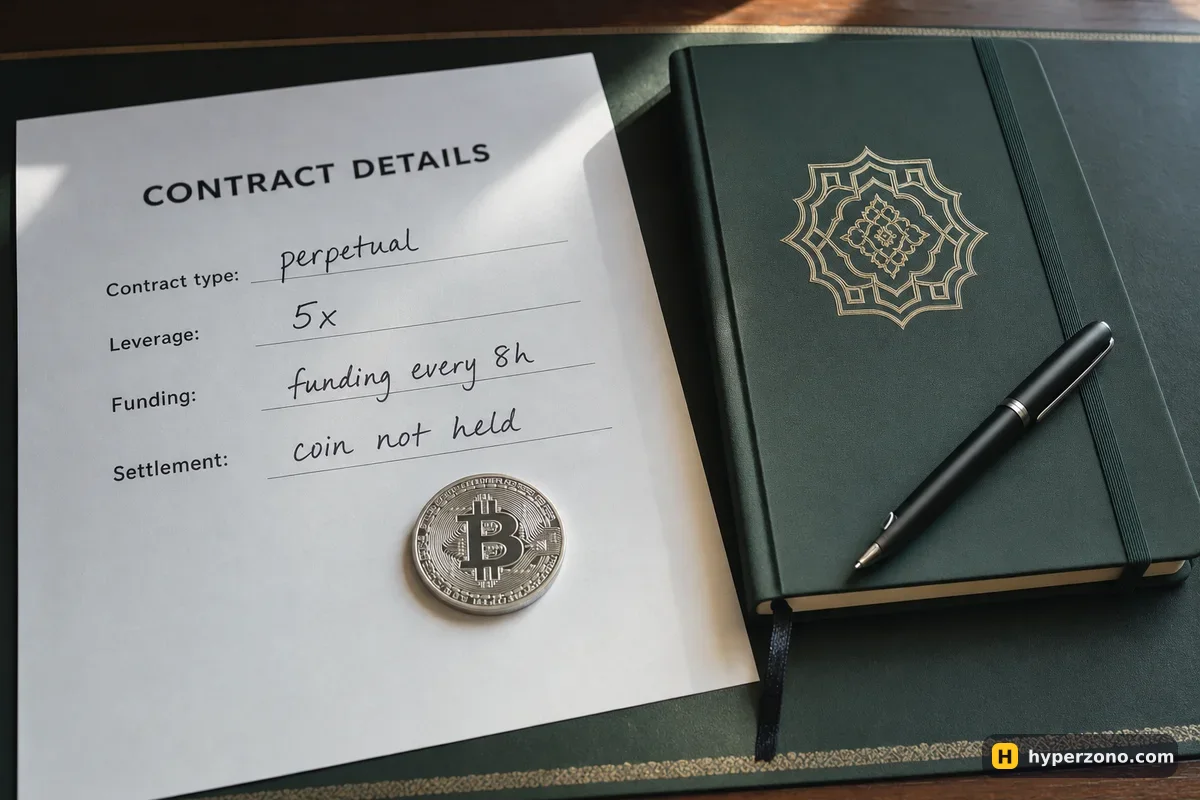
First, you never receive the coin. A USDT-settled contract pays you the price difference in USDT; nobody delivers bitcoin to anyone, and you can bet on a fall in a coin you have never held — that is how futures work without owning the asset. At the moment you open, no coins change hands at all. What does move is your margin — the exchange sets it aside — and the entry fee. The price difference itself is only settled when you close. Those facts are what the discussion about selling what you do not possess is built on.
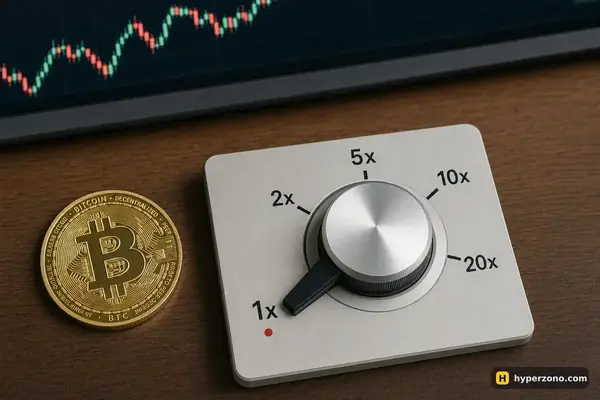
Second, leverage. The exchange sets part of your balance aside as margin and lets you hold a position several times larger. It is not structured as a loan with a stated interest rate, which is why people argue about whether riba — making money from lending money — is involved at all. The plain fact to describe is that the position is larger than the money behind it. You can also open a futures position at 1x, which takes that part of the question off the table.
Third, funding on perpetuals. Every 8, 4 or 1 hour, depending on the contract, one side pays the other a small percentage of the position size; the exchange does not take it. It is a payment between traders, not a charge from a lender — and again, that is exactly the point people disagree on. If you want to see the real numbers before you ask, our page on funding shows who pays whom and how much.
Fourth, liquidation. If price moves against you far enough, the exchange closes the position and your margin is gone. Your gain is another trader's loss and the other way round. That raises two things people name in these discussions: gharar (too much uncertainty in what each side is actually agreeing to) and maysir (gambling). We look at the non-religious side of that comparison on trading or gambling, but it is a separate question from the religious one.
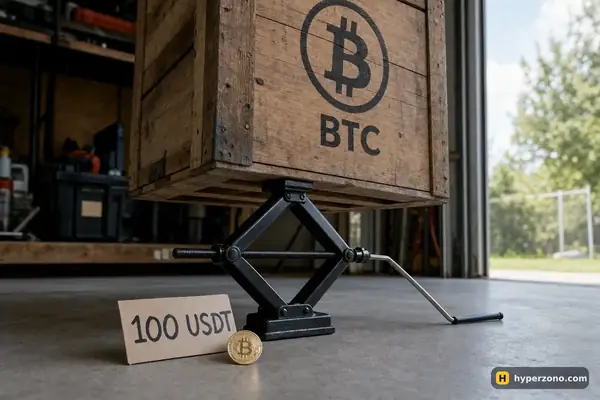
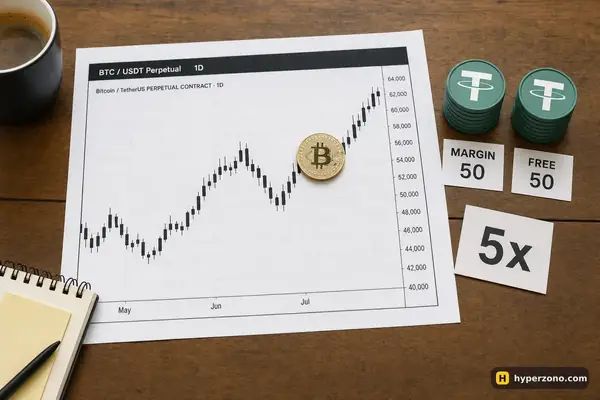
Here is one illustrative trade with the numbers in it, so you can describe it instead of summarizing it. Say you put 100 USDT aside as margin and open a 500 USDT position on bitcoin — that is 5x. No bitcoin reaches you at any point: when you close, the exchange credits or debits USDT for the price difference.
Funding on that position is a small percentage of the 500, not of your 100 — at a common rate that is a few cents every 8 hours, paid to the trader on the other side. If the price moves far enough against you, the exchange closes the trade and the 100 USDT you set aside is gone. Those are the four facts to write down and carry into the conversation.
The arguments on the other side
The minority view is not "everything is allowed". It is usually narrower, and it is worth hearing so you can put it to your scholar as a question. Some argue that a perpetual is not the classical futures contract at all, because it never expires and never settles on a date. Some argue that funding, being a transfer between two traders with no lender in the middle, is not the thing the rules on riba were written about. Some draw a line between speculation and protection: holding coins you already bought on spot and opening a 1x short against them is a different intention and a different risk profile from a 20x bet on direction.
Present these as arguments, not as permission. A scholar may accept one, reject all of them, or tell you the distinction does not matter for the reason you came with.
A label on a button is not a ruling. A product team decides what an account type does. Only a qualified scholar decides what you may use. Those are two different authorities, and the first one does not substitute for the second.
What an "Islamic" or "swap-free" account actually changes
If you come across an account type labeled Islamic or swap-free — on a crypto exchange or at a forex broker — treat the label as a product setting with a list attached. Wherever you see it, find the venue's own help page, not its marketing page and not a review site, and read what the setting actually switches off and which instruments it covers. If futures are not named in that list, the account does not cover futures, however the page is titled.
Removing one charge also leaves the rest of the contract as it was: the leverage, the way it settles in cash, what happens at liquidation. If a venue claims more than a changed fee, ask which scholar or board reviewed the product and whether that review is published anywhere you can read it.
How to ask a question a scholar can answer
"Is Binance halal?" is almost unanswerable, because an exchange is not one contract. It sells spot, futures, bots, lending and more, and the ruling you need is about the specific thing you plan to do. Write down these facts first and bring the list with you:
- Whether it is a perpetual contract or one with an expiry date.
- The leverage you plan to use, and the margin amount in dollars — for example 100 USDT of margin behind a 500 USDT position.
- How funding works on that contract: how often it is charged, that it is a percentage of the position size, and that it moves between traders rather than to the exchange.
- Whether you own the underlying coin on spot, or nothing at all.
- Whether the purpose is protecting something you already hold, or taking a position on price direction.
- How the position ends: cash settled in USDT, never in the coin itself.
If the answer you get is no, spot trading is the usual next question to ask about — you actually own the coin there, which removes several of the issues above, though scholars also differ on crypto assets themselves. Our page on spot or futures for a beginner explains the practical difference between the two in plain terms, so you can describe accurately what you would be doing instead.
Is Binance futures halal?
We cannot give you that answer, and nobody who sells trading access should either. Binance is a venue with many different products; the ruling you need is about the specific contract — perpetual or dated, leveraged or 1x, speculative or protective. Collect those details and put them to a scholar you trust.
Does an Islamic account on an exchange make futures permissible?
It changes what that account can trade and which charges it applies, nothing more. Read the venue's own help page for the account type and check whether futures appear in the product list at all. A marketing label is not a review by a Shari'ah board, and even a real board's approval applies only to the products it examined.
Is the funding fee the same as interest?
Mechanically, funding is a payment between long and short traders, settled every 8, 4 or 1 hour depending on the contract, and the exchange does not keep it. Whether that counts as riba is exactly the point scholars argue over. Describe it accurately when you ask, because many people wrongly tell a scholar it is a fee paid to the exchange for borrowing.
What about using futures only to protect coins I already own?
That is the case some scholars treat separately, because you hold the asset and the intention is protection rather than a bet on direction. It is an argument to raise, not an exemption you can assume. Bring the exact setup: how many coins you hold, the position size in dollars, and the leverage.
Where do I find the actual standards instead of summaries?
Look on the bodies' own sites — AAOIFI for the numbered Shari'ah Standards, the International Islamic Fiqh Academy for its numbered resolutions. Ask your scholar which number applies to your case and read that text together, instead of arriving with a screenshot of someone's summary. Forum posts and blog paraphrases tend to drop the conditions that decide the question.
If futures are out, what are my options?
The usual ones people consider are buying and holding the asset on spot, where you actually own it, or staying out of this market entirely. Both are legitimate outcomes of asking the question, and the second one costs you nothing.