
Contents
What the number on the slider is actually doingHow big a move doubles your money — and how big a move wipes itWhy 5% matters so much at 20xLiquidation arrives a little earlier than the table saysWhy 20x on a tiny position is not the same as 20x on everythingSo which number should you put on the slider?
What the number on the slider is actually doing
When you pick 10x, you are telling the exchange: open a trade worth ten times the money I am setting aside for it. That money set aside is called your margin, and there's a whole page on how margin works if you want the detail. Here we stay with the number on the slider.
So with 100 USDT and 10x, you are trading a 1,000 USDT position. With 20x, the same 100 USDT opens a 2,000 USDT position. Your profit and your loss are always calculated on the position size, not on your margin — which is exactly why the same price move feels ten or twenty times stronger in your account.
How big a move doubles your money — and how big a move wipes it
There is one piece of arithmetic worth memorising, and it answers both questions at once. Divide 100 by the leverage number. That is the percentage move in your favour that would double your margin, and roughly the percentage move against you that would wipe it out.
| Leverage | Move in your favour that doubles your margin | Move against you that wipes it | In dollars, if BTC is at 100,000 |
|---|---|---|---|
| 2x | +50% | −50% | 50,000 |
| 5x | +20% | −20% | 20,000 |
| 10x | +10% | −10% | 10,000 |
| 20x | +5% | −5% | 5,000 |
| 50x | +2% | −2% | 2,000 |
100 divided by your leverage. That one number tells you how much room the trade has before your margin is gone. At 5x you have about 20% of room, at 20x about 5%, at 50x about 2%. Everything else on this page is just detail around that.
Why 5% matters so much at 20x
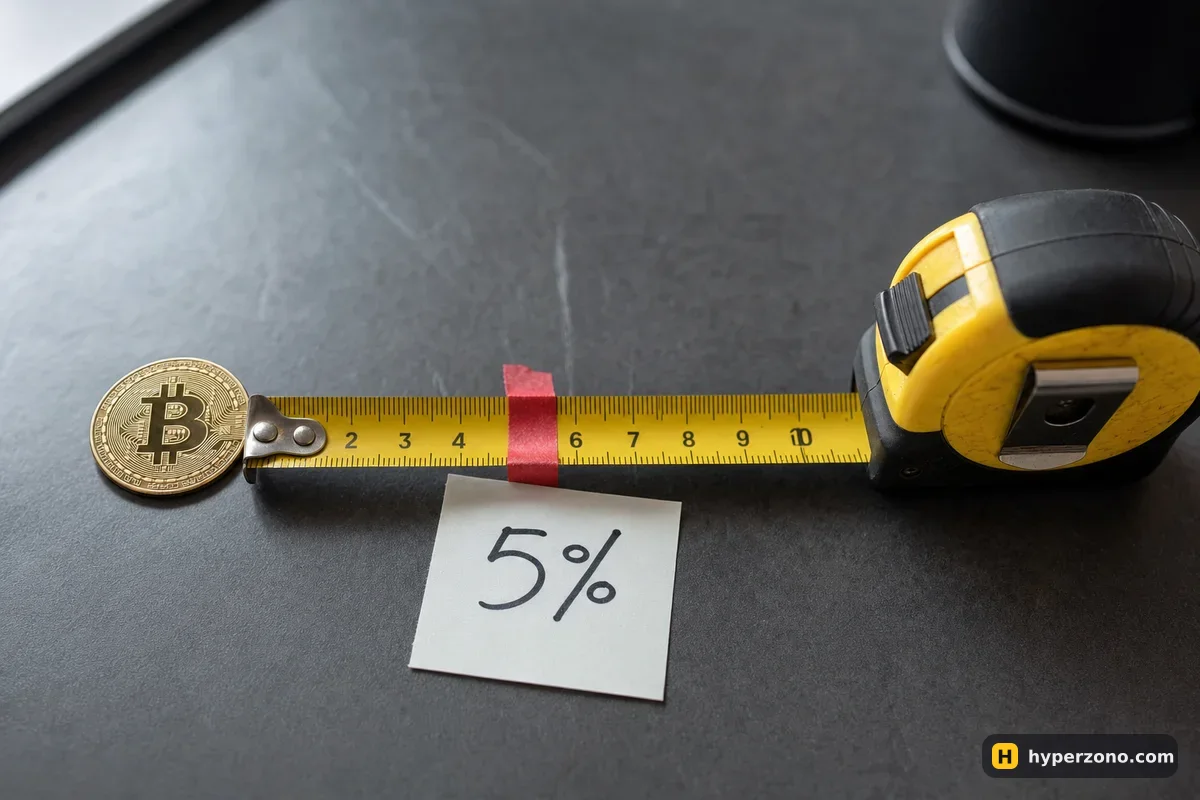
Five percent sounds like a lot until you look at what bitcoin does on an ordinary day. On our illustrative 100,000 price, 5% is a 5,000 dollar move — the kind of swing that can happen while you sleep, on a news headline, or in twenty minutes on a nervous afternoon. At 50x it is only 2,000 dollars, and bitcoin can cover that in a few minutes.
Here is what that looks like with real money. You put 100 USDT behind a 20x long on bitcoin, so your position is 2,000 USDT, about 0.02 BTC. The price drops from 100,000 to 95,000 and your loss is 0.02 × 5,000 = 100 USDT. The whole deposit on that trade, from a move most people would describe as "a normal red day".
Liquidation arrives a little earlier than the table says
The exchange does not wait politely until your margin hits exactly zero. It keeps a small cushion called maintenance margin, and it closes the position while a little money is still there, so the trade can be covered. On top of that, the entry and exit fees come out of the same pot. In practice your trade ends a bit before the clean 5% or 10% in the table — how much earlier depends on the contract, the position size and your margin settings.
The exchange also uses a fair price derived from several markets, not the last trade on the screen, to decide the moment. The full story is in what liquidation is; for now, treat the "100 divided by leverage" figure as the optimistic version and assume the real line sits slightly closer. You can put your own numbers in here and see where it lands:
Why 20x on a tiny position is not the same as 20x on everything
This is the part most beginners get backwards. The leverage number does not decide how much money you can lose — the size of the position does. If you open a 1,000 USDT trade, a 2% move against you costs you 20 USDT whether you picked 5x, 10x or 20x. All the slider changed is how much of your balance got locked up as margin, and how dramatic the percentage looks next to the position.
The position is 1,000.00 USDT in every row. A 2% price move gives the same money result — 20.00 USDT. Only the share of your margin changes: from 10% to 40%.
There is a real difference, though. Higher leverage locks up less money for the same trade, so more of your balance stays free. If the trade is set to use your whole account balance, that free money can be pulled into the losing position when the price goes the wrong way.
You can also set a trade so that only the margin you gave it is at stake, which is the safer habit while you are learning — the two settings are compared in cross or isolated margin.
With that setting and a small position, 20x risks less money than 5x on a trade that is far too big for your account — but remember the 20x trade is still closed by a 5% move, while the 5x one survives 20%. These are two different protections and you want both. Small size limits what you can lose; low leverage buys you room.
The easiest way to feel this is to open a Binance Futures account, type in a position size and then drag the leverage slider up and down. The trade size stays where you put it, the required margin shrinks, and the liquidation price moves closer — all from one number you just changed.
So which number should you put on the slider?
Start from the move you want to survive, not from the number that looks exciting. If you think bitcoin can swing 3% against you before your idea is proven wrong, then 20x leaves you almost no room, and a stop-loss is doing all the work. Decide the position size first, then set leverage so the trade has room for that swing, then place a stop-loss before you ever look at the profit column.
What to actually pick for a first trade is its own question, and what leverage a beginner should use goes through it properly. Before you put money anywhere, check that futures are available where you live — this varies by country and by exchange, and the app will tell you during sign-up. Then choose an amount you can genuinely afford to lose, and let the slider follow that decision instead of leading it.
What does 10x leverage mean in simple words?
It means your trade is ten times the money you set aside for it. Put 50 USDT behind a 10x trade and you are controlling a 500 USDT position. Every 1% the price moves is worth about 10% of your 50 USDT, up or down.
What does 20x leverage mean in crypto?
Your position is twenty times your margin, and roughly a 5% move against you is enough to take that margin. With fees and the exchange's maintenance cushion, the trade usually ends slightly sooner than the clean 5%.
Does 10x leverage multiply my profit by ten?
It multiplies the percentage return on your margin, not money out of nowhere. A 1% move on a 1,000 USDT position is 10 USDT regardless of leverage — but if you only locked up 100 USDT of margin, that 10 USDT is a 10% gain on your margin. The loss works exactly the same way.
Why can't I select high leverage on my new account?
Some exchanges limit new users. On Binance, for example, leverage above 20x is not available during the first 30 days of a futures account. The maximum also depends on the contract and on how big your position is, so the range you see in the app may differ from the headline number on the website.
Is lower leverage always safer?
For the same position size, yes: lower leverage gives the price far more room before your trade is closed, 20% at 5x against about 5% at 20x. But if you take a huge position at 3x with no stop-loss, you can still lose a painful amount, because the money you lose comes from the position size. Use both — a size you can afford and leverage that leaves room.
Can I change leverage after opening a position?
Most exchanges let you adjust it on an open position, which changes the margin held and shifts the liquidation price. The exact rules and limits differ by venue and contract, so check in the exchange app before you rely on it mid-trade.