
Contents
What actually makes a casino a casinoWhy you can be wrong more often than right and still make moneyThe small built-in edge against you: fees and fundingThe exact moment it turns into a casinoA checklist: is your process trading or betting?When to stop, honestly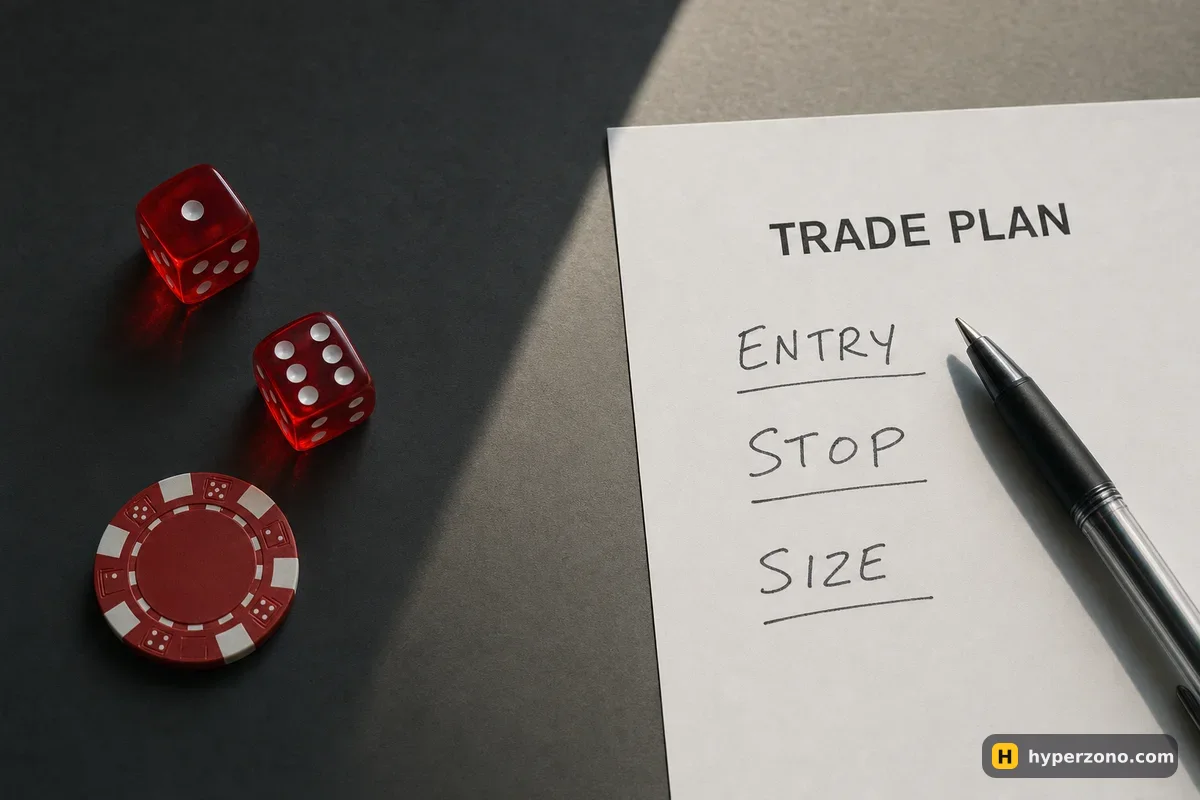
What actually makes a casino a casino
On a roulette wheel the payout is deliberately set a little below the true chance of winning. You can bet small or large, slow or fast, but you cannot change that gap. Play long enough and the result is not uncertain at all — it's a slow, mathematically guaranteed slide toward zero. The house doesn't need luck; it needs you to keep playing.
Futures work differently in one specific way: nobody fixes your payout. If Bitcoin moves 1% in your favor, you get that 1% of your trade size, and if it moves 1% against you, you lose it. The exchange doesn't win when you lose — it just takes a small fee either way. That's the whole mathematical difference, and it's the reason futures *can* be trading. It does not mean they will be.
Why you can be wrong more often than right and still make money
Say you only take trades where you risk 2 USDT to try to make 4. You're right 4 times out of 10 — and you still finish the week up. Six losing trades cost you 12 USDT, the four winners bring in 16, so across those ten trades you're ahead by 4 USDT. The numbers are illustrative, but the shape is real: your winners simply have to be bigger than your losers while your trade size stays the same.
Flip one thing and it collapses. Risk 4 to make 2, be right 6 times out of 10, and you lose money while feeling like a good trader. That is what a lot of beginners do without noticing — they take small profits quickly and let losing trades run, hoping the price comes back. Whether a beginner can realistically get ahead at all is a separate, honest conversation in can you really make money on futures.
The small built-in edge against you: fees and funding
You don't start at exactly zero. Every entry and every exit costs a fee on the full size of the trade. On Binance USDⓈ-M futures at the base level that's 0.05% if your order fills immediately, so a 500 USDT trade costs about 0.25 USDT to open and 0.25 to close — half a dollar in and out. Tiny, until you take thirty trades a day, at which point you've handed over 15 USDT just for existing. Fees are explained properly in what fees you pay on futures.
Long 500.00 USDT, entry 60,000 → exit 60,600, fees 0.05% + 0.05% (example rates).
On perpetual contracts there is also funding — a payment made every few hours between traders holding longs and traders holding shorts. The exchange doesn't keep it, but when you're on the paying side it quietly comes out of your result. How funding works covers the details.
Fees come off every trade you open and close. Funding only touches you if your position is still open when the payment time comes around — which is why holding for days is a different kind of cost. The more often you trade, and the longer you hold, the more of your result goes out the door before you even look at the price.
The exact moment it turns into a casino
There are four habits that flip the math, and beginners usually adopt all four in the same week. The first is extreme leverage. At 50x, a move of roughly 2% against you is enough to burn through the margin behind the trade and the exchange closes it — the exact price where that happens depends on your settings and the fees, so check the liquidation price the exchange shows you before you confirm the trade.
Bitcoin moves 2% on an ordinary Tuesday. That isn't a trade with a reason behind it, it's a coin flip with a clock running. Leverage by itself isn't the problem — leaving no room for an ordinary daily swing is. Picking a sane number is covered in what leverage a beginner should use.
Number two is having no exit price. If you open a position without knowing where you'll admit you were wrong, you've placed a bet and handed the decision to your emotions. A stop-loss fixes that in ten seconds.
The third habit is averaging down — adding money to a losing position so the "average price" looks nicer. It feels clever, and it is how small losses turn into total ones. Then there's the revenge trade: you lose 20 USDT, feel the sting, and immediately open something twice as big to get it back.
That last one has nothing to do with markets at all. More patterns like these are collected in why beginners lose money.
A checklist: is your process trading or betting?
Run this before your next trade. It takes under a minute and it is brutally clear.
- You can say out loud, before entering, the price at which you'll close if you're wrong — and you place that stop immediately.
- You know the loss in actual USDT at that price, and it's a small slice of your account, not a chunk you'd feel for days. (How to size a trade)
- You have a reason for the trade that you could explain to a friend in one sentence, and it isn't "it feels like it's going up".
- You counted fees and funding before you counted profit.
- Your position size is the same after three losses as it was before them.
- You could skip trading today entirely and feel nothing.
Six yes answers and you're trading, even if this particular trade loses. Two or three, and you're at a table. The easiest way to test your own process without paying for the lesson is demo mode — you can sign up on Bybit and run the checklist on simulated trades first, then on small real ones. Check during sign-up that futures are available where you live; they aren't offered everywhere.
Two losses in a row and the app closes for the day. This is the single rule that separates people who survive their first month from people who don't. It costs you nothing on a good day and saves your account on a bad one — the big losses almost always come from the third trade, taken angry.
When to stop, honestly
Some signs are not about strategy, they're about you. If you're trading with money meant for rent or food, borrowing to top up your balance, hiding trades from your partner, sizing up specifically to "get back to even", or checking the chart at three in the morning with your heart racing — the instrument stopped mattering. That's the behavior a casino is designed to produce, and futures can produce it just as well.
The response is simple and not dramatic: withdraw what's left to your spot wallet, take a week off entirely, and tell one person you trust. If the pull doesn't fade, most countries have free gambling support lines, and using one is a sensible thing to do, not an embarrassing one. Futures will still be there later, and so will the only version of them worth doing — small size, a written plan, and the boring kind of patience.
Is crypto futures trading gambling?
It is gambling when your trade has no exit plan, no size rule and no reason beyond a feeling. It's trading when you decided the loss before the entry and your size stays the same whether you just won or just lost. The contract is neutral — your process decides.
Is leverage trading gambling by itself?
Leverage doesn't make you richer and it doesn't make you a gambler on its own; it just makes everything move faster. The problem is that high leverage leaves almost no room for normal price noise, so at 50x a routine daily swing can close your position. Low leverage with a stop is a trade; maximum leverage without one is a bet.
Why do so many people say trading crypto is just a casino?
Because most of what they see is the casino version: huge leverage, no stop-loss, revenge trades after losses. Add fees on every entry and exit and funding on positions held for days, and someone trading that way really does face worse odds than a roulette wheel.
Can a beginner actually get ahead?
Not in week one, and anyone promising otherwise is selling something. What a beginner can control immediately is risk — small size, a stop on every trade, no adding to losers. That alone turns a fast loss into a slow, survivable learning curve.
How do I check whether I'm trading or betting right now?
Open your position list and answer one question for each trade: at what price do I get out if I'm wrong, and how much is that in USDT? If you can't answer instantly for every position, you're betting, and the fix takes a minute — set the stops.