
Contents
Yes — you just set the leverage to 1xHow a 1x long differs from simply buying the coinThe real reason people use 1x: going shortWhat 1x actually costs youIs 1x leverage safe? Can you still be liquidated?Why 1x is a sensible setting for your first trade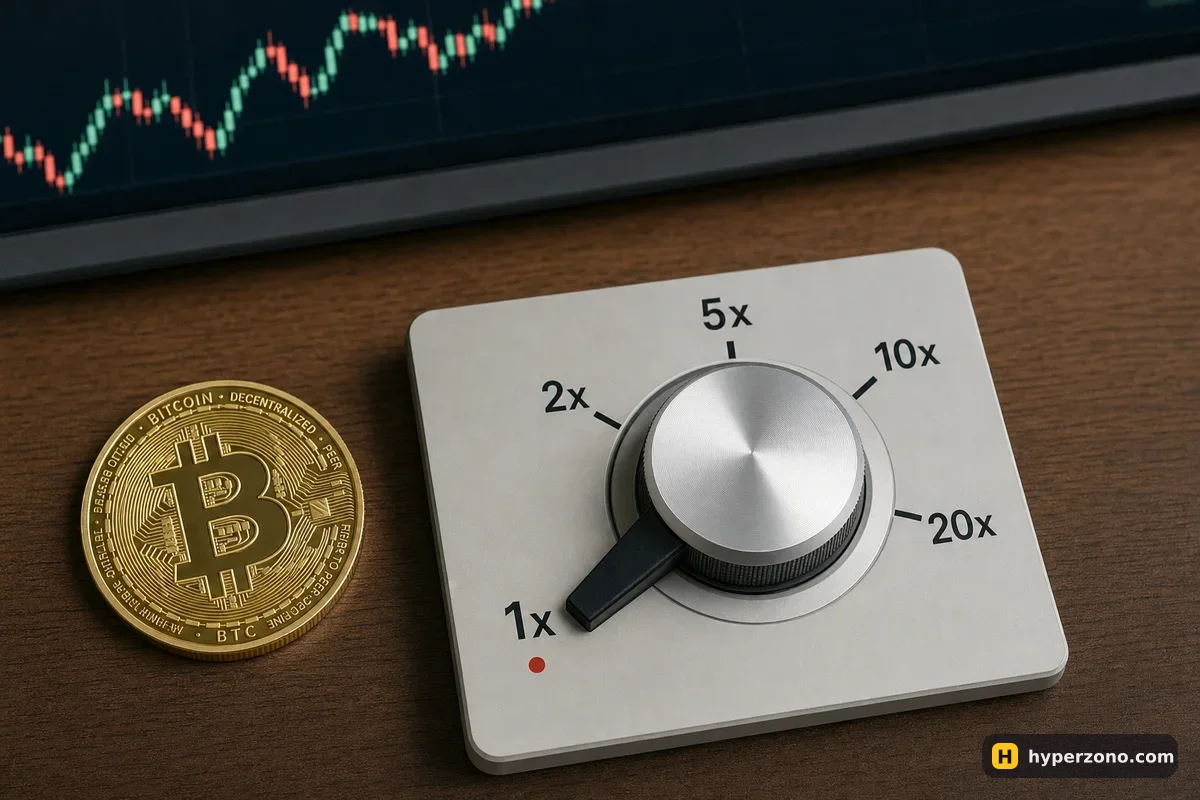
Yes — you just set the leverage to 1x
On the order screen there is a small button showing the current leverage for that contract, something like 10x or 20x. Tap it and you get a slider or a list of numbers; move it down to 1x and confirm. On Binance the starting value depends on the experience level you picked when you opened the futures account — Beginner starts at 2x, Experienced at 5x, Advanced at 20x — so most people have to change it by hand the first time.
At 1x your margin equals the full size of the position. A 100 USDT position needs 100 USDT set aside, a 500 USDT position needs 500 USDT. That is the whole trade-off: nothing is borrowed, so nothing is amplified, and the money you can put to work is only the money you actually have. If the word margin is still fuzzy, the margin page explains it properly.
One practical detail: each contract has a minimum size, and at 1x that minimum sets your smallest trade. On Binance the smallest bitcoin position is 0.001 BTC, so at 1x you need roughly whatever 0.001 BTC is worth at that moment in margin. Most altcoin contracts start from about 5 USDT of position value, which at 1x means about 5 USDT of margin — so a small account is not locked out, it just has fewer coins to choose from.
The position is 500.00 USDT in every row. A 2% price move gives the same money result — 10.00 USDT. Only the share of your margin changes: from 2% to 20%.
How a 1x long differs from simply buying the coin
A long at 1x and a spot purchase move your money by almost the same amount, but they are not the same thing. On futures you never hold the coin — you hold a contract settled in USDT, so there is nothing to withdraw to a wallet, nothing to send to a friend, nothing to stake. You also keep paying or receiving funding for as long as the position is open, which never happens on spot. Here is the short version side by side, and the full picture is on the spot versus futures page.
| Buying on spot | Long at 1x on futures | |
|---|---|---|
| What you own | The coin itself, in your account | A contract priced in USDT |
| Can you withdraw it | Yes, to a wallet | No — only USDT |
| Funding payments | None | Yes, while the position is open |
| Can you bet on a fall | No, you can only sell what you hold | Yes, open a short |
The real reason people use 1x: going short
This is the one thing you cannot do on spot, and it is why most people use 1x futures at all. On spot you only make money if the price goes up. On futures you can open a short, and a short at 1x gives you the mirror image of holding the coin: the price falls 3%, you gain 3% of your position. No borrowed money, no amplification, just the other direction. If that idea is new, start with how people profit when the price falls.
The same trick is used to protect coins you already own. Say you hold bitcoin on spot and you do not want to sell it this week, but you think it will dip. A 1x short of a similar size roughly cancels the move — what you lose on the coin you gain on the short, and the other way round. It is not free, because of the fee and funding, but it is a calm way to wait out a bad week without selling the coins you own.
What 1x actually costs you
You pay a fee when you open and a fee when you close, and both are charged on the size of the position, not on your margin. On Binance USDⓈ-M futures at the base level there are two rates. If you buy at the current price straight away, it is 0.05%. If you instead leave your order waiting at your own price and someone trades against it later, it is 0.02%. On a 500 USDT position, 0.05% is 25 cents each way, and spot has its own fee schedule — look it up on the fee page in the app before you decide which is cheaper for you.
Then there is funding, the payment that longs and shorts exchange directly; the exchange does not keep it. Binance settles it every 8 hours by default, with some contracts on a shorter schedule. If the rate at settlement were 0.01% — an illustrative number, the real one changes constantly and is shown on the contract screen — a 500 USDT position would pay or receive 5 cents each time, around 15 cents a day. Small, but it never stops, and over a month of holding it adds up.
Is 1x leverage safe? Can you still be liquidated?
Much safer than 10x, but it is not a setting where nothing can go wrong. If the price moves far enough against you, the exchange closes the trade itself so that you do not lose more than the money you set aside for it — that is liquidation, and it can happen at 1x too, it just takes a much bigger move. You can read what liquidation is for the full picture. One thing worth knowing now: the exchange does not use the last trade on the chart to decide this, it uses a fairer price called the mark price, so a single strange tick does not close your position.
A long at 1x would need a catastrophic drop before that point, because the coin would have to lose almost all its value. A short at 1x is the one to watch: prices can double, and a doubling costs you an amount equal to the whole position. In practice the exchange closes the short before the price has fully doubled, which is small comfort if you were hoping to sit it out. The safest habit is isolated margin plus a stop-loss, and which margin mode to pick is covered on the cross versus isolated page.
1x lowers the risk, it does not remove it. Use isolated margin so the trade can only touch the money you assigned to it, and put a stop-loss on every position, including 1x shorts. With cross margin your free balance backs the position, and a bad short can reach money you were not planning to risk.
Why 1x is a sensible setting for your first trade
If you have never opened a futures trade, 1x is a good first setting for one specific reason: every button on the screen behaves exactly as it will later, but the price has to move a lot before anything dramatic happens to your balance. You learn where the order window is, how a stop-loss is attached, what the position tab looks like, how closing works — and your balance moves at the same speed as the price itself, instead of a position that a 5% drop could wipe out.
The simplest way in is demo first, then one small real trade at 1x, and only then decide whether you need more. You can do both on the same account — open a Binance Futures account, try the mechanics in demo mode where it is available in your country, and then put 20 or 50 USDT behind a 1x position to feel the difference between a simulation and real money. When you do start raising the number, read what leverage a beginner should use first.
Is 1x leverage the same as spot trading?
Close in terms of money, different in substance. Your profit and loss track the price move one-to-one, but you never hold the coin, you cannot withdraw it, and you pay or receive funding while the position is open. The big practical difference is that futures let you short.
How do I set leverage to 1x on Binance?
Open the contract you want, tap the leverage button in the order area (it shows the current value, like 20x), move the slider all the way down to 1x and confirm. The setting applies to that contract, so check it again when you switch to another coin.
Can I lose everything with 1x leverage?
It is much harder than at high leverage, but not impossible — especially on a short, where the price can keep climbing until the exchange closes the trade. Use isolated margin, set a stop-loss, and only put in money you can afford to lose.
Does futures trading with no leverage still have funding fees?
Yes. Funding depends on the size of your position, not on the leverage you chose, so a 1x position pays and receives it exactly like a 10x one of the same size.
How much money do I need for a 1x futures trade?
Enough margin to cover the full minimum position size of that contract. On Binance that is about 5 USDT of position value on most altcoin contracts, and the value of 0.001 BTC on bitcoin. So on altcoins a 1x trade can start from a few dollars; on bitcoin you need more because of the 0.001 BTC minimum.