Contents
What actually happened on 20 April 2020Why the oil contract on a crypto exchange is built differentlySo could the price on a crypto exchange go below zero?What stops you long before price gets near zeroWhat to check in the specification of the contract you are looking atWhat actually happened on 20 April 2020
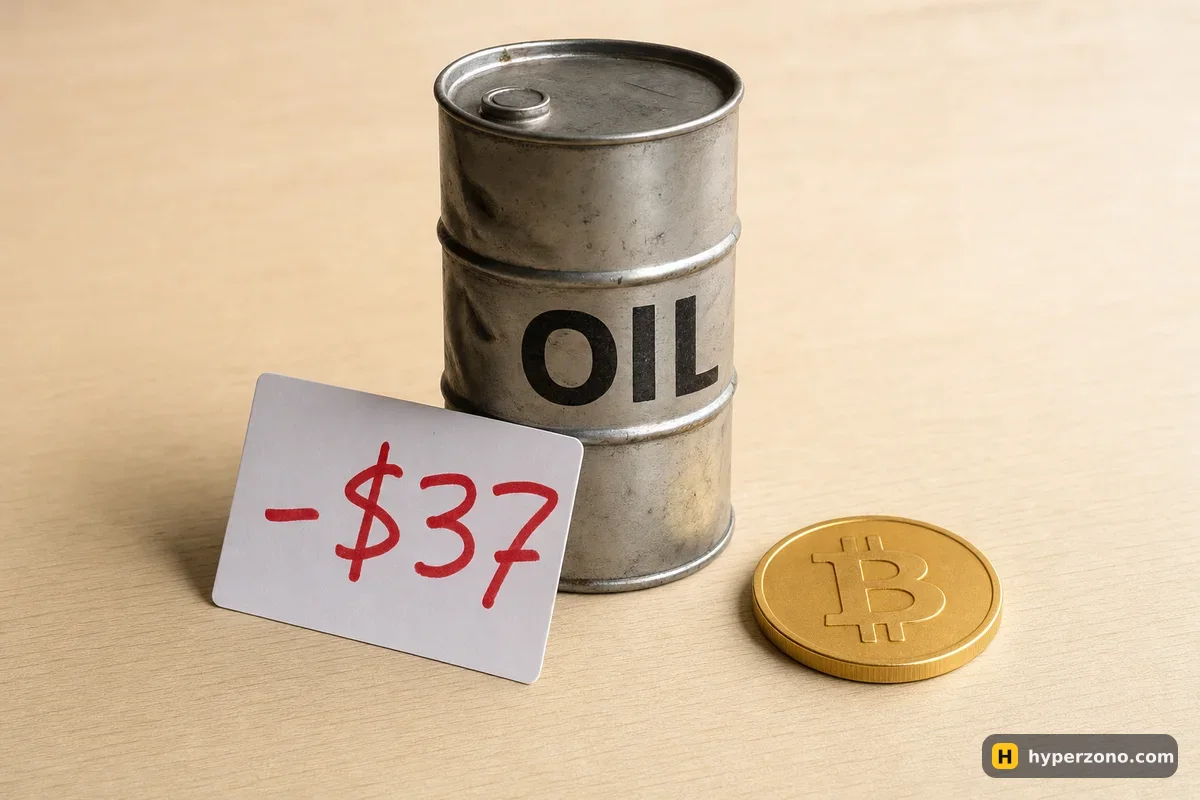
The contract that went negative was the WTI crude oil future for May 2020 delivery, on the day before it expired. The CFTC's staff report describes the price falling from $17.73 a barrel to a settlement of -$37.63, and says this was the first time the contract had traded at a negative price in the 37 years since it was listed.
Three things came together, and the CFTC release names them: the global crude market was already oversupplied at the start of 2020, COVID-19 cut demand by an unprecedented amount, and the market was worried that there was nowhere left to store the oil. That worry only matters in a contract that ends with real barrels being delivered. If you still hold it when it expires, the oil is yours — and if every tank is full, people will pay you to take it.
Far more of those contracts than usual were still held by someone as expiry approached, even though most traders had already closed out before that last day. And in the days before, fewer and fewer buy and sell orders were waiting on the exchange, so when the selling came there was little to absorb it. Between 1:00 p.m. and the 2:30 p.m. settlement the price moved in a way the CFTC calls exceptional, even though the exchange's pause mechanisms for fast or large moves were triggered. The report does not say what caused each move; that was outside what it set out to do, and it describes itself as an interim report.
Why the oil contract on a crypto exchange is built differently
On OKX, crude oil trades as a commodity perpetual: CLUSDT for WTI and BZUSDT for Brent. OKX describes these as perpetual swaps that track the price of commodities without holding physical goods or traditional delivery contracts, with no expiry date. You post margin in USDT and your result is paid in USDT, under the same margin, funding and liquidation rules as other perpetual swaps of the same margin type. There is no day on which the contract ends and somebody has to deal with actual crude — which is exactly the pressure point that made April 2020 what it was. If this is new to you, the oil contract explained from scratch covers the basics.
The price still comes from the oil market, though, and it is worth seeing how. For CLUSDT, OKX says the underlying tracks the active WTI delivery contract rather than a spot price, and that the index is a blend of several sources, not a one-to-one mirror of any single delivery contract. Its own simplified example weights the index as 72% the ICE August 2026 contract, 18% the September contract, 5% the OKX perpetual and 5% the Hyperliquid perpetual. ICE data comes through a direct data partnership; other delivery-based products use vendors such as Pyth.
Two things can move the price on your screen for reasons that have nothing to do with oil traders. If one of the price feeds stops updating, it is dropped: its weight falls to zero over five minutes and the other sources scale up to keep the total at 100%, so your price keeps moving, just driven by what is left. And while the traditional oil market is shut — all weekend, for example — the index is held within 10% of the last ICE close, with the ICE feed excluded automatically.
Crypto trading runs 24/7 anyway, so you can sit in a position all weekend on a capped price and then watch it catch up quickly once the outside market reopens. OKX also notes that liquidity is thinner and spreads wider at those times.
Once a month the index switches to the next delivery month, in five steps of 20%. You do not have to do anything, and this is why a contract with no expiry still changes its underlying.
So could the price on a crypto exchange go below zero?
Here is the honest answer. The machinery that produced -$37.63 — a contract with a last trading day, and holders who physically could not take the oil — is not there in a USDT-settled perpetual with no expiry. OKX's commodity perpetuals page says nothing about a floor or a minimum price, and nothing about how a zero or negative underlying would be handled. That means unknown, not safe. The quickest way to check for yourself is to open OKX and read the CLUSDT page together with the mark price and price limit documents it links to, and ask support if the answer still isn't there.
What you can say is that the one historical cause does not apply to you, and that the index still leans heavily on the WTI delivery-contract prices. So if the real oil market drops hard, most of that drop shows up on your screen too — in the example above the two ICE contracts make up 90% of the price.
An unpublished rule is not a promise. If the handling of extreme prices matters to you, look for it in the contract specification and the price-limit document for the exact contract, and ask support if it is not there. "The page doesn't mention it" means unknown, not safe.
What stops you long before price gets near zero
In practice your margin runs out long before price gets anywhere near zero. Say you put 100 USDT of margin into a 500 USDT oil position at an illustrative $60 a barrel — that is 5x leverage. A 10% fall to $54 costs you 50 USDT — half your margin, on a move oil can make in a couple of days. Keep falling and the exchange closes the trade itself to stop the loss going past your margin. That is liquidation, it works off the mark price rather than the last trade, and it happens a long way above zero.
Isolated long of 500.00 USDT, 5× leverage, maintenance margin 0.50% of position size (example). Simplified model without closing fees, risk-limit tiers or other positions — the exchange will show its own price.
That gives you three controls that work whatever the market does. Use isolated margin so only the money you assigned to that trade is at stake — the difference between cross and isolated is worth five minutes before your first commodity trade. Set a stop-loss when you open the trade, not after. And keep the position small enough that a jump past your stop still leaves you trading tomorrow; in a fast market a stop can fill well below its trigger price, and oil has shown it can move faster than buyers can keep up.
What to check in the specification of the contract you are looking at
What the price follows
OKX lists CLUSDT and BZUSDT as based on delivery contracts, and gold and silver as based on spot. Oil follows the price of the oil contract traders are using right now for the nearest delivery month, so it moves with that market. Gold and silver follow the ordinary market price instead.
The price sources and their limits
Which feeds build the price, what happens when one goes stale, and whether the price is held within a band around the last traditional-market close. For CLUSDT that band is 10% while the outside market is shut.
Rollover dates
Once a month the price starts following the next delivery month instead, in five small steps. You do not have to do anything — but the index level can shift a little while it happens, so do not be surprised by a move with no news behind it.
Costs of holding
Funding follows the standard perpetual mechanism and is charged only if you hold the position at the settlement moment; the interval varies by product, so read it per contract rather than assuming eight hours.
Size, leverage and availability
The commodity perpetuals page does not publish contract size, tick size, leverage caps or minimums — those live in the contract specification in the app. Commodity contracts are not offered everywhere, so check during sign-up that oil perpetuals actually show up in your account.
One more line from OKX's own page deserves a place in your notes: it reserves the right to adjust index components and rollover parameters without prior notice. That is normal for this kind of product, and it is a good reason to check the specification again if you plan to hold oil for weeks rather than hours. If your real question is how small a first oil position can be rather than whether the price can go below zero, that is answered separately.
Did oil really go to minus $37?
Yes. The CFTC's staff report covers the WTI contract for May 2020 delivery, which fell from $17.73 a barrel on 20 April 2020 and settled at -$37.63, one day before that contract expired. The release calls it the first negative price in the contract's 37 years, and names oversupply, the COVID-19 demand collapse and storage worries among the factors around it.
Can my oil perpetual on a crypto exchange go negative?
OKX's commodity perpetuals page does not say. It describes a contract with no expiry, settled in USDT, and says nothing about a floor or about how a negative underlying would be handled — so treat that as unknown rather than as protection. What you can say is that the delivery mechanism behind April 2020 is absent, and that for your account the realistic ending of a bad trade is liquidation long before price approaches zero.
Will I ever have to take delivery of barrels?
Not on a perpetual like CLUSDT. OKX describes it as a way to trade price moves without holding physical commodities or traditional delivery contracts, and it has no expiry date. The price references delivery contracts, but you settle in USDT.
What happens to the oil contract at the weekend, when the real market is closed?
Trading continues 24/7, but the price is built differently: the ICE source is excluded automatically, so the remaining sources carry more weight, and the index stays within 10% of the last ICE close. OKX also warns that liquidity is thinner and spreads wider at those times, so market orders can fill further from the price on your screen.
Does a stop-loss protect me in a crash like that one?
It limits most ordinary losses and you should always set one, but it does not guarantee your exit price. A stop-market order fills at whatever is available when it triggers, which in a fast or jumping market can be meaningfully worse. That is why position size, not just the stop level, decides how much a bad day costs you.
Is gold on a crypto exchange built the same way as oil?
No, and that matters. On OKX, gold and silver perpetuals track the ordinary spot market price, while oil and copper track designated delivery contracts with a monthly rollover. So the rollover story and the delivery-month behaviour apply to oil, not to the metals.
Sources and fact-check
Exchange terms were checked against official documents on November 10, 2026. Terms change — before you trade, check what matters to you in the exchange app and in your contract’s specs.
CFTC: Staff Interim Report on NYMEX WTI Crude Contract Trading on and around April 20, 2020OKX: Commodity Perpetuals help article