Contents
Same word, two different indicesWhat the Nasdaq-100 actually holdsYour contract may follow neither indexWhy the same sector story lands differentlyFour quick checks before you act on a headlineSame word, two different indices
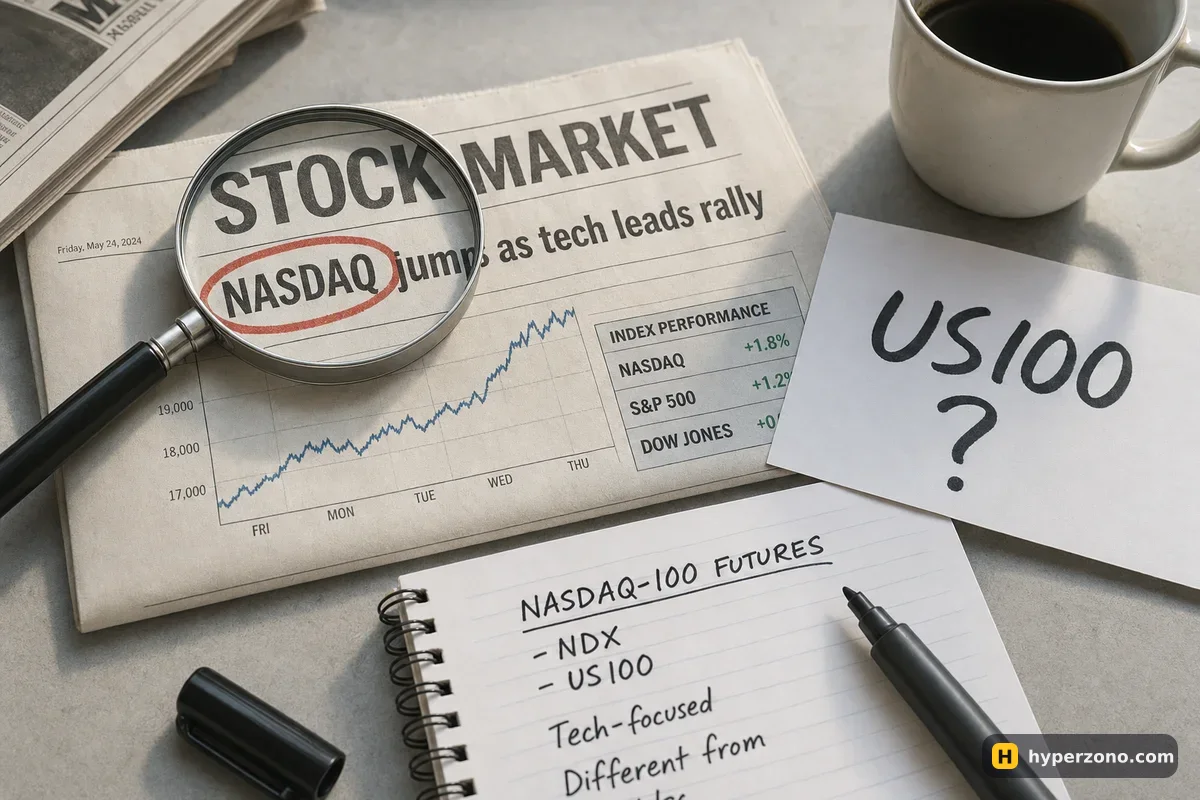
When a news site writes "the Nasdaq rose today", the number behind that sentence comes from one specific index with a full name, and Nasdaq publishes more than one. The Nasdaq-100 is a selection: Nasdaq describes it as 100 large-cap companies listed on its stock market, with financial companies left out on purpose. The Composite is not a shortlist at all — it covers the companies listed on that stock market, financial firms included, rather than the 100 biggest names.
That one difference already changes what a headline means for you. If a bank has a bad day, the Nasdaq-100 does not care — banks are not on its list. The Composite does include them, so the same story shows up in its number. The two indices can move by different amounts on the same day, and sometimes in a different mood: a story that shakes a lot of smaller companies can barely register in the index of 100, and a story about one giant can move the index of 100 much more than the broad one.
What the Nasdaq-100 actually holds
Nasdaq's own page for the Nasdaq-100 lists "Exclusion of Financials" as a key characteristic: the index concentrates on non-financial sectors. So if the news you are reading is about banks, insurers or a financial group, those companies are simply not in the index you are trading. The story can still affect the general mood of the market, but it is not arriving through any company the index is built from.
The same page is clear that this is not a pure technology index. It says the index includes prominent international companies and covers healthcare, consumer goods and industrials alongside technology, naming Walmart, PepsiCo and Costco as consumer-oriented members. A chip headline and a supermarket headline can both be "Nasdaq-100 news", and they will not move it by the same amount, because the index is weighted by company size: the biggest companies carry the most weight, a small member barely registers.
Two more details are worth keeping in mind. The index is reviewed and rebalanced quarterly, so the list you looked at months ago may not be the list today — that is a topic of its own, covered in what index rebalancing changes for a futures trader. And Nasdaq also publishes a separate Nasdaq-100 Equal Weighted Index, mentioned as an alternative that reduces concentration risk. Same 100 companies, different weighting, different chart. That is a third similarly named thing to keep apart.
Your contract may follow neither index
Here is the part most beginners skip. On OKX the index perpetual is called US100, and OKX says plainly that this is just the name it gave its own contract: it does not promise to follow the Nasdaq-100 or any other named index, and it has no licence to copy one. The description it does give is deliberately general — "a major US 100-stock, growth- and technology-oriented equity benchmark". The words Nasdaq-100 and Nasdaq Composite do not appear in it.
What moves your money is the exchange's own reference price. For US100, OKX mixes three prices together: one from a price service called Pyth, which for this contract looks at two funds that hold those big companies (QQQ and QQQM); one from a market running on the Hyperliquid network; and the price people are actually paying for the contract on OKX itself. The point for you is simple — none of those three is the official Nasdaq-100 level, and OKX says so.
Binance works the same way in a different form: QQQUSDT and SPYUSDT are called index perpetuals there, but the stated underlying is the QQQ and SPY ETFs, not a broker's Nasdaq future. If you want the general picture of these contracts first, the overview is in trading the S&P 500 and Nasdaq-100 on a crypto exchange; this page is only about not mixing up the names.
| What you're looking at | What it actually is | Where to check it |
|---|---|---|
| The headline | One specific index: Nasdaq-100, Nasdaq Composite, or an equal-weighted version | The index provider's page for that exact full name |
| The ticker in the app (US100) | A product name the exchange chose for its own contract | The contract's help page and specification |
| The price your profit moves on | The exchange's own index and mark price, not the official index level | The contract specification, before you open anything |
The vocabulary on the screen follows the same split: the index price is the calculated reference, the mark price is the fair price used for your unrealized profit and your liquidation, and the last price is simply the most recent trade on that exchange. If you have never looked at why one contract shows several prices, the difference between index, mark and last price is worth five minutes before your first index trade. The clearest way to see it for yourself is to open the contract page on OKX and read the specification next to the chart.
Why the same sector story lands differently
Say a big bank listed on Nasdaq reports a bad quarter and its shares fall 8% (illustrative numbers). The Nasdaq-100 will not show it: that bank is not one of its 100 companies, because financials are left out. The Composite counts that bank among the companies it covers, so the fall does turn up in its number — how visibly depends on how big the bank is next to everything else. Before you decide which way to lean, check whether the company in the headline is even in the list you are trading.
Now flip it. A chip maker that is one of the largest members by market value jumps 6% on strong demand news. Because the index weights by company size, that single move can carry the whole index of 100 upward, while an index built from every company listed on the market feels it less. Same sector, same day, two different reactions.
In money terms, this is what you are betting on. Say you open a 500 USDT position on an index contract (illustrative figures). A 1% move in the index is about 5 USDT before fees and funding — pleasant if you are right, and the same 5 USDT against you if the headline turns out to be about the index you were not trading. Leverage does not change that 5 USDT; it only changes how much margin you put up and how close your liquidation sits. If you want to convert index points into your own position size, index points to USDT value does the arithmetic.
Four quick checks before you act on a headline
Write down the exact index name from the news
Not "Nasdaq" — the full name, including "-100", "Composite" or "Equal Weighted". If the article never says which, treat it as unusable for a trade decision and find one that does.
Open the contract page and find two lines
The first is what the price is built from: on OKX's index perpetuals that is the exchange's own calculation from fund prices and traded prices, not the published index level — the page says so. The second is how often funding is charged, which is on the same screen, so you know what holding the position overnight costs you.
Ask whether the story touches the actual list
Is the company in the headline one of the companies your index is built from? And is it big enough to matter in a size-weighted index? A bank is simply not on the Nasdaq-100's list, and one small member moves it very little.
Decide the size and the exit before the direction
Pick the position size you are comfortable losing, set a stop-loss, and check whether the US stock market itself is open — that's where the shares trade. OKX notes that when that market is closed, liquidity may be lower, spreads and volatility may widen, and the contract price can drift further from where the shares last traded.
One habit saves most of this trouble. Keep the full index name and the contract's price source in the same note as your trade plan. If a headline does not name the index, or the specification does not name what the contract follows, you are not reading about the same thing — and that is a reason to wait, not to guess.
If you want to see how an exchange assembles these reference prices in general, what a crypto exchange's stock index is based on walks through the list of inputs, and the full set of what you can trade this way sits in the markets section.
Is the Nasdaq-100 the same as the Nasdaq Composite?
No. The Nasdaq-100 is a selection of 100 large companies listed on the Nasdaq Stock Market, and Nasdaq's own description says financial companies are excluded. The Composite is much wider: it covers the companies listed on that market, financial firms included, not just the biggest names. So a story about a bank turns up in the Composite's number and not in the Nasdaq-100's.
Does US100 on a crypto exchange track the Nasdaq-100?
No — OKX says the name US100 is only the label it chose for its own product, with no promise to follow the Nasdaq-100 and no licence to copy it. Your profit moves on a price OKX builds itself from fund prices and traded prices. Read the contract page before you assume the two match; the level on the news chart and the level on your screen can differ.
Why does my index contract move when the US stock market is closed?
Index perpetuals can trade continuously, subject to product rules and local availability. OKX warns that when the US stock market is closed, liquidity may be lower, spreads and volatility may increase, and the contract price can drift further from the last price the shares traded at on the stock exchange. Smaller size and a stop-loss make those hours easier to handle.
Do I receive dividends or own anything with an index perpetual?
No. OKX states that contract holders get no ownership rights, voting rights, dividends or other shareholder benefits, and that the contracts do not represent shares, ETFs or index interests. The price calculation behind the reference may account for fund distributions, stock splits, reverse splits and special dividends, but that is an adjustment to a number, not a payment to you.
What is the Nasdaq-100 Equal Weighted Index?
It is a separate index Nasdaq mentions as an alternative that reduces concentration risk. The companies are the same, the weighting is not, so the chart is not the same chart. One more name to keep apart from the one your contract is built on.
Which index contract should I look at first?
Start with whichever one you can explain in a sentence. The comparison between the two most common names in crypto-exchange apps is in US100 or US500: which index matches your trading idea, and the practical guide to opening one of these trades is in the S&P 500 and Nasdaq-100 overview.
Sources and fact-check
Exchange terms were checked against official documents on November 10, 2026. Terms change — before you trade, check what matters to you in the exchange app and in your contract’s specs.
Nasdaq: Nasdaq-100® Index: Companies, Methodology & DataOKX: Index Perpetuals