Contents
What a trade looks like with 50 USDTWhich tickers people use for US indicesWhy the price can drift from the index on the newsHow this differs from an index future at a brokerLeverage, funding and what holding costs youWhen these markets are usable, and when to stay awayWhat a trade looks like with 50 USDT
Say you think US tech stocks are going up. Instead of opening a broker account, you open a long on the Nasdaq contract with 50 USDT of margin at 5x, which gives you a 250 USDT position. If the contract rises 1%, you are up about 2.50 USDT before fees; if it falls 1%, you are down about the same, and your 50 USDT becomes roughly 47.50. The numbers here are made up to show the mechanics, but the shape is real: your money result comes from the 250 USDT, and leverage only decides how little of your own money you had to set aside to get there.
You never own shares, you never receive a dividend, and nothing is delivered to you — you simply make or lose the difference between your entry and your exit, settled in USDT. The contract sits in the same futures list as BTCUSDT, with the same order window, the same leverage slider and the same stop-loss tools. If the idea that a crypto exchange offers anything other than coins is new to you, start with what stocks and indices on a crypto exchange actually are.
Which tickers people use for US indices
Names are not standard across exchanges, so the symbol you search for depends on where you trade. OKX lists index perpetuals under short names like US500 for the S&P 500, US100 for the Nasdaq-100 and JP225 for the Japanese index, priced from an index OKX calculates itself rather than copied from the official index — you can open an OKX account and type 500 into the contract search to see the current list. Binance went another way with the naming: its versions are called SPYUSDT and QQQUSDT, and what the contract actually tracks is the SPY and QQQ funds, which hold the shares in the index, rather than the index itself. Whether either exchange opens futures for you depends on where you live, so check that during sign-up on each one.
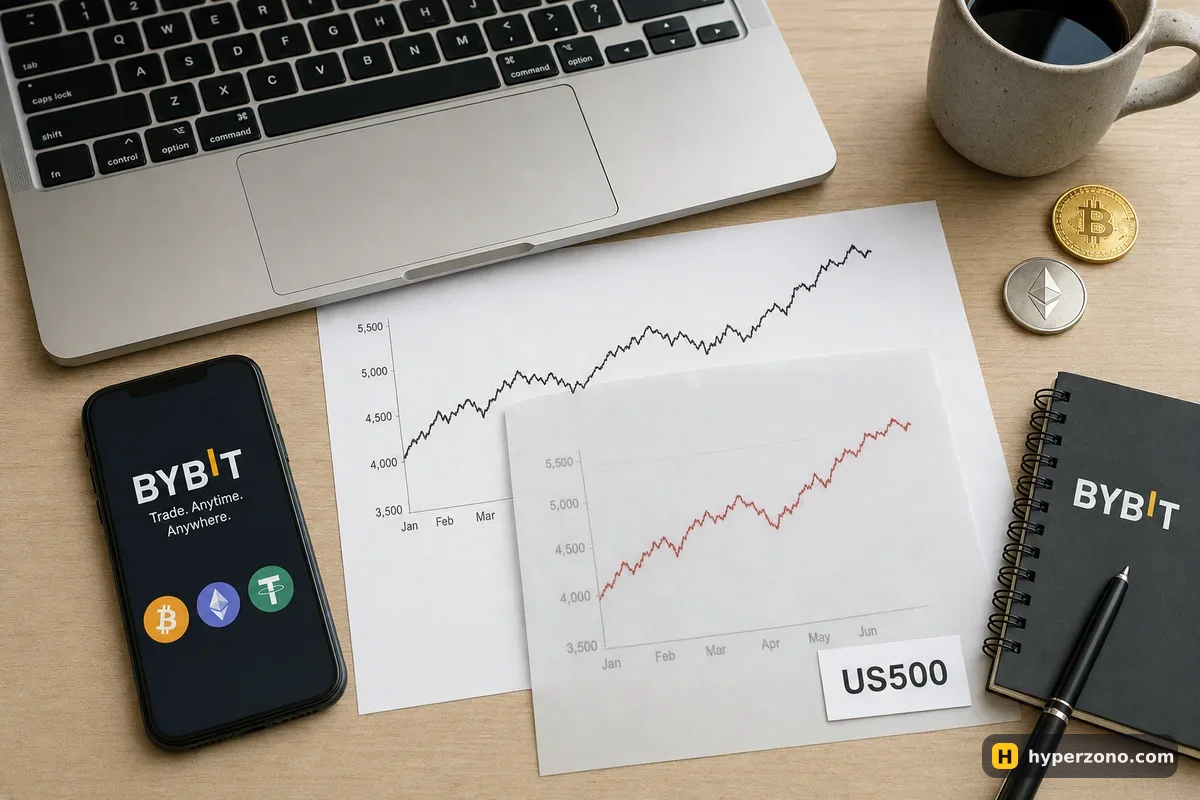
Bybit also lists perpetuals on traditional markets alongside its crypto ones — search the futures list in the app to see exactly which ones are there today. Lists and ticker names change as exchanges add markets, so the only reliable check is the futures list inside the app itself. Availability also varies by country and by which local entity you sign up with, so confirm during registration; our page on which exchanges work where you live explains what to look for.
Why the price can drift from the index on the news
The number on your screen is made by buyers and sellers on that one exchange, not copied from the index. The exchange publishes the price it treats as fair — either its own index or the price of the fund behind the contract — and funding payments pull the contract back toward that price when traders push it too far in one direction. While the US stock market is closed, that fair price barely moves, yet crypto traders keep trading their opinion, so a gap can open and then snap closed when New York reopens. The main New York session runs 9:30 to 16:00 New York time; what happens at night and on weekends is covered separately.
The index and your contract are two different prices. If a news site shows the S&P 500 up 0.4% and your position shows something else, nothing is broken. Look at the contract price inside the exchange, and at the mark price — the fair price the exchange calculates to decide liquidations. Those two numbers, not the index on a news site, decide your profit, your loss and whether you get closed out.
How this differs from an index future at a broker
| Index perpetual on a crypto exchange | Index future at a broker | |
|---|---|---|
| What you need | A crypto exchange account and USDT | A broker or futures account with its own approval process |
| Smallest trade | Set per contract, usually small — check the order window | Fixed contract sizes set by the exchange; the smaller versions still need a futures-approved account |
| Expiry | None — it runs until you close it | Fixed expiry dates, you roll to the next one |
| Cost of holding | Funding payments plus fees on entry and exit | No funding; carrying cost is built into the price |
| Hours | Set by the crypto exchange, often around the clock | The exchange's own session hours |
| Price reference | The exchange's own index, or a fund that holds the shares in the index | The official index at settlement |
Leverage, funding and what holding costs you
Maximum leverage is set per contract and differs between exchanges and between index, stock and commodity markets, so read the number on the slider in the order window instead of assuming it matches bitcoin. Fees are charged on the full size of your trade, once when you open and once when you close — not on the margin you put up. Funding is settled at fixed moments on a schedule that depends on the contract, and it can run either way: a positive rate means longs pay shorts, a negative one the opposite. How funding works and when you pay it is worth reading before you hold an index position overnight, and you can see the live rate for SPYUSDT or QQQUSDT once you open a Binance Futures account and tap the contract.
When these markets are usable, and when to stay away
These contracts are newer than BTCUSDT and far fewer people trade them. You see that in the gap between the price you can buy at and the price you can sell at — the fewer people trading, the wider that gap. During the New York session it is usually small enough to live with; late at night, at weekends and in the first chaotic minute after the US open it can widen sharply, and a market order will then fill at a price you did not plan for.
Use limit orders, keep the position small, and set a stop-loss the moment you are filled. When few people are trading, your stop can close you out at a worse price than the one you set, so plan the size as if your loss could come out a bit bigger than planned. If you are unsure which order to use, market or limit for a first trade walks through it.
Single stocks like Tesla or Nvidia behave differently again — more news, bigger single-day jumps — and they have their own page. If an index contract is your first non-crypto trade, treat the first few as practice: small size, one position at a time, and no leverage you cannot explain out loud.
Is a US500 perpetual the same as the E-mini S&P 500 future?
No. It follows the same index, but it is a different contract on a different venue, with no expiry date, funding payments while you hold it, and a reference price chosen by the crypto exchange. Prices usually move together, yet they are not interchangeable and they do not settle against each other.
Can I trade the Nasdaq-100 with a small amount like 50 USDT?
Often yes, because the minimum size on these contracts is set in small steps rather than one big contract. The exact minimum depends on the contract and on the leverage you pick, so look at the order window: type a small amount and the exchange will tell you straight away if it is below the minimum.
Do I get dividends from an S&P 500 or Nasdaq-100 contract?
No, you are not a shareholder and you own nothing. Some exchanges apply a dividend adjustment to equity-based perpetuals so the contract price stays fair; whether that applies to a particular index contract is written in its specification, so check there rather than assuming.
Why did my index position move while the US market was closed?
Because the contract keeps trading on the crypto exchange around the clock. While the US stock market is closed, the price moves on whatever crypto traders expect, which can push it away from the last official index level and then snap back at the reopen. That is exactly the kind of move you don't want to sleep through, so set your stop-loss before you close the app.
Which exchange should I use for index perpetuals?
Pick the one you already trade on and whose app you find readable, then check that the index contract you want is listed and available where you live. Conditions differ, lists change, and a contract that exists on one exchange may be missing or barely traded on another — so compare the live list rather than an article's list.
Can I try an index contract in demo first?
Sometimes. Demo accounts usually cover the main crypto contracts, and whether a specific index ticker is there depends on the exchange, so search for it in demo before you count on it. If it is missing, practise the mechanics — order window, stop-loss, closing — on a contract that is available.