Contents
Which news moves which contractBefore the release: everything that protects you is placed nowAt the release: why your fill can be worse than the price you sawAfter the move: the US stock market opens, funding, and how long to holdWhich news moves which contract
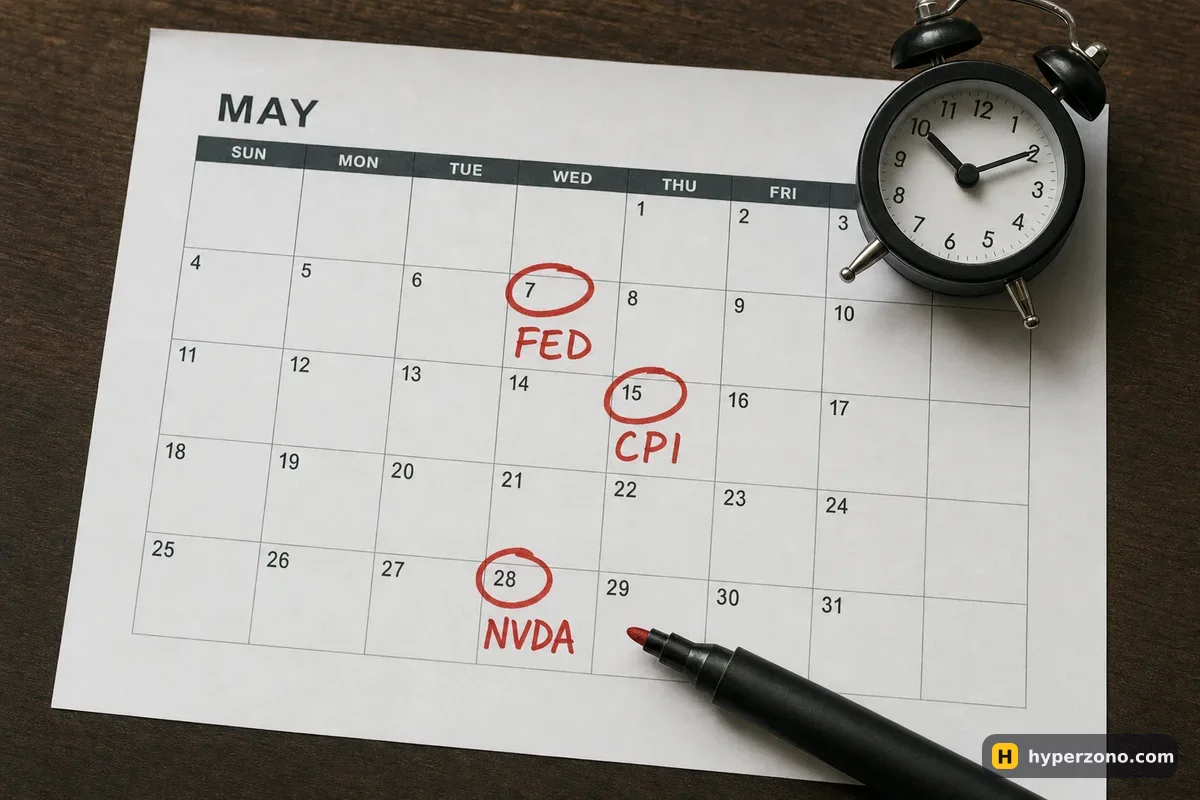
Start by matching the event to one instrument instead of watching ten screens. A company's quarterly results move the futures contract on that company and not much else — Nvidia's numbers move an Nvidia perpetual, Tesla's move a Tesla one. A central bank rate decision or an inflation report is broader: it tends to move bitcoin, the index contracts and gold at roughly the same moment, because they all react to the same question about money getting cheaper or more expensive.
Binance lists 217 TradFi perpetual contracts on US stocks and ETFs, gold, silver, WTI and Brent crude, natural gas, copper, plus Hong Kong and Korean stocks; the stock perpetuals inside USDⓈ-M futures launched on 6 October 2026, with new listings capped at 20x. On Hyperliquid the same kinds of markets exist through a third-party deployer, trade.xyz, where Tesla and Nvidia run at up to 20x and the S&P 500 market at up to 50x. If the whole idea of trading a share or an ounce of gold on a crypto exchange is new to you, the overview of what you can trade covers the basics; here we stay with the event itself.
| Event | What usually reacts first | Where to look for the contract |
|---|---|---|
| Company earnings (Nvidia, Tesla, Apple) | The perpetual on that single stock | Stock perpetuals on Binance USDⓈ-M futures; stock markets on Hyperliquid via trade.xyz |
| Central bank rate decision | Bitcoin and ether, index contracts, gold | Crypto perpetuals plus QQQUSDT/SPYUSDT on Binance (the underlying is the QQQ and SPY ETFs), gold contracts |
| Inflation data (CPI, PCE) | The same broad group — crypto, indices, gold | Same contracts; check each one is listed and tradable in your app |
Two warnings about naming. An index perpetual built on the QQQ or SPY ETF is not the same thing as an exchange-traded index future at a broker, so read the contract specification rather than assuming. And a gold contract does not have to work like an oil one: on OKX, for example, gold and silver track the spot metal, while copper, WTI, Brent and natural gas track a designated deliverable future with a rollover. On other exchanges the mechanism can differ, so open the specification of the exact contract you want to trade — the page on trading gold shows what to look for.
Before the release: everything that protects you is placed now
Pick one contract and one direction you would be willing to take, then build the trade backwards from the loss you accept. Here is what that looks like with round numbers on an Nvidia perpetual, all figures illustrative.
Start with your loss limit
You have 200 USDT on the futures account. You decide a losing trade must not cost you more than 5 USDT — about 2.5% of the account.
Write down the entry
The contract trades at 180 USDT per share, and that is where you plan to enter.
Put the stop where your idea is wrong
You place it at 175.50, which is 2.5% below your entry. One share's worth would lose 4.50 USDT there, just inside your limit.
Let the size follow from those two numbers
So the position is one share's worth, 180 USDT. If the stop distance had produced a bigger loss, you would take a smaller position — you would not raise the limit.
Set margin mode and leverage last
At 5x that position needs about 36 USDT of margin. Choose isolated margin so the rest of the balance stays out of this trade.
On Binance new contracts open in cross margin by default, so switching to isolated is something you do yourself, before the event rather than during it. Check the leverage cap on that specific contract too. Accounts in their first 30 days of futures cannot go above 20x on Binance at all, which for news trading is no loss: high leverage puts your liquidation price inside the normal noise of a release.
There is one more thing worth knowing before an event. When the exchange decides whether to liquidate you, it uses a fair price it calculates itself, not the last price flashing on your screen — that price is called the mark price, and why a contract shows several prices explains where it comes from. During a violent minute the two can differ, which is another reason to keep the liquidation level far away. The quickest way to see all of this on a real screen is to open the contract on Binance Futures a day early and read the order window while the market is quiet.
Check the cost line as well. Fees are charged on the position size of each fill, entry and exit separately; at the base level Binance publishes 0.02% maker and 0.05% taker for USDⓈ-M futures, and the rate shown for a TradFi contract may differ, so look at what your exact contract displays. On a 180 USDT position, 0.05% in and out is roughly 0.18 USDT — small next to a 5 USDT risk, but worth knowing before you plan to enter and exit three times in one hour.
Then go and measure the event on the chart yourself: find the last earnings date on your contract and compare that day's range with a normal day beside it. That comparison, not a rule of thumb, tells you how big the event really is on this market. Put it in money: a 4% move on your 180 USDT position is about 7 USDT before fees, while the same 4% on a 900 USDT position is about 36 USDT. The move is identical; what changes your result is the size you chose beforehand. The page on Tesla, Apple and Nvidia contracts shows how these contracts are built.
At the release: why your fill can be worse than the price you saw
In the seconds around a number, the gap between the best buy price and the best sell price widens — that gap is called the spread — and your order is filled against whatever is actually sitting in the book. A market order can fill noticeably away from the price you just read on the screen; that difference is slippage. A stop order has the same issue with an extra twist: the trigger price and the execution price are two different things. Your stop-market triggers at your level and then fills at the next available price, which during a release can be lower; a stop-limit protects your price but may not fill at all, leaving the position open while price runs. The comparison of the two stop types explains when each one makes sense.
Put numbers on it with the same Nvidia trade. Your stop sits at 175.50 and your planned loss is 4.50 USDT. The release hits, price drops straight through the level, and your one share's worth fills at 174.30 instead: the loss becomes 180 − 174.30 = 5.70 USDT. That is 1.20 USDT more than planned — annoying but survivable. With ten shares' worth the same slip would turn a 45 USDT loss into 57 USDT. Size the trade so that a fill a bit worse than your stop still leaves you calm — that one habit is most of what separates news trading from a coin flip.
The number is not the trade. Inflation can come in higher than expected and price can still rise, because the market had already positioned for worse. That is why the plan is built around your stop and your size, not around a guess about the number. If you are not ready to accept either direction, the honest move is to watch this one and trade the next.
After the move: the US stock market opens, funding, and how long to hold
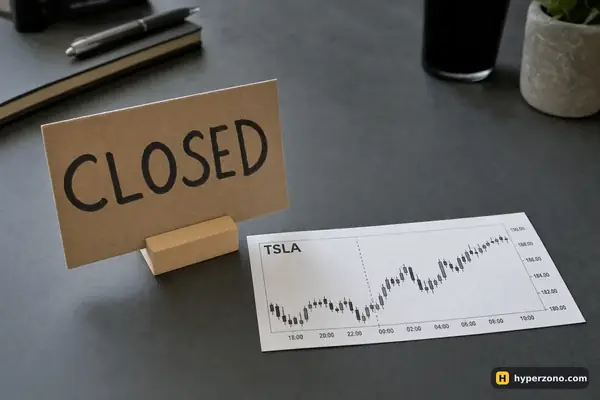
Company results usually land outside regular stock market hours: the stock exchange itself only trades 9:30 to 16:00 New York time, while the perpetual on a crypto exchange keeps going around the clock, weekends included. So a price gets made overnight by whoever is trading it, and when the stock exchange opens that price can be revisited sharply in either direction. If you plan to hold through the opening bell, treat it as a second event with its own stop — the page on nights and weekends covers how off-hours pricing works.
Holding also costs or pays funding. On a perpetual, longs and shorts exchange a payment at fixed moments: Binance settles every 8 hours by default (00:00, 08:00 and 16:00 UTC), some contracts every 4 hours, and the interval can shorten to 1 hour when the rate hits its cap; on Hyperliquid funding is paid every hour. You pay or receive only if you hold the position at that moment, and the amount is your position size times the rate. After a big one-sided event the crowd often piles into one direction and the rate moves against that side, so decide in advance whether you close before the next funding payment or accept the cost — the funding explainer shows how to read the rate.
If you would rather rehearse all of this without money first, demo trading is the cheap way to do it — just check that your exact contract is listed in demo before you build a plan around it, because stock and index contracts are not always there. When it is missing, follow the live chart through the event without opening a trade, or practise the mechanics on a contract that is available; learning without real money goes through the options.
One last detail for stock contracts: an equity perpetual provides a dividend adjustment, but holding it does not make you a shareholder, and the exchange can change contract terms. Read the specification of the contract you intend to hold for days rather than minutes.
Can I trade Nvidia or Tesla earnings on a crypto exchange?
You can, if the stock perpetual is listed and available where you live. Binance lists TradFi perpetuals on US stocks and ETFs inside USDⓈ-M futures, and Hyperliquid has stock markets deployed by trade.xyz. Check availability in the app during sign-up — these products are not offered everywhere, and some countries are restricted entirely.
Is it better to enter before the release or after it?
Before means you are in position for the whole move, including the part that goes against you in the first seconds. After means you let the worst spreads pass and enter into a clearer picture, at a price that may already have moved a long way. Many beginners find the second option easier to manage, because you can see where your stop would sit instead of guessing.
Will a stop loss protect me during news?
It limits the damage but does not fix the price. The stop triggers at your level and then fills at the next available price, which during a release can be worse. Plan your size so that a fill a little past your stop is still an acceptable loss, and don't rely on being able to widen or move it in the moment.
What leverage should I use for an event trade?
Lower than you would use on a quiet day, because the price range of one hour around a release is far bigger. High leverage puts your liquidation price inside the normal swing of the event, and the exchange decides on liquidation using the mark price it calculates, not the last trade on your screen. On Binance, accounts in their first 30 days of futures are capped at 20x anyway.
Does funding matter if I only hold for an hour?
It can. You pay or receive funding only if you hold the position at a settlement moment, so a one-hour trade may cross one of them or none. Check the next funding time on the contract before you enter — Binance settles every 8 or 4 hours depending on the contract, Hyperliquid every hour.
Which single event is the easiest to start with?
Pick one contract you already follow and watch two or three of its events without trading, writing down what the spread looked like and where your stop would have filled. Demo is a cheap way to do it, but check first that your exact contract is listed in demo — stock and index contracts are not always there. If it is missing, watch the live chart without opening a trade, or practise the mechanics on a contract that is available.
Sources and fact-check
Exchange terms were checked against official documents on October 22, 2026. Terms change — before you trade, check what matters to you in the exchange app and in your contract’s specs.
Binance: USDⓈ-M Futures Trading Fee Rate