Contents
Price impact is a different price, not a different feeWhat your order is measured againstWhen the venue pays you for your tradeA 500 USDT trade with the numbers kept apartHow to read the confirm screen before you tapBefore you pick a venue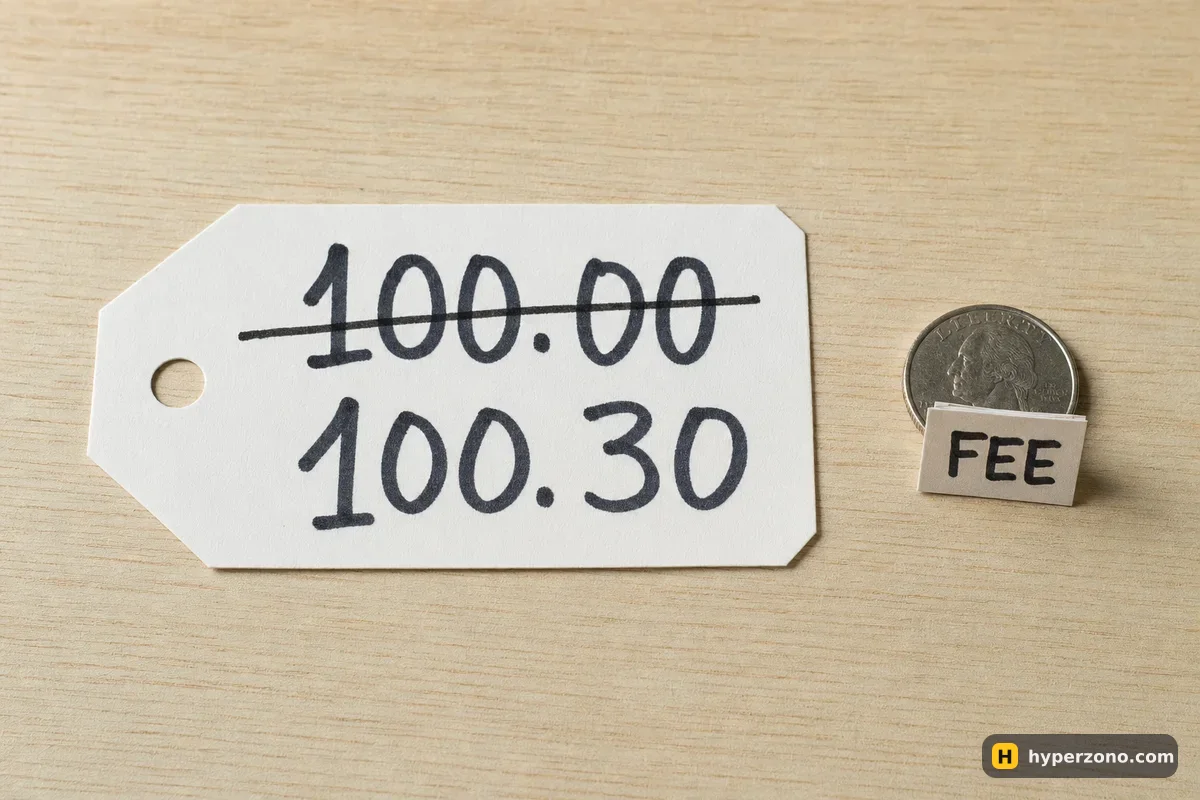
Price impact is a different price, not a different fee
When you trade on a centralised exchange, the costs you see are mostly fees: a percentage of the trade size on the way in and on the way out. If you have never gone through those numbers, the basics are already covered in what fees you pay when trading futures. On a perpetual DEX there is a second number that beginners often mistake for another fee, and it behaves completely differently.
GMX says it plainly in its own documentation: price impact is a separate mechanism from fees and from slippage. It is a positive or negative adjustment that comes from how unbalanced the market is between longs and shorts. A fee is money taken from your account; price impact is a better or worse price given to your trade. For positions, GMX applies it to the entry or exit price rather than deducting it from your collateral, so your leverage stays what you chose.
There is one more surprise in the GMX rules. When you open, nothing is added to or taken off your price — your entry comes straight from the outside price feed, which on GMX is called the oracle. But the protocol remembers how much your opening pushed the two sides apart, combines that with the imbalance at the moment you close, and settles the net result when you close or reduce the position. So a trade can look perfectly clean at entry and still settle for a little less than the chart suggested.
| What it is | Where it shows up | Does it depend on your order size? |
|---|---|---|
| Trading fee | A percentage of position size, charged on open, close, increase and decrease | Yes, proportionally — double the size, double the fee |
| Price impact | An adjustment to the price you are filled at, credited or charged on close | Yes, but through how much your trade shifts the long/short imbalance, and it is capped per market |
| Slippage setting | Your own tolerance for the oracle price moving between request and execution | No — it is a limit you set, for market orders only |
What your order is measured against
Size matters everywhere, but what it is compared against depends on how the venue is built. On an order-book DEX, your order walks through the orders other people have placed, so a large market order takes worse and worse prices as it eats through them — that is the order book side of the story, and the difference between the two designs is covered in order book or liquidity pool.
GMX works from the other direction. There is no book to walk through: prices come from the oracle feed, and the impact is calculated from the gap between the long side and the short side of that market. The protocol sets its own numbers for each market, so the same order size can be treated differently on BTC and on a small coin. If your trade makes the imbalance smaller, the formula gives you a better price; if it makes the imbalance bigger, you get a worse one.

Opening the opposite trade on a related market does not cancel the impact — GMX counts them together. For genuinely large orders the docs mention around $1,000,000 or more with negative impact above 0.2%, and they suggest splitting the execution over time instead of sending it in one piece. At the amounts most readers of this site trade, you are nowhere near that, which is the real point: on a small trade, impact is usually small, but you still want to know which number on the screen it is.
When the venue pays you for your trade
Because the sign depends on the imbalance, impact can be positive. If the long side is heavily crowded and you open a short, your trade pulls the two sides closer together, and the formula hands you a better price. GMX caps that gift at 0.4% for most markets. The cap on the unfriendly side varies by market: 0.5% on BTC, ETH, BNB, SOL and PEPE, 0.75% on BONK and LTC, and up to 10% on a few small markets. The current values live on the protocol's Monitor page, and the risk team can change them.
There is a safety valve on top. If a closing order's negative net impact would exceed the market's cap, the excess becomes claimable as a rebate after a five-day delay — it is reviewed first, and you collect it in the claims section of the trade page. A couple of GMX markets are set up with the impact switched off entirely; you can see which ones in the market list. One detail worth carrying with you: capped negative impact is included in the liquidation price calculation, while positive impact is not.
A 500 USDT trade with the numbers kept apart
Here is what this looks like with illustrative figures at a size a beginner would actually use. You have 100 USDT in the account. At 5x you open a long worth 500 USDT on a GMX market where longs are already the heavier side — the 100 USDT is your margin, and the 500 USDT is the position size that both the fees and the impact are measured against.
Your opening fee is 0.06% of the position, because your trade pushes the two sides further apart: that is 0.30 USDT. Your entry price itself is clean, straight from the oracle feed, with nothing added or taken off. A few hours later you close. Closing your long when longs are crowded pulls the two sides closer together, so the closing fee drops to 0.04% — 0.20 USDT. Fees together: 0.50 USDT.
The impact is a separate story. The imbalance your opening created was remembered, and the friendly part from your closing does not fully cancel it, so the net lands at about −0.25% of your position — 1.25 USDT, which arrives as a worse exit price and therefore slightly less collateral coming back. Add it up and the trade cost you 1.75 USDT in all, about three and a half times what the fee schedule alone suggested.
Flip the story and the arithmetic flips too. If shorts had become the crowded side by the time you closed, the net could have landed positive instead, up to that 0.4% cap on most markets — around 2 USDT added back on a 500 USDT position. The fee is predictable from the schedule; the impact is only knowable at the moment the order executes. Add funding and borrowing costs on top and you have the full picture of what holding a perp costs.
How to read the confirm screen before you tap
The good news is that the interface does most of this for you. GMX says the expected output shown before you confirm already accounts for estimated fees and estimated price impact — the slippage setting is an extra buffer on top of that, not a substitute for it. That setting defaults to 1%, can be raised to 5%, warns you above 2%, and only applies to market orders; limit and trigger orders use an acceptable price fixed when you create them. And slippage covers only oracle price movement, not impact.
Read the expected output, not the chart price
The chart shows a middle price — the average of the buy side and the sell side of the price feed. Your own fill uses one side or the other, so the number on the confirm screen is always the honest one.
Open the net value tooltip
On the positions list or in the close window, the tooltip shows the net price impact separately from the displayed open and close prices. In trade history those displayed prices are oracle prices, so the impact is not inside them.
Turn on the breakdown
In display settings there is an option to break down net price impact into the part stored at open, the part coming from the close, and the net result. Switch it on once and you stop guessing where a dollar or two went.
Set slippage deliberately
Leave it near the default for ordinary conditions. A large tolerance does not protect you from impact; it only widens how far the oracle price may move before the contract refuses your order.
The quote is an estimate, and the rules are per market. The numbers behind the impact, and the caps on it, are set market by market and the protocol's risk team can update them. Two markets on the same venue can treat the same order size very differently, so check the market you are actually trading rather than assuming one number applies everywhere.
Before you pick a venue
Everything above is GMX's design, written down in GMX's own documentation — the imbalance formula, the remembered impact, the 0.4% cap on the friendly side. Another protocol answers the same problem its own way. An order-book venue like Hyperliquid has no imbalance formula at all, and what you pay beyond the fee comes from how your order meets the orders already waiting in the book. Its cheapest level charges 0.015% if your order waits in the book and 0.045% if it fills straight away, and holding costs are settled every hour — different costs, different vocabulary, same need to read before you trade. If GMX itself is new to you, why trading there feels different is the natural place to start.
So the practical step is not to pick the venue someone recommended and hope it behaves like the last one. Open the protocol's own fee and pricing documentation, find the section on price impact or slippage, and check the terms for your country — Hyperliquid's terms, for example, exclude people who live in or are located in the United States or Ontario, and in sanctioned territories. Then choose an interface, which is a separate decision again; if you want a shortlist with centralised options too, which exchange suits a beginner covers that side.
Is price impact the same as slippage?
No. Slippage is the oracle or market price moving between the moment you send the order and the moment it executes, and on GMX it is a tolerance you set yourself — 1% by default, up to 5%. Price impact is calculated from the market's imbalance and applied by the protocol's rules. Your slippage setting does not cover it.
Can price impact ever give me a better price?
Yes, when your trade makes the market more balanced — for example opening a short where longs are heavily crowded. On GMX the friendly adjustment is capped at 0.4% for most markets. It is not something to build a plan around, but it is why the number on your close can land above the fee schedule's prediction.
Why did my position close for less than the price I saw in the history?
On GMX, the prices shown in trade history for opens and closes are oracle prices — the prices taken from the outside feed. The net price impact is a separate value that is not included in them, and it adjusts the collateral you get back. Open the net value tooltip on the position, or enable the price impact breakdown in display settings, and the missing piece appears.
Does price impact affect my liquidation price?
On GMX, capped negative price impact is included in the liquidation price calculation, while positive impact is excluded. That is the conservative choice from the protocol's side, so do not assume a possible favourable adjustment will save a position that is already close to the line.
Does a small trade suffer price impact at all?
Usually very little, because the adjustment grows with how much your order shifts the long/short imbalance and a 100 or 500 USDT position barely moves it. The point of understanding the mechanism is not to fear it on small trades, but to know which line on your statement it is when your result does not match the quote.
Do all DEXs calculate price impact the same way?
No. GMX remembers the imbalance until you close and caps the adjustment market by market; an order-book venue has no such formula, and your extra cost comes from the orders sitting in the book. Before you deposit anywhere, read that venue's own fee and pricing page.
Sources and fact-check
Exchange terms were checked against official documents on November 11, 2026. Terms change — before you trade, check what matters to you in the exchange app and in your contract’s specs.
GMX: FeesGMX: Positions and order types