Contents
What you are actually agreeing toWhere that big percentage comes fromThree settlement prices, three very different endingsIf you expect bitcoin to rise, what does a long do instead?Access, exit and where the result comes fromHow to check both before you commit money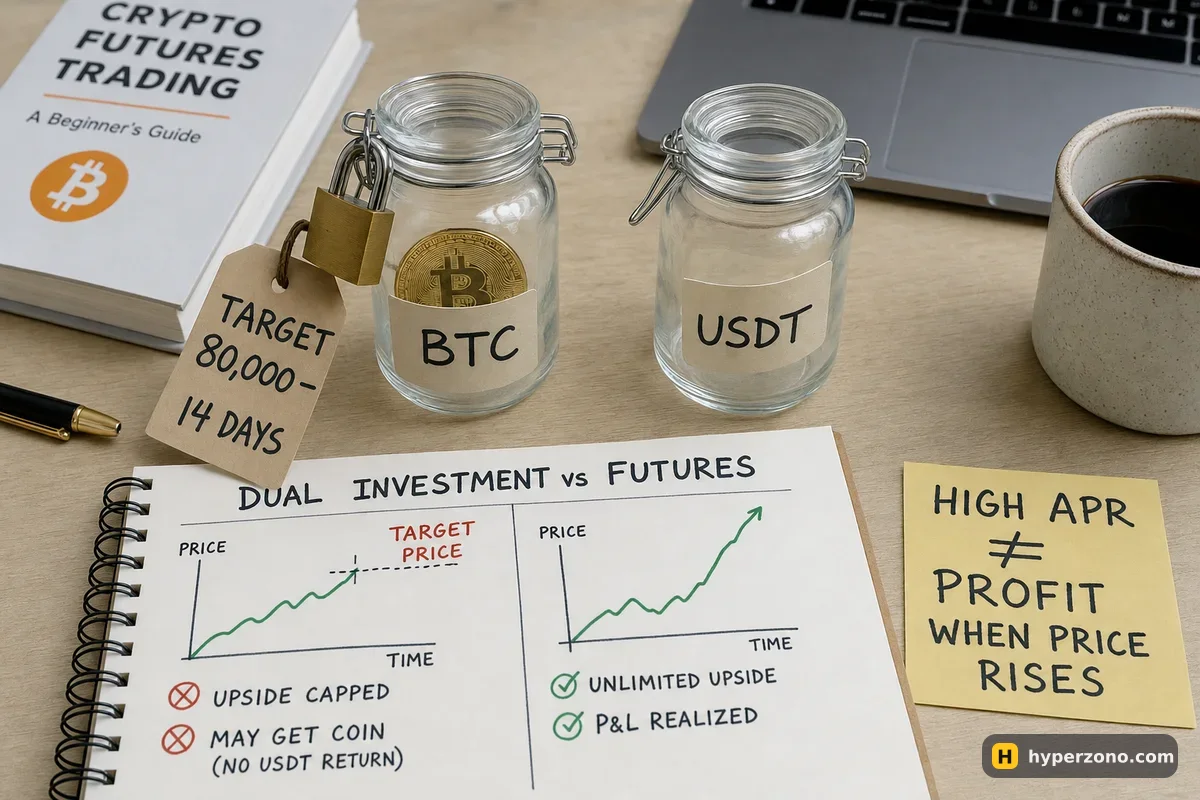
What you are actually agreeing to
Here is the deal you sign. You put in coins or USDT, name a price and a date, and promise to swap at that price if the market reaches it. Binance pays you a fixed reward for that promise — it calls this a structured product, and it pays whether the price goes up or down.
There are two modes. Buy Low: you put in USDT and agree to buy the coin at a target price below today's price. Sell High: you put in the coin and agree to sell it at a target price above today's price. When you subscribe, four things are fixed — the deposit currency, the target price, the settlement date and the rate.
The settlement price is the average market price over the last 30 minutes before 08:00 UTC on the settlement date. BTC, ETH and BNB settle every Tuesday and Friday, other tokens every Friday, and the payout reaches your spot wallet within six hours. If the target is reached, your money comes back in the other currency; if it is not, it comes back in the one you put in. The reward is paid either way.
Once you press subscribe, nothing can be edited. Binance states that the target price, settlement date and rate are fixed and that you cannot edit, cancel or redeem the subscription early. The funds stay locked until the settlement date, however the price moves in between. The app even shows a pop-up reminding you of this before you confirm.
Where that big percentage comes from
The reward is a simple calculation on the amount you put in, for the number of days you are locked. Binance's formula is: reward = subscription amount × (rate × days ÷ 365), with the middle part rounded down to four decimal places. Their own example on the page is a 1,000 USDT Buy Low at 85.3% for two days — the reward is 1,000 × 0.0046 = 4.6 USDT. A headline figure near 85% turns into four and a half dollars, because you only hold the product for two days.
The card may show APR or APY next to the number. Either way it is a yearly rate — the amount you would get if your money stayed in the product for a whole year. It usually stays there for a few days instead, so you receive that same fraction of a year: two days out of 365 is about half a percent of the headline figure, which is how 85% became 4.6 USDT. Use the exact rate printed on the product card when you do the sum, not a figure you read in an article.
So the percentage tells you what the exchange pays for your promise over that short window. It says nothing about what the coin will do, and it is capped: the reward is the most the product itself can give you. Everything else in your result comes from which currency you are holding when the window closes, and at what price the swap happened.
Three settlement prices, three very different endings
Here is a Sell High example with round, illustrative numbers. You hold 0.1 BTC, bitcoin is around 60,000, you pick a target price of 80,000 and a 14-day period at an advertised 30%. The reward works out as 0.1 × (0.30 × 14 ÷ 365, rounded down to 0.0115) = 0.00115 BTC. Now look at what you own when the window closes, compared with doing nothing at all.
| Settlement price | Sell High result | If you had just held 0.1 BTC |
|---|---|---|
| 55,000 (target not reached) | 0.10115 BTC ≈ 5,563 USDT | 5,500 USDT |
| 65,000 (target not reached) | 0.10115 BTC ≈ 6,575 USDT | 6,500 USDT |
| 95,000 (target reached) | Sold at 80,000 → 8,092 USDT | 9,500 USDT |
Read the first row carefully before the exciting one. Bitcoin fell to 55,000, you still hold the coins, and your 0.10115 BTC is worth about 5,563 USDT instead of the 6,000 you started with. The reward softened the fall by roughly 63 USDT, and that is all it was ever going to do.
The third row is the part people miss. Bitcoin rose 58%, the reward was paid in full, and you still ended with about 1,400 USDT less than if you had left the coins alone — because above 80,000 your coins were already sold at 80,000. The rate was never wrong. It simply was not a payment for being right about direction.
If you expect bitcoin to rise, what does a long do instead?
The Dual Investment side had 6,000 USDT of bitcoin working. To keep the comparison fair, take a long of the same 0.1 BTC — 6,000 USDT of position — and see what 60,000 → 95,000 gives you there. Say you have 1,500 USDT in your futures wallet and choose 5x leverage: the exchange sets aside 1,200 USDT of that as margin, and the rest stays free. Note the difference in what you need up front: Dual Investment required you to already own the coins, the long needs margin.
Your result is quantity × (exit price − entry price), nothing more complicated. At 65,000 that is 0.1 × 5,000 = +500 USDT. At 95,000 it is 0.1 × 35,000 = +3,500 USDT, the whole move instead of the part up to 80,000. At 55,000 it is −500 USDT, and with about 6 USDT of fees and roughly 25 USDT of funding over two weeks you are down around 530 — real money out of your balance, not a smaller number of coins. If you are not sure which way round long and short work, start with the plain-words version.
Futures cost money at every step, and Dual Investment does not: Binance lists no trading fees when the target is reached. On Binance USDⓈ-M the taker fee is 0.05% of the position on the way in and again on the way out — about 3 USDT each way on a 6,000 USDT position — and a perpetual also charges or pays funding every few hours. At the common baseline of 0.01% per 8 hours, holding that long for two weeks costs around 25 USDT if longs are the ones paying. Counting fees and funding into your real result is the part beginners skip most often.
The other difference is what happens when you are wrong. If bitcoin falls to 40,000, the Sell High holder still has the coins and they are worth about 4,050 USDT instead of 6,000 — the reward does not stop that. The difference is that nobody closes your position for you: with futures, a loss keeps growing until you close it, your stop-loss triggers, or the exchange closes the trade because the margin is gone. That 5x long would be closed by the exchange somewhere near 48,000, a little above it once maintenance margin and fees are counted.
That is why you set the stop-loss before you open the trade, not after: decide the price at which your idea is simply wrong — say 57,000 — and the loss is about 300 USDT instead of whatever the market decides. Isolated margin keeps the rest of your balance out of that one position. Those two settings are the whole reason a futures long can be sized to a loss you chose in advance.
Access, exit and where the result comes from
Three practical questions separate them better than any rate does. Can you get your money out before the end? With Dual Investment, no — the funds are locked to the settlement date, and the optional Auto-Compound setting will re-subscribe you into a new position with a new target and date unless you switch it off at least 30 minutes beforehand. With a futures position you can close at any time the market is trading, in full or in part.
What decides the number at the end? For Dual Investment it is one price at one moment — the 30-minute average before 08:00 UTC on settlement day — and everything the price did in between is irrelevant. For futures it is the price when you choose to exit, minus fees and funding. And what are you paid for? A fixed fee for accepting a conditional swap in one case; the size of the price move you predicted in the other. Our page on whether you can really make money on futures as a beginner covers the wider trade-off, so this page stays on the swap itself.
How to check both before you commit money
Open the Dual Investment product card and read four lines out loud: deposit currency, target price, settlement date, and the rate with the number of days. Then do the arithmetic the exchange does — amount × rate × days ÷ 365 — and ask yourself whether you would be happy holding the other currency at that target price on that date. If the answer is no, the percentage is not the problem; the swap is.
For the futures side, the honest way to see the difference is to watch one position move instead of reading about it. Binance has a demo mode for USDⓈ-M futures (it is not offered in every country, so check in the app), and the step-by-step demo walkthrough shows where to find it. You can open a Binance account and look at the order window first, without depositing — the quantity field, the leverage setting and the liquidation price tell you more about what you are taking on than any yearly rate on a product card.
Is Dual Investment the same as earning interest on my crypto?
No. Interest leaves your coins as coins; Dual Investment can hand them back as a different currency. The reward is fixed and paid either way, but which asset you end up with depends on the settlement price against your target price.
Why is the reward so small if the rate says 85%?
Because APR and APY on the card are yearly rates and you only hold the product for a few days. Two days out of 365 gives you roughly half a percent of the headline number, so 1,000 USDT at 85.3% for two days pays 4.6 USDT. Always multiply by days ÷ 365 before you get excited.
Can I cancel a Dual Investment subscription if the price moves against me?
Binance says you cannot edit, cancel or redeem before settlement. The target price, settlement date and rate are locked in at subscription, and the funds stay locked until the settlement date.
What happens if the price is exactly at my target price?
The Binance page does not state clearly how an exact match is handled — its own wording for Buy Low and Sell High is not consistent on that point. Treat it as unknown and check the product terms in the app before subscribing.
Which one gives a bigger profit if the coin doubles?
A correctly sized futures long, because its result follows the whole move. Dual Investment stops at your target price plus the fixed reward. The reverse is also true: if the coin falls, a futures long keeps losing until your stop-loss or the exchange closes it, which is exactly why you set that stop before you open the trade.
Does Dual Investment charge fees?
Binance lists "no trading fees" when the target is reached and the product is filled. On futures you pay a fee on entry and on exit, plus funding on a perpetual while the position stays open.
Is Dual Investment available in my country?
That depends on where you live and which exchange entity serves you, and the exchange pages do not publish a full country list. Check inside the app during sign-up, and check whether futures are offered to you there too.
Sources and fact-check
Exchange terms were checked against official documents on November 2, 2026. Terms change — before you trade, check what matters to you in the exchange app and in your contract’s specs.
Binance: What Is Binance Dual Investment?Bybit: P&L Calculations (USDT Perpetual and Expiry Contracts)