Contents
What Hibachi is, and what trades thereDeposit: which network, and USDT or USDCWhat one trade really costsWeekends, maintenance and how much leverage you getPoints, referrals and who cannot sign up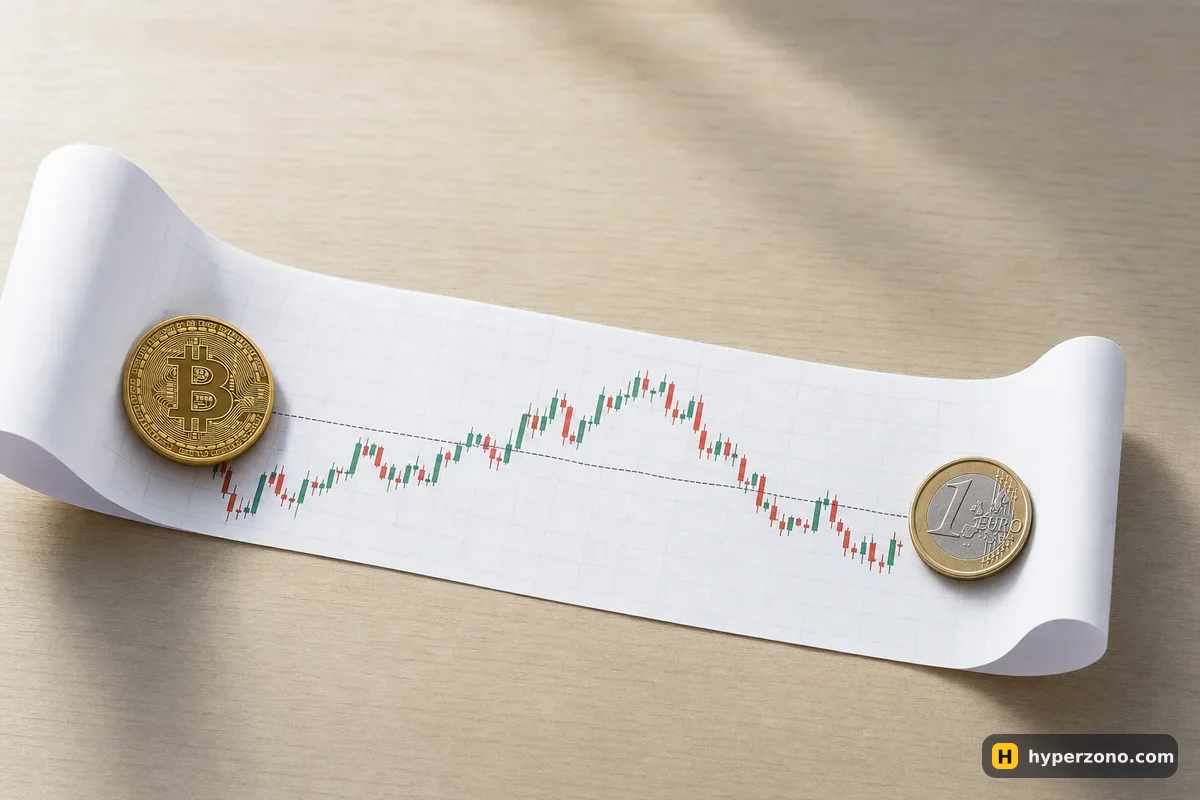
What Hibachi is, and what trades there
Hibachi describes itself as a stablecoin-native FX exchange, and the market list matches that. Fifteen markets are live, all settled in USDT — bitcoin, ether and a handful of other coins alongside currency pairs like the euro and the pound. The split of activity is the surprising part: the exchange's own data on 22 October 2026 showed about $32M traded in 24 hours, of which roughly $17M was the euro and $6.7M the pound, against $6.5M on bitcoin.
You place normal limit and market orders, and there is a setting that keeps your limit order waiting in the book instead of filling straight away. Whichever you use, the fill you get can't be more than 0.5% away from the exchange's own price, so a thin moment in the market can't throw you far from the price you saw.
That price is built from two independent feeds, Pyth and Stork, and the hourly funding payment is worked out on it as well. Check which price your liquidation is measured against in the app before you choose how big a trade to open. Orders that take a price out of the book wait 25 thousandths of a second before they match, which protects the orders already resting there; your own limit orders and cancellations are not delayed.
Hibachi settles on-chain with cryptographic proofs: your collateral can only move when the math checks out, not because someone approved it by hand. Behind the exchange is Hibachi PTE. LTD., with terms dated 10 October 2024 and disputes going to arbitration in Singapore, and the contracts have been audited by Hexens and Quantstamp. How the venue sits next to the bigger on-chain exchanges is covered in our perp DEX comparison; if you came looking for Tesla or Nvidia contracts, Hibachi does not list stocks — stocks on a crypto exchange shows where those trade.
Deposit: which network, and USDT or USDC
Arbitrum is the settlement chain, so that is the safest default: send USDT there and it lands as USDT. Deposits are also accepted in USDC on Base and on Arc, and the exchange's data lists USDC on Arbitrum too. USDC is converted into USDT inside your account at a published rate of 0.9992, so 100 USDC becomes about 99.92 USDT of collateral. One caution: the documentation and the FAQ do not describe the network list the same way, so check the deposit screen in the app before you send anything.
Create the account
Sign up with a wallet or with an email address plus two-factor authentication. MetaMask, Phantom, Trust Wallet, Fireblocks and Fordefi are supported; MPCVault and Gnosis Safe are not. The wallet must produce deterministic signatures, otherwise the docs warn you can lose access to your funds — so stay with a listed wallet.
Send your stablecoin
USDT on Arbitrum, or USDC on Base or Arc. The deposit fee charged by the exchange is tiny — about 0.0072 USDT — but you still pay the network's own gas on whichever chain you send from.
Check how your margin is set up
Margin is cross only inside one account: every position shares the same balance. If you want a position walled off, you open a separate sub-account. Currency trades sit in a segregated FX sub-account of their own.
Know the way out before you trade
A standard withdrawal costs about 0.019 USDT and takes roughly 10–20 minutes, to an Arbitrum-compatible address. An instant withdrawal costs 0.2%–2% depending on size, and moving money between your own sub-accounts costs 0.01%.
The smallest order the exchange accepts is 1 USDT, so you can open a tiny trade of a dollar or two while you get used to the screen. The docs mention neither identity verification nor an invite code — sign-up asks only for a wallet or an email — but availability is always decided when you actually register, so treat the first screen as the real answer.
What one trade really costs
Say you deposit 100 USDC on Base. It becomes about 99.92 USDT, and you use it as margin for a 10x long on the euro — a position of roughly 1,000 USDT. If you enter with a market order, you are taking a price that is already in the book, and that costs 0.045% of 1,000, so 0.45 USDT. Closing the same way costs another 0.45. That is 0.90 USDT for the round trip, which means the euro has to move about 0.09% in your favor before you are even.
Long 1,000.00 USDT, entry 1.08 → exit 1.0908, fees 0.05% + 0.05% (example rates).
Funding is settled every hour on Hibachi, calculated from the average premium over the previous hour and capped at ±10%. At an illustrative hourly rate of 0.001%, holding that 1,000 USDT position costs 0.01 USDT an hour, so about 0.24 USDT over a full day — and when the rate is negative, that payment comes to you instead. Now the other side of the same trade: if the euro goes 1% against you, the position loses 10 USDT, and with fees and a day of funding you are down about 11.14 USDT — a little over 11% of the money you put in, because you used 10x.
The 0% fee only applies if your order waits. An order that sits in the book and gets traded into is called a maker order, and the maker fee is 0.000% on every volume tier. Place a limit order with the setting that keeps it waiting, and the entry side of the example above costs nothing at all, leaving just 0.45 USDT on the exit. Take a price that is already there and you are a taker, whatever the order was called when you placed it.
Weekends, maintenance and how much leverage you get
Currency markets follow the forex week, not the crypto week: they trade 24/5 and halt from Friday 17:00 to Sunday 17:00 New York time. When trading reopens after a halt or a maintenance break, it doesn't just reopen with everyone trading at once. The exchange collects all the orders first and opens at one shared price for everybody — one price, not a scramble. That matters if you leave a stop sitting close to the market over the weekend, because the first price of the new week can be some distance from Friday's close.
The exchange also takes scheduled maintenance windows; one is published for 27 October 2026, 18:00–20:00 UTC. During maintenance the exchange is down, so prices cannot trigger liquidations, and liquidations are processed on the latest price once it comes back — but you cannot close or adjust anything either, which is the honest trade-off. Liquidation itself is partial: the system trims your position back toward a risk target rather than closing everything at once, and an insurance fund covers accounts that go bankrupt, with liquidation fees going into that fund.
Hibachi doesn't publish a leverage table anywhere, so the number on the pair's own screen is the only one that counts. Whatever it allows, the maximum is not a recommendation: on 20x a 5% move against you is enough to lose the margin you put in, and in practice the exchange starts closing the position a little before that, because the fees and the small cushion the exchange keeps back are taken out of your margin first. If you are not sure what number to start from, what leverage a beginner should use walks through it with the same kind of small trade.
Points, referrals and who cannot sign up
Hibachi runs a points program: 1,000,000 points per seven-day epoch, distributed every Monday at 03:00 UTC. A trading competition called The Hibachi Open ran from 7 to 18 October 2026, finished with $435,670,003 of volume and reached a $6,000 cash tier, with payout due the week of 26 October. No token has launched — nothing in the documentation or the market data names one — so points have no published value yet, and that is how to treat them. We go through that whole question in trading rewards and points.
Everyone is enrolled in the referral program automatically, with weekly payouts, but the numbers in the documentation disagree: the referrals page gives 10% of the fees of people you invite, 5% at the second level and 1% at the third, while the affiliate page shows a regular referrer earning 5% and nothing beyond the first level. Check the rate on your own dashboard rather than trusting either page. We have no referral arrangement with Hibachi — the next step for this venue is its own app and documentation, with no link from us.
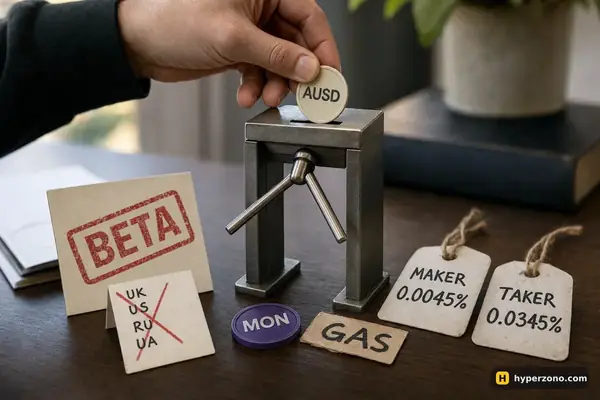
The restrictions are written plainly in the terms: the interface is not available to people or companies who reside in, are located in, are incorporated in, or have a registered office in the United States or the United Kingdom. Beyond that, no country list is published, so the sign-up screen is the only real answer for your country — the same rule we apply to every venue in which exchanges are available in my country.
If Hibachi is closed to you, or if you simply want a deeper crypto book before you try currency perpetuals, Hyperliquid works in a similar way from a wallet: an order book, hourly funding, no exchange registration, and far more daily volume on BTC and ETH. It restricts some places too and publishes no list, so you find out when you connect. You can connect a wallet to Hyperliquid and look at the order window before you deposit anything, and our Hyperliquid guide explains how the venue is put together.
Can I use Hibachi from the UK?
No. The terms say the interface is not available to anyone residing, located or incorporated in the United Kingdom or the United States. There is no legitimate way around that, and trying one puts your money at risk rather than solving anything.
Do I need KYC to trade on Hibachi?
The documentation does not mention identity verification or an invite code: sign-up asks for a wallet or for an email with two-factor authentication. Rules change, so the sign-up screen is the real answer on the day you try.
Should I deposit USDT or USDC?
Either works. USDT on Arbitrum is the simplest because Arbitrum is the settlement chain. USDC on Base or Arc is converted into USDT inside your account at a published 0.9992, so 100 USDC gives you about 99.92 USDT of margin.
How much do I need to start?
The smallest order the exchange accepts is 1 USDT of position, and the exchange's deposit fee is a fraction of a cent. No minimum deposit is published, so check it in the app — and remember you still pay network gas on whichever chain you send from.
Can I trade the euro at the weekend?
No. Currency markets halt from Friday 17:00 to Sunday 17:00 New York time. When they come back, the exchange collects the waiting orders and opens everyone at one shared price. Crypto markets keep going, apart from the exchange's scheduled maintenance windows.
Does Hibachi have a token?
Nothing has launched. The documentation and market data show no token and no issue date, and reports of a ticker are not confirmed by the exchange. Points are distributed weekly, but with no published value attached to them.
Sources and fact-check
Exchange terms were checked against official documents on October 22, 2026. Terms change — before you trade, check what matters to you in the exchange app and in your contract’s specs.
Hibachi docs: FeesHibachi data API: exchange infoHibachi: Terms of Service