Contents
How does trading on Decibel actually work?Your wallet, your USDC and the gas questionWhat one small trade costsStocks, crypto, gold: what is listed and how much leverage each getsAmps points, referrals and who cannot trade hereHow does trading on Decibel actually work?
Your order goes into the same order list as everyone else's — buyers on one side, sellers on the other, and whoever got there first at the best price gets filled first. The unusual part is that all of it happens on the Aptos blockchain itself: the match and the settlement are one transaction, which the docs say takes about 0.125 seconds. There is no extra network stacked on top and nothing is sent to a side system to be matched, which is why the venue can run a normal-looking order list instead of trading you against a pool.
Next to the public traders sits the protocol's own pot of money, the DLP vault. It posts buy and sell prices on most markets itself, using an outside price feed as its guide. So when the market is quiet, the person on the other side of your trade may well be that vault rather than another trader.
The same vault is also the safety net in a liquidation: if your margin runs out and the order book cannot absorb your position, the vault takes it over. More on that further down. If you want to see how all this sits next to other wallet-based venues, our perp DEX comparison lines them up in one table.
Your profit, loss and margin are measured against the mark price. Here the exchange takes three price sources — that outside price feed, the middle of the order list, and a smoothed version of the two over the last few minutes — and uses the middle number. The outside feed comes from Chainlink, according to Decibel's launch announcement. What this means for you is simple: one thin moment in the book or one odd price tick cannot push your position around.

Your wallet, your USDC and the gas question
This is the part that stops most people, and it is simpler than it sounds. You do not have to create an Aptos wallet or buy APT. If you already have MetaMask, OKX Wallet or a Ledger, that works. So do Phantom, Solflare and Magic Eden on Solana, Sui Wallet, and Aptos wallets — including a plain Google login through Aptos Connect, if you have no crypto wallet at all. Deposits and withdrawals are in USDC from Ethereum, Arbitrum, Base, Solana, Sui or Aptos, and the move onto Aptos is done for you through Wormhole with Circle's CCTP.
Connect the wallet you already have
Pick your wallet type in the app and sign the connection. No invite code is needed, and the docs describe no KYC step for ordinary trading — though the terms say the operator may ask for verification and source of funds for certain services.
Send USDC from whichever chain it sits on
Choose the chain, send the USDC, and it arrives as your trading balance on Aptos. Decibel charges nothing for the deposit or the withdrawal and covers gas on Aptos, so you do not need APT — you only pay the usual network fee on the chain you send from. A few wallet types, such as Petra Vault and some MPC wallets, pay their own gas.
Check what is actually withdrawable
Your withdrawable balance is your collateral value minus the initial margin your open positions require and minus any unrealized loss. Unrealized profit does not count until you close. Minimum amounts and withdrawal times are not published — check in the app.
One detail the docs skip and the terms of service spell out: what you send is held in the protocol's smart contracts "as a combination of USDC and usDCBL". usDCBL is a stablecoin issued by Bridge, a Stripe company, not by Decibel. The current split between the two is not published anywhere, and the documentation pages that describe collateral only ever mention USDC.
Read the withdrawal clause before you deposit real size. The terms say payouts come only from assets available in the protocol, in processing order, and that "users who seek to receive value later may receive reduced value or may be unable to receive value at all". That is standard defensive wording, but it is the reason to start with an amount you can afford to leave stuck for a while, and to withdraw once early just to see the round trip work.
What one small trade costs
Fees are charged on the size of the position, not on your margin, and they are paid in USDC. At the base tier — under $1M of 30-day volume, which is where you will be — if you buy at the price that is already on the screen, you pay 0.045%; that is the taker fee. If you leave an order waiting at your own price and someone else comes to it, you pay 0.015% — the maker fee. The tiers fall to 0.024% taker and 0% maker at $1B of volume, spot and perps share one tier, and a referral code changes nothing about what you pay. Third-party apps that plug into Decibel can add their own builder fee on top.
Say you put 100 USDC of margin into a BTC long at 10x. That is a 1,000 USDC position — not 10,000, and never multiply by leverage twice. Taking the price on the screen in and out costs 0.45 USDC each way, so 0.90 USDC in total. Funding is settled hourly here; it builds up inside your unrealized profit and loss and only becomes real USDC when you reduce or close the position. It starts from a baseline of 0.03% a day and moves with how far the contract trades from the spot price, with a daily cap on how far it can move. As an illustration, a day on the paying side at the baseline costs about 0.30 USDC on a 1,000 USDC position.
Long 1,000.00 USDT, entry 100,000 → exit 101,000, fees 0.05% + 0.05% (example rates).
Add it up and the trade costs about 1.20 USDC, so bitcoin has to move roughly 0.12% in your favour before you are level. Now the other direction, which matters more: if price moves 1% against you, the position loses 10 USDC, and with costs you are down to about 88.80 of your 100.
On every market there is also a floor under your margin. On BTC, where the top leverage is 40x, that floor is 1.25% of the position — about 12.5 USDC on a 1,000 USDC trade. Fall below it and the exchange starts closing you. (The rule is half of what the market's top leverage would allow, so a 20x market has a 2.5% floor.)
The closing happens in stages. First the exchange tries to sell part of your position in the book at whatever price it can get. If that is not enough, your whole account is taken over by the protocol's DLP vault — the same pot of money that was quoting prices earlier. And in the worst case the exchange closes profitable positions on the other side to balance the books; that last step is called auto-deleveraging (what ADL means).
Stocks, crypto, gold: what is listed and how much leverage each gets
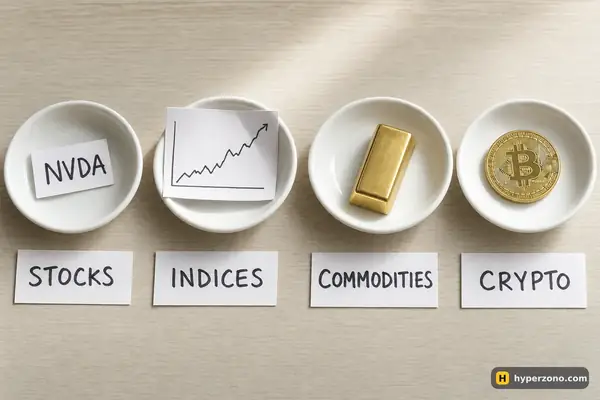
The app shows 81 markets in total: 76 perpetual contracts, of which 72 are open to everyone, plus 5 spot pairs (BTC, ETH, SOL, APT and XRP against USDC). Of the open perps, 36 are stocks and ETFs, 31 are crypto and 5 are commodities. There are no FX markets. Four perps — AVAX, SONY, TTWO and GME — are allowlist-only, so you will see them but not be able to trade them.
Equity, ETF, index and commodity perps are described simply as trading 24/7, with no special rules published for hours when the underlying market is shut — a real difference from a broker, and the same trade-off you meet anywhere you trade stocks on a crypto exchange. Leverage is set per market:
- SPY 50x — the highest on the venue; QQQ 30x
- BTC 40x; ETH 25x; SOL and XRP 20x
- GOLD and SILVER 25x; COPPER and WTIOIL 20x
- Large US stocks — AAPL, NVDA, MSFT, META, AMZN, GOOGL — 20x; most other stocks 10x
- Most altcoins 5x–10x; a few names such as MEGA, CHIP and MRNA only 3x
Those numbers are the ceiling, not a suggestion — on a 50x market a 2% move against you is your whole margin. Set your stop loss when you open the trade (how to set a stop loss), and if you only want one market at risk, switch that market to isolated margin so a bad trade cannot reach the rest of your balance.
Margin is cross by default, with isolated available per market and some markets isolated-only. Minimum order sizes are set per market too — BTC, for example, starts at 0.00002 BTC with a lot step of 0.00001 BTC — so small test trades are genuinely possible. Shares in the DLP vault count as secondary collateral at 90% of their value once you enable them in the Collateral tab, while plain USDC counts at 100%.
Amps points, referrals and who cannot trade here
There is no Decibel token yet. The roadmap says a token launch is "expected" in Q4 2026 and beyond, and the docs mention the ticker DCBL only as an example. Meanwhile the venue runs Amps, now in Season 1, which accrue daily from four pools: trading, streaks, referrals and DLP deposits. The formulas are, in the docs' own words, deliberately undisclosed, there is no published end date for the season, and Amps are described as "a primary input" for the token distribution — not a promise of any amount. Our page on what trading points and airdrops are really worth is the honest frame to keep here: points are not money until someone turns them into money.
A referral code is optional and can only be applied before your account first deposits or trades, and it gives you nothing on fees. To hand out codes yourself you need $25,000 of all-time volume, and the reward is 10% of your referees' Amps from a separate pool — no cash. A separate affiliate program is approval-only through the official Discord and can pay in USDC instead. A "First Trade on Us" campaign was listed as running from 21 July to 21 October 2026; its status after that date is unclear, so check the rewards page rather than assuming it is live.
The terms are governed by the laws of Panama and name Amplify Labs Inc. as the operator, which also states that it does not control the protocol and is not an exchange; the press releases come from a separate Decibel Foundation in the Cayman Islands, and the link between the two is not explained. Residents of the United States and of Ontario, Canada are barred, as are residents of sanctioned countries and territories including Cuba, North Korea, Iran, Syria, and the Crimea, Donetsk and Luhansk regions. The app's own location check also covers Panama, Sudan, South Sudan, US territories and Sevastopol. The UK, the EU and Russia are not restricted as countries, and the terms explicitly prohibit any attempt to get around these restrictions — if availability is your main question, start with our guide to which exchanges work in your country.
No exploit, hack, trading halt or outage has been reported at Decibel between its 26 February 2026 launch and 22 October 2026. DefiLlama showed roughly $29.4M of total value locked on 22 October, down from the $50–57M range reported around launch — a young venue with real but modest depth. If you want a venue with a longer track record and a much deeper book before you experiment with a new one, Hyperliquid is the obvious comparison, and you can connect a wallet to Hyperliquid without any registration either.
Do I need an Aptos wallet and APT to trade on Decibel?
No. You can connect MetaMask, OKX Wallet, Ledger, Phantom, Solflare, Magic Eden, Sui Wallet or an Aptos wallet, including a Google login through Aptos Connect. Your USDC is moved to Aptos for you and the app covers gas there, so you never buy APT. Some wallet types, such as Petra Vault and certain MPC wallets, do pay their own gas.
Is my deposit still USDC once it is in the protocol?
The docs treat USDC as your collateral at 100% of its value. The terms of service say assets are held in the smart contracts as a combination of USDC and usDCBL, a stablecoin issued by Bridge, a Stripe company. The current split is not published anywhere, so if that matters to you, keep the amount small and test a withdrawal early.
Is there an invite code or KYC on Decibel?
The docs say Decibel is open to everyone and a referral code is optional — and a code only gives points, not a fee discount. No KYC step is described for normal trading, although the terms let the operator ask for verification and source of funds for certain services.
What are Amps worth?
Nobody can tell you, including Decibel. Amps are described as a primary input to the token distribution at launch, the formulas are not disclosed, the token does not exist yet, and no end date for Season 1 is published. Treat them as a possible bonus on top of trading that makes sense on its own, never as the reason to trade.
Can I trade Decibel from the UK, the EU, India or Nigeria?
The terms and the app's location check do not list those countries. What is blocked is the United States and its territories, Ontario in Canada, Panama, Sudan, South Sudan, Cuba, North Korea, Iran, Syria, and the Crimea, Donetsk, Luhansk and Sevastopol regions, plus anyone on OFAC, UN, US, UK or EU sanctions lists. Lists change, so check in the app before you deposit.
Do stock perps on Decibel stop when the US market closes?
The docs say equity, ETF, index and commodity perps trade 24/7 and describe no special rules for hours when the underlying exchange is shut. In practice the price then leans on the outside price feed and on the DLP vault's quotes rather than a busy stock market, so spreads and moves outside normal hours can behave differently from what you see during the US session.
Sources and fact-check
Exchange terms were checked against official documents on October 22, 2026. Terms change — before you trade, check what matters to you in the exchange app and in your contract’s specs.
Decibel docs: FeesDecibel: Terms of ServiceDecibel app: Markets